

The Fossil fuel industry isn’t just the main driver behind the climate crisis, it is also fuelling violence, militarism, and inequalities. Oil, gas, and coal have been called “weapons of mass destruction” because of their devastating role in both the climate crisis and in conflict. For this year’s Global Week of Action for Peace and Climate Justice, read more to explore how feminist peace action can break the cycle.
For us, this is not abstract. Gloria Capitan, a Filipino grandmother campaigning against coal projects was murdered in front of her grandchildren seven years ago. All she wanted was to stop the pollution in her community that was killing them. This reality has shaped my (Mitzi) activism as an anti-imperialist climate justice activist: fossil fuel projects kill, destroy livelihoods and expose women and Indigenous peoples to heightened risks of violence and exploitation. And as someone working in international advocacy, I (Katrin) witness how today’s fossil-fuel-driven hypermilitarisation undermines multilateral efforts on climate mitigation, adaptation, conflict prevention, and human rights. At every level — from UN agencies to local authorities — I see public resources drained into record-breaking military budgets, instead of being invested in care, justice, and peace.
But there is hope: a growing movement for a Fossil Fuel Non-Proliferation Treaty, grounded in feminist peace principles, shows us that another future is possible.
Ahead of the upcoming webinar “Fossil fuels as roadblocks to peace– Why the Fossil Fuel Treaty is Key to Peace and Climate Justice,” organised by the Fossil Fuel Treaty Campaign and WILPF during this year’s Week of Action for Peace and Climate Justice, we explore nine ways fossil fuels are tied to conflict—and how feminist peace action through the Fossil Fuel Treaty can break the cycle.
1 — Wars for Control of Oil and Gas
War has served to secure and protect fossil fuel extraction sites. The US war against Iraq and its ensuing occupation led to Anglo-American oil industries like BP and Shell making billions of profits from oil extracted from Iraq. An estimated one-quarter to one-half of all interstate wars have been linked to oil since the 1973 Oil Crisis. Control over reserves, pipelines, and shipping routes have played a key role in invasions and territorial disputes. Research suggests that one reason for Israel’s ongoing devastating genocide in Gaza is its desire to control oil and gas reserves off the coast of Gaza, Israel and Lebanon.
2 — Petro-Profits That Finance Wars
Petro-states use oil and gas revenues to fund aggression. Russia’s war in Ukraine has been propped up by over €937 billion in fossil fuel revenues since 2022. In 2023 alone, Global Witness found that Russian crude oil to the European Union has resulted in €1.1 billion in direct tax revenues. According to Global Witness, these profits are enough to buy over 1,200 Kalibr cruise missiles or 60,000 Shahed drones, both of which have been used to bomb cities and kill civilians across Ukraine.
3 — Militaries Depend on Fossil Fuels
Militaries are among the world’s largest oil consumers. It is conservatively estimated that military activity contributes at least 5.5 per cent of global greenhouse gas emissions. To put this into perspective, global emissions of the civilian aviation industry account for roughly 2.5 per cent. Yet, military emissions are exempt from national climate reporting, concealing a significant factor driving the climate crisis.
4 — Skyrocketing global military expenditure accelerates climate breakdown
An increase of military expenditure positively correlates with emissions. In 2024, global military expenditures reached an unprecedented high of $2,718 billion. The 9.4 per cent increase from 2023 to 2024 was the steepest year-on-year rise since at least 1988. Allocating scarce resources to the military also takes away public resources to provide climate finance, including funding for a just transition.
5 — Fossil Fuels Drive Civil Wars and Separatist Movements
Oil-rich regions like Sudan or Nigeria’s Niger Delta are flashpoints for violent separatism. Fossil fuel rents enrich elites while marginalised groups are excluded, driving cycles of rebellion and repression. These conflicts are made worse by the legacies of colonial rule and by global economic systems that continue to put many countries in the Global South at a disadvantage.
6 — Climate Crisis as a “Threat Multiplier”
As fossil-fuelled climate breakdown worsens droughts, floods, and displacement, many Global North governments and military alliances respond not with care but with militarisation — treating the climate crisis as a security rather than a justice issue.
7 — Fossil Fuel Extraction Fuels Human Rights Abuses and Gender-Based Violence
From Mozambique’s Cabo Delgado to Colombia’s coal and oil fields, the fossil fuel industry has left a systemic and extensively documented trail of harm of structural violence across the globe. Fossil fuel projects bring forced displacement, militarised policing, silenced land defenders, and violence against women. Extraction zones are hotspots for sexual violence, exploitation, and femicide.
8 — Conflict Supercharges Emissions
The use of missiles and bombs and the destruction of infrastructure and entire ecosystems, including carbon sinks such as forests, all combine to create immense amounts of emissions. The first two years of Russia’s invasion of Ukraine produced more emissions than the annual output of 175 countries. In Gaza, the long-term climate cost of destroying, clearing and rebuilding Gaza could exceed the combined 2023 annual greenhouse emissions by Costa Rica and Estonia.
9 — Corporate Power and Neo-Colonial Exploitation
Fossil fuel profits enrich Global North corporations, while communities in the Global South bear the costs — pollution, displacement, and violence. Six major oil corporations, based in the Global North, account for two-thirds of the global investment in fossil fuel exploration, pocketing soaring profits, while Indigenous communities from the Peruvian Amazon to local communities in the Doba oilfields of southern Chad endure cascading and costly impacts from environmental disasters and human rights violations.
“The fossil fuel industry fuels the extractivist, patriarchal, and imperialist system. It fuels the extraction and exploitation of people and nature, leading to wasteful overproduction, the biodiversity and the climate crisis – all for the profit of the richest. This system will protect and prioritise this profit at all costs – leading to war and violence, impacting especially the lands and bodies of marginalised genders and communities. The Fossil Fuel Non-Proliferation Treaty cuts off the lifeline of these oppressive systems, so it is essential not just for climate justice but for liberation and peace.” — Mitzi Jonelle Tan
Toward a Feminist, Fossil-Free Peace
The Fossil Fuel Non-Proliferation Treaty is not only a climate tool — it can be a peace tool. We believe that it has the potential to tackle the root drivers of violence by cutting dependence on fossil fuels which can help dismantle militarised and patriarchal systems, and enable a just transition.
Feminist peace activists from Mozambique to Colombia, from Spain to the Philippines, are already showing the way. Our struggles connect climate, gender, and peace — proving that another world is possible.
WILPF Colombia (LIMPAL) continues to amplify the voices and perspectives of women land defenders in Meta, Guaviare, and Bolívar, where fossil fuel extraction has caused violence, displacement, and environmental destruction, and they propose community-led energy sovereignty as a path to peace. In the Philippines, women Indigenous defenders are leading campaigns against extractive mining industries and fossil fuel projects. Feminist activists and researchers in Spain expose how Spanish banks and companies finance fossil fuel expansion abroad, often in conflict zones, and WILPF Spain campaigns for the redirection of public resources away from war and extractivism toward care and community.
Across continents, feminist peace activism is not only resisting fossil-fueled violence, but also imagining and building alternatives rooted in care, justice, and community. Our struggles open up urgent questions for all of us: How can transitions be truly just? How do we dismantle militarism and extractivism? How can global solidarity strengthen local resistance, and what role can the Fossil Fuel Treaty play in tying all of these struggles together?
We believe the Fossil Fuel Treaty has the power to disrupt the hypermasculinised patterns that reproduce systems of extraction, exploitation, and colonialism — even within the renewable energy transition. At its core, the movement for this Treaty uplifts the leadership of affected communities, women, Indigenous peoples, and Global South communities on the frontlines of extraction, climate impacts, and structural violence. Already, we are witnessing how this global, intersectional movement is not only resisting harm but actively building the just and peaceful world we all want to see.
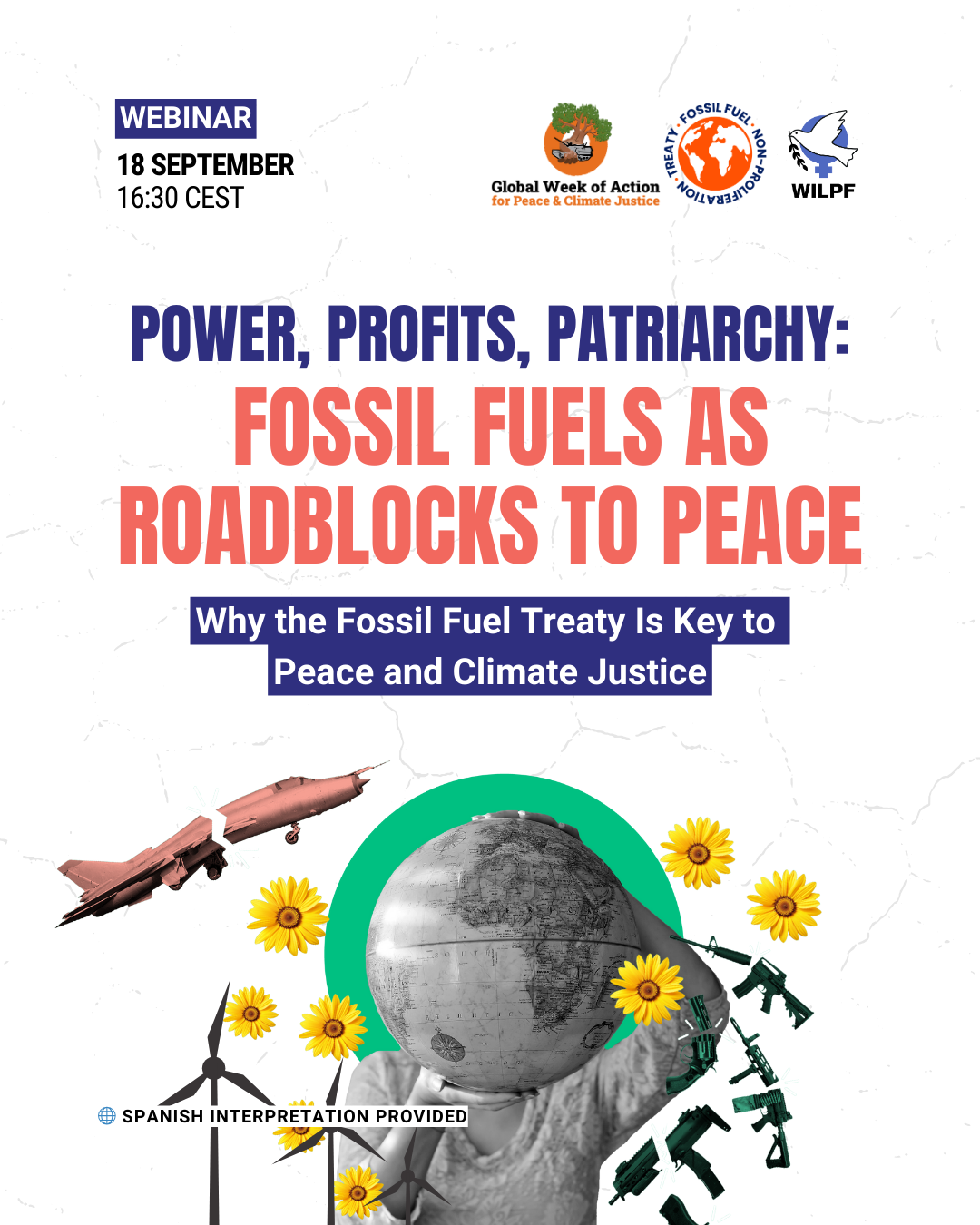
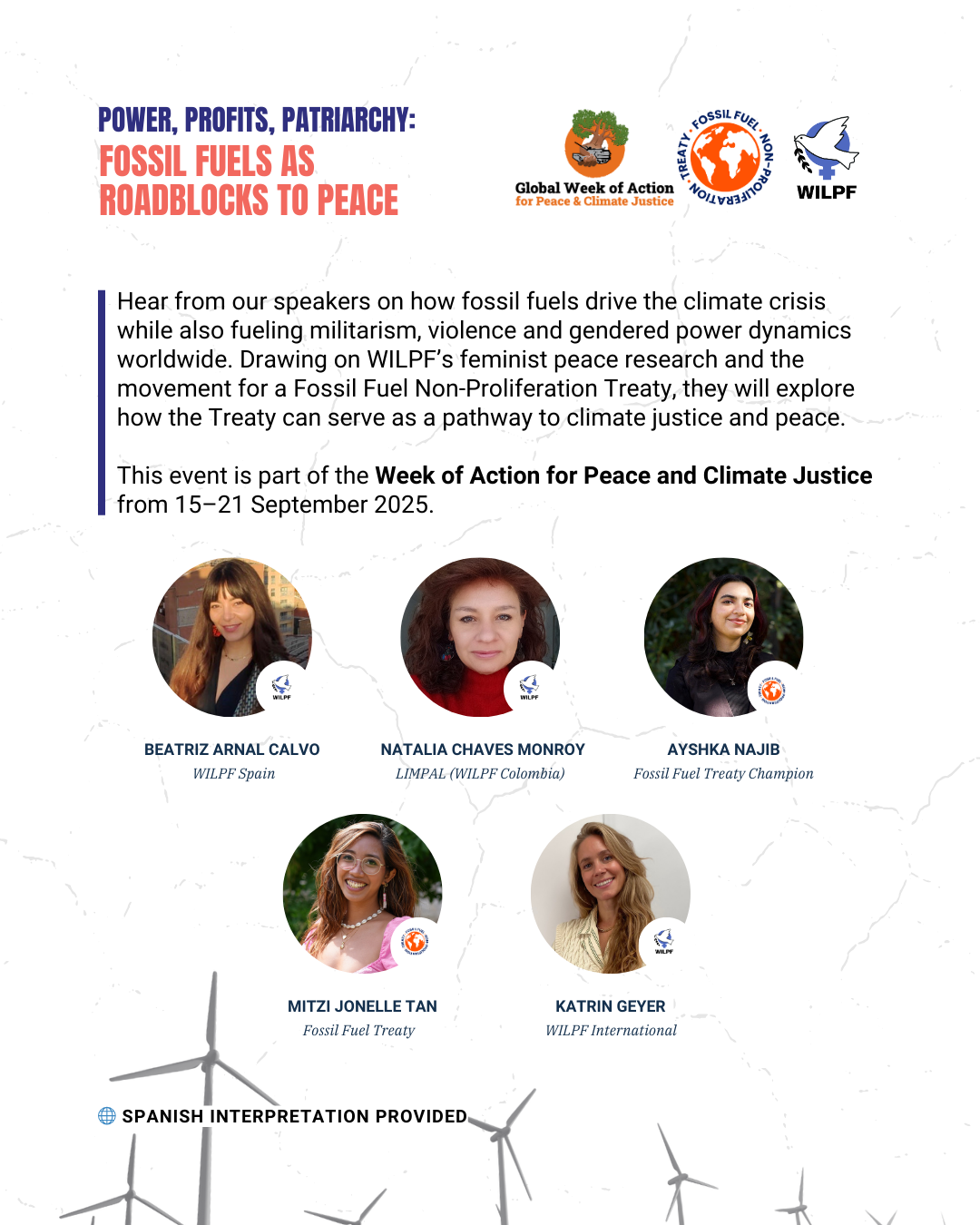
Join us for our upcoming webinar on 18 September at 4:30PM CEST to explore how feminist peace action through the Fossil Fuel Treaty can stop fossil-fuel driven conflict and insecurity, and help build a just, peaceful,and flourishing world for all.
Follow the conversation and stay updated:
- WILPF: Twitter/X | Instagram | Facebook | LinkedIn
- Fossil Fuel Treaty: Twitter/X | Instagram | Facebook | LinkedIn
Resources
The facts above are drawn from WILPF’s recent research, supported by the Fossil Fuel Treaty Campaign. For a deep dive into this topic, explore the below resources:
- Beatriz Arnal Calvo, WILPF Spain, Hacia una política climática libre de combustibles fósiles. Aportes desde el feminismo pacifista, 2024
- Katrin Geyer, Stop Fossil Fuels From Fuelling Conflict: Why the Fossil Fuel Non-Proliferation Treaty is an essential climate tool for peace?, WILPF International and Fossil Fuel Treaty Non-Proliferation Treaty, 2024
- Aportes al Tratado de No proliferación de Combustibles Fósiles desde el ecofeminismo antimilitarista, WILPF Colombia (Limpal), 2024
- It’s time to share my own experience, to highlight the exploitation of gender, climate, and capitalism | Missing Perspectives


