
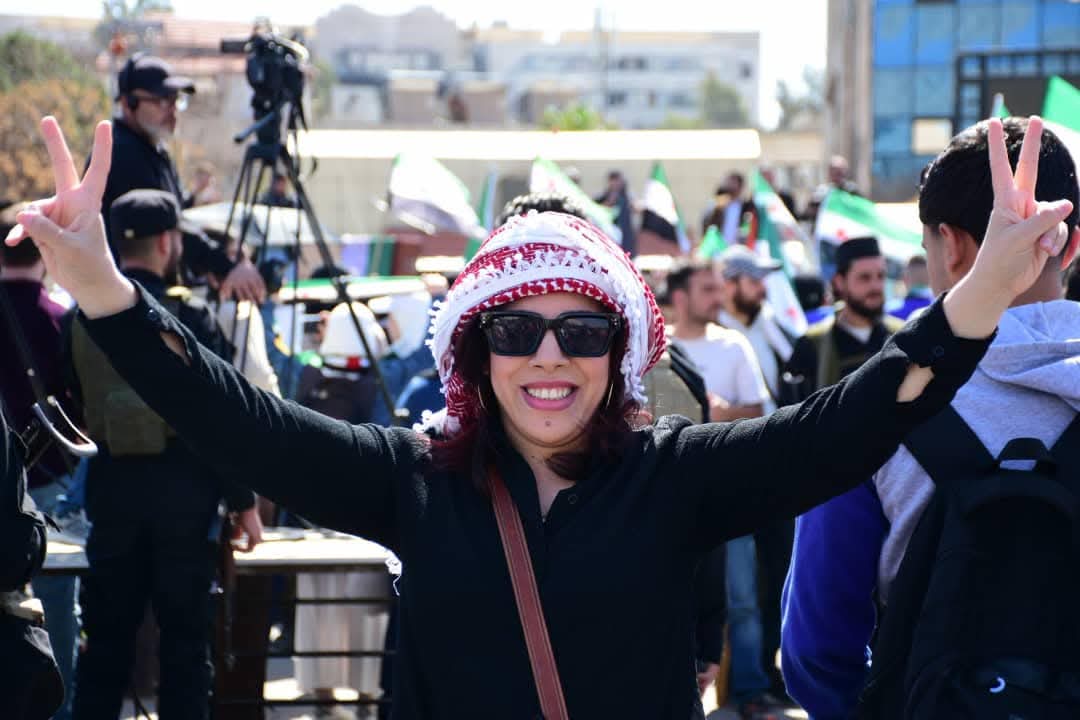
“Assad has fallen… We have reclaimed our rights!” I screamed these words at the top of my lungs in the first moments of the Syrian regime’s downfall on the historic day of 8 December 2024.
I bolted from my house at dawn, sprinting through the streets of Gaziantep—the city where I had sought refuge and endured 13 years of exile, forbidden from returning to my homeland because of my political stance. I fled Syria in 2012, terrified of imprisonment—being a woman meant enduring double discrimination, especially as an outspoken opponent of the Assad regime.
I was desperate to return to my home country at this very moment. But it struck me that a lot has changed in my life since I left. I was a single young woman fleeing with my family. Now, I am a mother raising my children alone, far from my husband, who migrated to Europe in search of a more stable life for our family. I had to make many arrangements, but I eventually managed to return to Damascus—victorious.
Here I was, in Damascus, on 17 February 2025, after years in exile. I did not return to Syria just for the sake of returning, even though it was a long-awaited dream. As a feminist activist and journalist, I seized the opportunity to discuss emerging realities and the need for peaceful activism and social initiatives with women’s groups across different provinces.
Over the course of 14 years of conflict, Syrian women have demonstrated extraordinary leadership and responsibility in political, social, humanitarian and educational fields. And with the fall of the dictatorship opening up new political horizons that once seemed impossible, we have become more optimistic and eager to take part in rebuilding the country.
The few days I spent in Syria were truly inspirational. Traveling through Damascus, Latakia, and Homs, I met remarkable women who have dedicated their lives to fostering peace, rebuilding communities and advancing political participation. As Syria enters this delicate transitional phase, requiring the collective engagement of every segment of society to shape its future, the critical role of Syrian women in this profound transformation is more important than ever.
“If women make up half of society, why shouldn’t they be half of the solution?” — Khawla Dunya, Syrian feminist political researcher
Building Bridges for Civil Peace
As the country undergoes a transformative transition, women-led initiatives in Syria are increasingly focusing on social cohesion and civil peace, particularly in areas that have been deeply affected by the social consequences of the war and conflict.
Speaking at a social justice event organised by Mosaic Human Relief and Development in Latakia—a city known for its sectarian and religious diversity, Syrian feminist political researcher Khawla Dunya emphasised that “hope could only ever be realised through civil peace—something we [Syrians] desperately need now more than ever.”
As a Syrian in direct contact with diverse communities—especially those grappling with deep sectarian and social divisions—I understand that the pursuit of civil peace is essential for protecting lives and preventing further harm. Civil peace—meaning a state of coexistence and mutual respect where we reject violence, embrace diversity, and resolve conflicts peacefully— is the first step toward calming tensions, rebuilding trust among communities, and creating safe spaces for open dialogue rather than hostility. Sustainable peace remains unattainable as long as entrenched societal divisions, ongoing inter-group tensions, and persistent sectarian and communal rifts continue to plague us—not to mention the heavy legacy of past violations.
In fact, promoting civil peace has long been a priority for women and feminist organisations in Syria, often organising community dialogues to encourage conversations among diverse groups in safe environments whenever possible. Dunya explained, “A significant part of our work focused on community dialogues where we discovered that women were often more capable of fostering conversations among different groups—not only among themselves but also with men. Unlike men, who often view political struggles in absolute terms of victory or defeat, women tend to lean toward outcomes that promote stability and peace. Wherever a safe environment is created, women can build a better future for their children. This ability is a strength that should be actively harnessed.”
The event by Mosaic also showcased case studies from countries with experiences similar to that of Syria, such as South Africa and the former Yugoslavia. What struck me throughout these discussions was the overwhelming attendance of women, while the presence of men remained minimal. Women were eager to discuss solutions for achieving stability.

In Homs, the spirit of unity and co-existence was also palpable at another event organised by The Capital of Peace Initiative, exploring how hope and dreams can help us overcome the brutal ordeals we have faced as Syrians. The gathering brought together women from every corner of Syrian society in Homs, representing a wide spectrum of political views. As I looked at them, I was struck by their remarkable ability to embrace differences. Even when voices grew heated, they remained steadfast, carrying on with passionate political dialogue and a shared vision for Syria’s future.
“Women-led initiatives play a pivotal role in building more cohesive community relations, especially in societies suffering from political and social divisions. These initiatives help foster dialogue and build bridges between different groups. Women often possess the ability to communicate effectively and mediate, which helps create spaces for dialogue, understanding, easing tensions and promoting mutual respect.” — Julia Jamal, co-founder of the “Capital of Peace” initiative in Homs
Many of the newly emerging or previously existing women-led initiatives in Syria today focus on shared humanitarian issues such as peace, health and education — causes that unite communities beyond political polarisation, and contribute to spreading a culture of nonviolence and peace. These initiatives also work to empower marginalised groups by focusing on education, employment and health, seeking to reduce social and economic disparities and tackling the root causes of division within society. They are based on the principles of mutual support and collective work, thereby strengthening bonds between individuals and groups regardless of their affiliations.
Advancing Women’s Political Participation and Leadership
Another critical priority for women in Syria in this transformational phase is to secure meaningful political participation and leadership. Despite undeniable resilience and adaptability, Syrian women have continuously faced systemic barriers that have limited their political engagement. At this pivotal moment—when women’s involvement is essential for rebuilding Syria—the obstacles remain substantial. Nonetheless, women and girls across the country are increasingly vocal and determined to actively shape our nation’s future.

During my visit to Damascus, I met with Hassna Issa, an inspirational journalist and the director of the news platform Akhbarna. Hassna explained that the authorities and the society in Syria have historically feared women attaining positions of influence, resulting in significant barriers to women’s political participation. She emphasised, “The fight is not just about ideology or competence—it’s about claiming a seat at the table in a political landscape dominated by men.” Political violence against women has also become increasingly entrenched and disproportionate, with “women facing the constant risk of detention or bullying simply for exercising their right to political activism,” as Hasnaa elaborated.
Despite all these challenges, the resolve of Syrian women, like Hasnaa, remains unyielding. For many of us, political activism began as a deeply personal mission to amplify Syrian women’s voices, and it has since evolved into a social and political responsibility that we are determined to uphold.
Speaking at the social justice event organised by Mosaic Human Relief and Development in Latakia, Dr. Lama Al-Mulla from the Syrian Red Crescent further highlighted the persistent societal barriers that impose a “glass ceiling” on women’s progress. According to Dr. Al-Mulla, real change requires implementing women’s quotas in local councils, parliaments and legislative bodies. This measure would ensure women’s meaningful representation and allow inclusive policies to guide Syria toward stability.
Dr. Al-Mulla also emphasised that restoring women’s roles in society requires genuine investments in their potential, so that they can significantly contribute to rebuilding a country that has been devastated by armed conflict, mass arrest campaigns, and the loss of thousands of lives. She noted, “The impact of women extends beyond [formal] politics as they play a critical role in shaping our collective consciousness. Their individual awareness often precedes societal awareness, and helps drive gradual change.”
Indeed, even beyond formal political roles, our participation and leadership in public life have always been profoundly challenged by entrenched social roles. Traditional expectations often confine women to social care and domestic responsibilities, leaving us with limited time and resources for engaging in political activities and reinforcing systemic biases that restrict our opportunities to assume leadership roles. I have constantly faced this challenge myself, often having to defend my choices and justify my positions. Like many other women, I have been responsible for providing for my family while actively working in journalism and advocating for Syrian women’s rights. Yet, these intertwined experiences have actually shaped my political awareness, reinforcing my belief that the personal is political.
At this transformative phase, Syrian women who have persisted in politics despite all challenges are beginning to see some tangible impact, though not at the desired scale. In political workshops and conferences, the presence of women is becoming more pronounced, yet exclusion remains a significant issue— as evidenced during the National Dialogue Conference, where women’s participation was still quite limited.
Political leadership of women is an uphill battle, as even the prospect of women in decision-making roles continues to be unsettling for many. However, many of us share a common aspiration today: We don’t just want to be included in the political scene – we need to be key partners in decision-making processes and in shaping Syria’s future. I firmly believe that women can bring about real change—not because they deserve it, but because Syria simply cannot be rebuilt without their active participation.
Urgent Priorities for State Action
Over the course of 14 years of conflict, Syrian women have had to overcome immense challenges, which they have survived and resisted with extreme resilience and determination. Today, entrenched obstacles persist, alongside emerging challenges at this transformative phase. While women-led groups and feminist organisations are making tremendous efforts to address these issues, urgent action from the state is imperative.
→ Reconstruction is an utmost priority for many of us. One of the hardest moments during my last visit was realising I had no place to return to after a long workday. The pain and heartbreak of seeing my destroyed home in southern Damascus and my old neighborhood in ruins were unbearable. I wonder how long it will take to rebuild these areas and whether women will play a role in this process, particularly through feminist approaches that centre on community needs and equitable development. It’s important that recovery efforts prioritise affordable, safe, community-needs based housing, and serve those most in need.
→ Ensuring protection from all forms of violence —especially domestic violence— requires a comprehensive response from the state and its institutions. Effective measures such as establishing shelters, enacting stricter laws that criminalise violence against women, and legal and social support services must be put in place and made widely available.
→ Access to medical and health care services, including reproductive health, is a fundamental right. Establishing free clinics where women can receive medical care for themselves and their children is essential. The only available healthcare is on a paid-basis, and most women cannot afford its cost. There is effectively no free government healthcare, especially in areas devastated by conflict.
→ Education must be a top priority. Many girls and boys have dropped out of school due to violence, economic hardships or early marriage. Laws that protect the right to education are important, albeit not enough on their own. Ensuring families’ economic well-being is also crucial so that they are not forced to withdraw their children from school for work or for marriage.
→ It is vital to expand employment opportunities for women beyond traditional fields and to ensure women’s participation in sectors such as technology and construction. Adopting a Feminist Political Economy (FPE) approach is also a crucial path to address the structural barriers that limit women’s access to economic resources and opportunities.
→ Ultimately, true change cannot be achieved without legal accountability to enforce women’s rights and ensure they can participate safely and with dignity. Justice and equality for women are not just demands—they are the foundation for a more stable and just society for all.


