Celebrating Feminists’ Voices, Inspiring Global Peace

Action
#Disarmament

Demanding Disarmament and Demilitarisation at the UN General Assembly

On 23 September 2025, the United Nations General Assembly will commence its annual high-level general debate. Heads of state and government, foreign ministers, and other officials in New York will be staking out their positions on all issues confronting the world today—and WILPF’s disarmament team will be demanding urgent disarmament and demilitarisation for people and the planet.

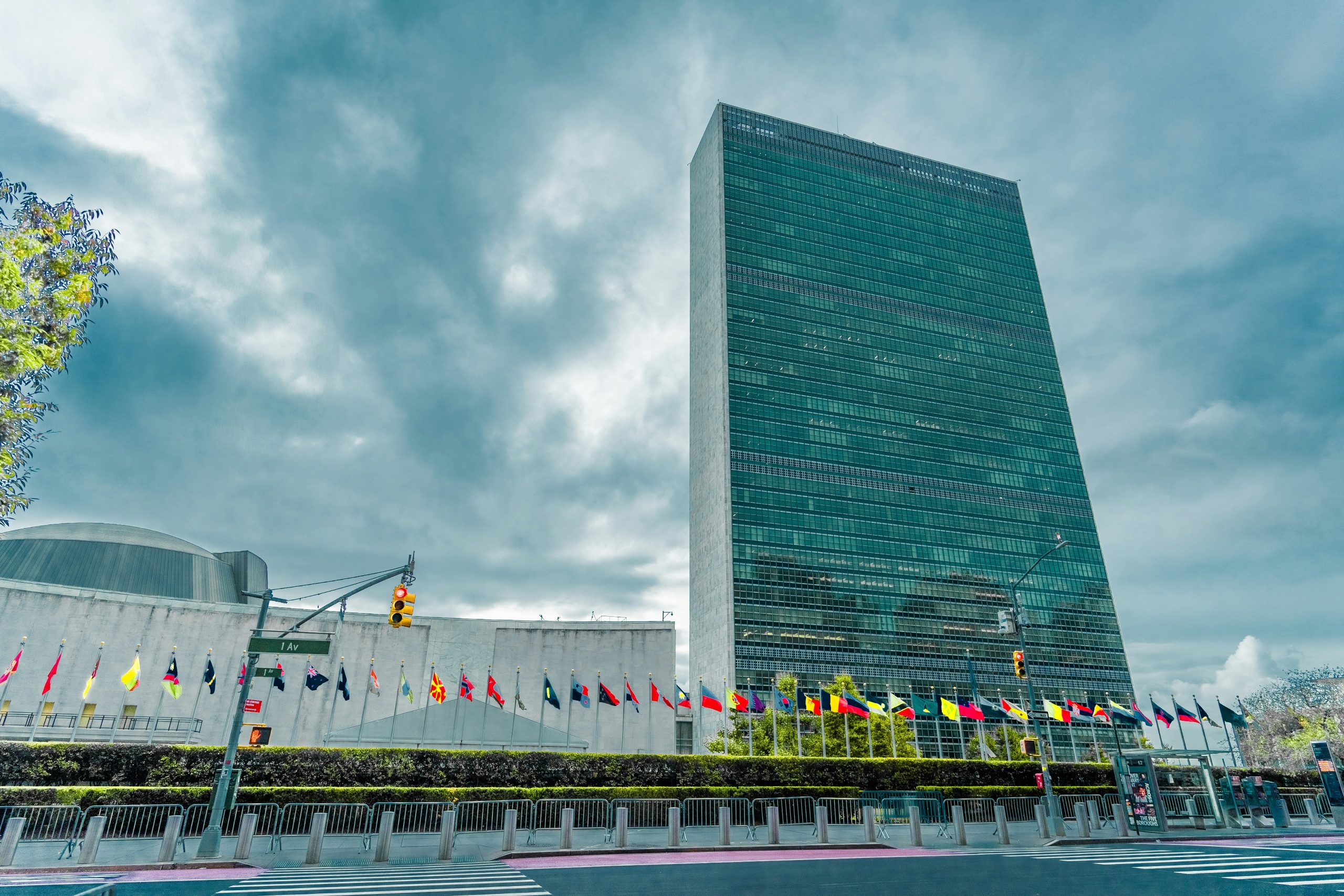
The United Nations Headquarters building in New York City, with rows of international flags displayed outside along the street under a cloudy sky.
Image credit: Nils Huenerfuerst | Unsplash
Ray Acheson
17 September 2025

The high-level debate of the UN General Assembly, which will begin on 23 September 2025, marks 80 years since the founding of the United Nations. Its original members were determined to “save succeeding generations from the scourage of war.” But the global military-industrial complex and it war profiteers have actively prevented the achievement of this goal. Instead, militarised states and private corporations have built political economies reliant on war, sending societies spiralling into violence and creating the conditions for neverending armed conflict, occupation, and genocide.

The opening weeks of the UN General Assembly each September are mostly about speeches and spectacle. But they also provide opportunities for officials from most countries of the world to meet at the highest level, to set out their priorities, and to apply pressure for policy changes. The meetings held during this time also provide an opportunity for activists and organisers to demand better from their governments and from this global institution.

Disarmament Priorities at the General Assembly

WILPF programmes will be pressing for real action for people and the planet across a range of issues during the UN General Assembly’s work, from finacing for peace to climate justice to women’s rights and gender justice. The Reaching Critical Will team will be focusing on amplifying WILPF’s demands for disarmament and demilitarisation, including:

  • An end to arms transfers and other material support to Israel, and stopping the global arms trade and war profiteering more broadly;
  • The abolition of nuclear weapons;
  • To stop using explosive weapons in populated areas;
  • To not build or use autonomous weapons or AI-enabled weapon systems;
  • To end the rampant proliferation and use of small arms and armed drones;
  • To uphold international law on cluster munitions, landmines, biological weapons, and chemical weapons; and
  • To significantly reduce military spending, divest from the military-industrial complex, and invest instead in peace, economic and envionrmental justice, gender equality, and other social goods.

The Reaching Critical Will team will monitor the high-level debate and track what governments say about weapons and war. We will post extracts from statements in our UNGA Disarmament Index and provide an analysis at the end of the debate.

The RCW team will also follow what’s happening with two high-level events on 26 September: the International Day for the Elimination of Nuclear Weapons and the Fourteenth Conference on Faciliating the Entry Into Force of the Comprehensive Nuclear-Test-Ban Treaty. Our demand for both of these meetings is clear: the total abolition of nuclear weapons is the only way to ensure these weapons are never detonated again; to prevent any further harm from uranium mining, radioactive waste, and nuclear development and deployment; and to free up the hundreds of billions of dollars a year wasted on nuclear bombs, missiles, and more.

How can you get involved?

While RCW will be taking forward WILPF’s demands at the international level, it’s also important that national governments hear from people at the local level! You can use the priorities listed above to make urgent calls on your government, depending on what is most relevant nationally.

You can also use our latest First Committee Briefing Book to find out more information and specific demands from various campaigns and coalitions working across all disarmament issues, and share this resource and its recommendations with your government.

If you want to watch the high-level debate or either of the nuclear weapon-related meetings, UN Web TV should be streaming live at https://media.un.org. RCW will also provide reports after these meetings—be sure to subscribe to Reaching Critical Will’s mailing list today!

RCW Resources for More Information

Share the post
Ray Acheson

Ray Acheson is Director of Reaching Critical Will, WILPF’s disarmament programme. They are author of Abolishing State Violence: A World Beyond Bombs, Borders, and Cages and Banning the Bomb, Smashing the Patriarchy. They organise for abolition, disarmament, and demilitarisation in their work with various coalitions and provide intersectional feminist analysis and advocacy at international disarmament forums.

Mercy Osei Konadu

Mercy Osei Konadu

Africa Alternate Regional Representative

Mercy Osei-Konadu is a Gender, Rights and Development Practitioner, with experience in programme planning and management, policy advocacy and partnership development. Her career spans the United Nations, USAID, other Public and Private Institutions, and Civil Society, with expertise in gender equality, women’s empowerment, population and development, SRHRs, WPS, humanitarian response and sustainable development.  

Mercy holds a Bachelor’s Honours Degree from the Kwame Nkrumah University of Science and Technology (KNUST), Kumasi-Ghana, and a Master’s Degree in Development Studies from the University of East Anglia, Norwich, United Kingdom. She is a member of WILPF Ghana Section, WGWYPS Ghana network, and other civil society advocacy networks. She currently serves as the WILPF Africa Alternate Representative.  

Contact: mercy.osei@wilpf.org

Matt Mahmoudi

Matt Mahmoudi (he/him) is a lecturer, researcher, and organizer. He’s been leading the “Ban the Scan” campaign, Amnesty International’s research and advocacy efforts on banning facial recognition technologies and exposing their uses against racialized communities, from New York City to the occupied Palestinian territories.

Hanne Peterson

Hanne Peterson

Europe Alternate Regional Representative

Hanne Petersen is a feminist peacebuilder from Denmark with expertise on gender and law, legal pluralism, and legal cultures (esp. Greenland, China, Nordic Countries, Germany). She is a retired Professor (emerita) of Legal Cultures at the Faculty of Law, University of Copenhagen. Hanne has been a member of WILPF Denmark since 2003, increasing her activism since she retired 2024 on the national, regional, as well as international level within WILPF. She is an alternate board member of WILPF Denmark since 2022 and an executive committee member since 2024. She’s been active in regional initiatives and mobilisations since 2023. She currently serves as the Alternate European Regional Representative on WILPF’s International Board. Hanne grew up in post & cold world war Northern/ Western Germany (‘South Schleswig’) in the 1950s and 60s as part of the Danish minority.  

Contact: hanne.petersen@wilpf.org

Your donation isn’t just a financial transaction; it’s a step toward a more compassionate and equitable world. With your support, we’re poised to achieve lasting change that echoes through generations. Thank you!

Thank you!

Person with short dark hair, glasses, and a red and black patterned jumper stands with arms crossed against a plain white wall.

Diana María Salcedo López

VICE-PRESIDENT

Diana María Salcedo López is an anti-militarist feminist from Colombia. She has a solid track record spanning two decades incorporating gender and intersectional perspectives into public policy, advocating for victims of armed conflict, and consolidating territorial peacebuilding processes as an activist, but also consultant for NGOs, international cooperation agencies, the UN and government entities in Colombia. She is the director of WILPF’s national section in Colombia (LIMPAL Colombia), where she leads efforts on issues such as feminist approaches to the energy transition, the protection of women human rights defenders and the implementation of the Women, Peace, and Security agenda. She represents the organisation in the Special Women’s Body for Monitoring the Peace Agreement and in the Intersectoral Commission on Security Guarantees for Women Human Rights Defenders and Leaders in Colombia. Diana holds a degree in political science from the National University of Colombia, a master’s degree in Women’s, Gender, and Citizenship Studies from the University of Barcelona, and as well as in Human Rights, the Rule of Law, and Democratisation from the University of Alcalá de Henares in Madrid.

Contact: diana.salcedo@wilpf.org  

A woman with straight, light brown hair and glasses stands indoors by a window, wearing a blue shirt and black blazer. The background is softly blurred with buildings and trees visible outside.

Desirée Sterner

VICE-PRESIDENT

Desirée currently serves as President of the Swedish Section (IKFF), a role she has held since 2023. Her engagement with WILPF began at the grassroots level through the local branch in Lund/Malmö during her university years. Desirée brings a deep substantive understanding of WILPF’s core issues, rooted in academic training in gender, peace and security (LSE), war studies (Swedish Defense University), peace and conflict studies, and human rights (Lund University), combined with several years of practical advocacy, movement-building and organisational leadership work in Swedish civil society.  


Contact: desiree.sterner@wilpf.org  

A woman in traditional African attire stands against an orange background, wearing a patterned headwrap, white dress with colourful trim, layered necklaces, bracelets, and a blue ring, with her hand resting on her chin.

Sylvie Jacqueline Ndongmo

PRESIDENT

Sylvie Ndongmo is a Cameroonian peacebuilder, feminist leader, civil society actor and Women, Peace and Security expert with over 30 years of experience in peacebuilding, mediation, and gender equality advocacy. This is her second term serving as International President of WILPF. She is also the founder of WILPF Cameroon and Executive Secretary of Women Peace Initiatives. She coordinates the Women and Youth Early Warning Monitoring Room in Cameroon and was appointed to the African Union Advisory Panel on Democratic Elections and Governance in Africa. Her work focuses on advancing women’s leadership, conflict prevention, and sustainable peace through feminist, inclusive, and intergenerational approaches.   

Contact: sylvie.ndongmo@wilpf.org

WILPF Afghanistan

In response to the takeover of Afghanistan by the Taliban and its targeted attacks on civil society members, WILPF Afghanistan issued several statements calling on the international community to stand in solidarity with Afghan people and ensure that their rights be upheld, including access to aid. The Section also published 100 Untold Stories of War and Peace, a compilation of true stories that highlight the effects of war and militarisation on the region. 

IPB Congress Barcelona

WILPF Germany (+Young WILPF network), WILPF Spain and MENA Regional Representative

Lorem ipsum dolor sit amet, consectetur adipiscing elit. Mauris facilisis luctus rhoncus. Praesent eget tellus sit amet enim consectetur condimentum et vel ante. Nulla facilisi. Suspendisse et nunc sem. Vivamus ullamcorper vestibulum neque, a interdum nisl accumsan ac. Cras ut condimentum turpis. Vestibulum ante ipsum primis in faucibus orci luctus et ultrices posuere cubilia curae; Curabitur efficitur gravida ipsum, quis ultricies erat iaculis pellentesque. Nulla congue iaculis feugiat. Suspendisse euismod congue ultricies. Sed blandit neque in libero ultricies aliquam. Donec euismod eget diam vitae vehicula. Fusce hendrerit purus leo. Aenean malesuada, ante eu aliquet mollis, diam erat suscipit eros, in.

Demilitarisation

WILPF uses feminist analysis to argue that militarisation is a counter-productive and ill-conceived response to establishing security in the world. The more society becomes militarised, the more violence and injustice are likely to grow locally and worldwide.

Sixteen states are believed to have supplied weapons to Afghanistan from 2001 to 2020 with the US supplying 74 % of weapons, followed by Russia. Much of this equipment was left behind by the US military and is being used to inflate Taliban’s arsenal. WILPF is calling for better oversight on arms movement, for compensating affected Afghan people and for an end to all militarised systems.

Militarised masculinity

Mobilising men and boys around feminist peace has been one way of deconstructing and redefining masculinities. WILPF shares a feminist analysis on the links between militarism, masculinities, peace and security. We explore opportunities for strengthening activists’ action to build equal partnerships among women and men for gender equality.

WILPF has been working on challenging the prevailing notion of masculinity based on men’s physical and social superiority to, and dominance of, women in Afghanistan. It recognizes that these notions are not representative of all Afghan men, contrary to the publicly prevailing notion.

Feminist peace​

In WILPF’s view, any process towards establishing peace that has not been partly designed by women remains deficient. Beyond bringing perspectives that encapsulate the views of half of the society and unlike the men only designed processes, women’s true and meaningful participation allows the situation to improve.

In Afghanistan, WILPF has been demanding that women occupy the front seats at the negotiating tables. The experience of the past 20 has shown that women’s presence produces more sustainable solutions when they are empowered and enabled to play a role.