
Since the world’s first Earth Day in 1970, 1 billion individuals have been mobilised to drive positive action for the planet, through collaborations with 150,000 partners in over 192 countries.
This year’s Earth Day’s call to action reads:
“Our world needs transformational change. It’s time for the world to hold sectors accountable for their role in our environmental crisis while also calling for bold, creative, and innovative solutions. This will require action at all levels, from business and investment to city and national government. That’s where you come in: As an individual, you yield real power and influence as a consumer, a voter, and a member of a community that can unite for change. Don’t underestimate your power. When your voice and your actions are united with thousands or millions of others around the world, we create a movement that is inclusive, impactful, and impossible to ignore.”
It is striking that the collective actions of around one-eighth of today’s world population who share this conviction have not been able to prevent the de facto worsening of pollution, destruction and climate catastrophes.
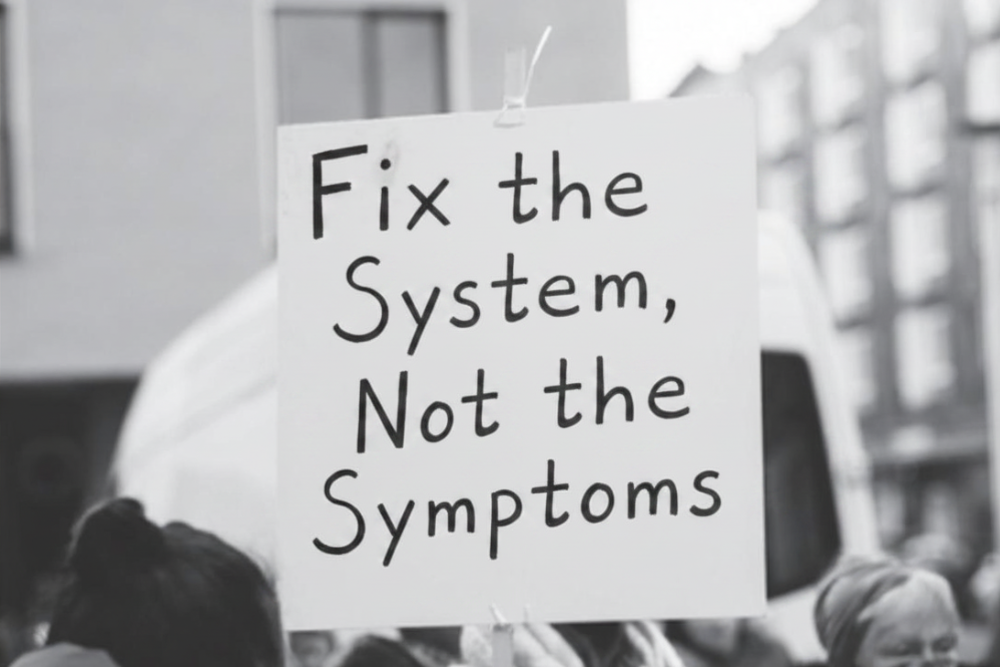
This points to the critical nature of the challenge: the extreme power imbalances and flawed systems that perpetuate exploitation and destruction of people and planet.
While individual action on the interlinking crises of climate, biodiversity loss and pollution is important, the responsibility to act is not evenly distributed. Rather than subject those most vulnerable to demands for changing their lifestyles and livelihoods, we need to call on those most responsible to act.
Those most responsible are the rich: 50% of global emissions come from the richest 10%. Those most responsible are the governments of the most industrialised and wealthy countries,recognising their disproportionate responsibility and climate debt. Those most responsible are global militaries, especially in these times of increasing war and destruction.
Perhaps the people who should be at the top of the list to be held to account are the CEOs of fossil fuel companies, who not only profit from our demise, but who have been actively spreading misinformation about their own pollution for over 40 years. Fearing loss of profits as the momentum is accelerating for a Fossil Fuel Treaty and transition to renewable energy increases, fossil fuel companies plan to increase plastic production worsening microplastic pollution of our bodies and the planet.
Let us take a look at some of the suggestions for Earth Day 2026:
Community cleanups: While people collect the rubbish thrown out into their neighbourhoods (plastic bags, cigarette butts or dog poop), agribusiness sprays pesticides and applies chemical fertilisers that intrude into soil and water and harm flora, fauna and human health in the long run. Nearly 99% of the global population lives in areas that exceed World Health Organization (WHO) air quality guideline limits. Microplastics are ubiquitous in drinking water, with studies finding contamination in over 80% of tap water samples worldwide. Corporate industries practise extractivism of resources and production methods that destroy landscapes and empty rivers and lakes.
This vast challenge demands systemic change, through regulation, voluntary corporate action and industrial transformation, as well as narrative and behavioural change. Rwanda sets a unique example – it is forbidden by law to use plastic packaging at all.
Tree planting: Numerous initiatives have planted trees around the world, from city gardens on rooftops to the Great Green Wall stretching from Senegal to Ethiopia, from tourists planting a tree to compensate their flight emissions to billions of trees planted in the Three-North Shelter Forest Program in China. But it has not terminated the deliberate cutting of trees for extractive mining and agribusiness. Generic tree planting does not recognise the vast difference in biodiversity value between newly planted trees and indigenous, ancient forests and their vibrant ecosystems.
The production of consumer goods like soy beans, palm oil or beef account for 80% of global deforestation. In 2020, FAO claimed that 10 million hectares, one third being primary forests, are destroyed per year.
The effect of wars on land use and biodiversity demands much more comprehensive research. Between 2022 and 2023, the first two years of Russia’s invasion of Ukraine destroyed almost 1,600 square kilometres of forests.
In the Occupied Palestinian Territories (Westbank), home to more than 10 million olive trees, about one million olive trees have been deliberately destroyed to deprive the Palestinian people of their livelihoods since the beginning of occupation in 1967. In Gaza, the continuous Israeli bombing had already eliminated 75 % of olive trees. It is estimated that heavily contaminated soil as a result of the genocide will counter reforestation efforts for generations to come.
However, legal recognition of Nature’s Rights is on the rise. Ecuador sets a unique example – since 2008 its constitution / Article 71 grants Pacha Mama (Mother Earth) the right to existence. This is a protection enforceable by any NGO in court, and one that has already halted the opening of a gold mine on Indigenous land.
Peaceful demonstrations: In September 2019 between six and eight million people participated in a worldwide climate strike, initiated by Fridays for Future, 350.org and numerous other environmental NGOs. Peaceful, colourful, enthusiastic.
But this movement failed to inspire any significant action at the climate-peace nexus among the 195 Parties to the Paris Agreement, a legally binding agreement to reduce greenhouse gas emissions and limit global warming to 1.5 degrees. On the contrary, those responsible for the greatest proportion in CO2 emissions have increased their military spending at record levels, and today send their arms to the most destructive wars in Ukraine, Sudan and West Asia. Global emissions caused by military activity is estimated at over five percent, but the military sector’s emissions are not reported and monitored under the Paris Agreement. Peaceful demonstration versus violent destruction and even genocide.
Year after year, parties to the Paris Agreement are fighting over funding climate change measures, but do not consider diverting military spending into care for nature and for humans endangered by catastrophes. This is despite peaceful demonstrators gathering at the doors of climate conferences year after year, their demands going unheard.
While the powerful remain preoccupied with minimising emissions, others, particularly communities and nations in the Global South, who face the most acute and existential climate risks, are championing a fairer path forward. A recent milestone came at the 2025 climate conference in Belém, Brazil, where climate justice wording was secured in the final document for the first time.
While the powerful remain preoccupied with minimising emissions, others focus on bringing a treaty into being that tackles the climate crisis at its roots. A large global movement is working for a Fossil Fuel Treaty, with a growing number of activists calling for the demilitarisation as essential for a fossil fuel phase out and a just transition.
Conclusion
While there are many benefits of individual participation in Earth Day activities such as planting a tree or cleaning up one’s neighbourhood with friends– from community-building to awareness-raising – let us also join forces to identify the systemic root causes, demand and amplify ‘the Polluter Pays’ principle, and identify levers for holistic and widespread transformation.
Since War Costs Us the Earth:
- Participate in the Global Days of Action Against Military Spending https://ipb.org/events/gdams-2026/
- Support the Fossil Fuel Treaty https://www.fossilfueltreaty.org/
- Join environmental groups that work for climate justice, such as WILPF to move the money from military spending to climate solutions https://www.wilpf.org/move-the-money/


