Celebrating Feminists’ Voices, Inspiring Global Peace

Blog
#Ukraine

From Survival to the Future: What Everyday Adaptation in Ukraine Tells Us About Human Dignity

Winter in Ukraine today is not only a season — it is a condition. A condition marked by prolonged blackouts, cold apartments, disrupted routines, and a constant need to improvise. For millions of Ukrainians, daily life is reduced to a sequence of urgent tasks: charging devices, storing water, finding cooking means, keeping children warm and protected, while managing fear — quietly, persistently, for an uncertain tomorrow.

This is not a story of heroism. It is a story of survival — and what it reveals about basic human needs, collective social memory, and the fragile line between resilience and exhaustion.

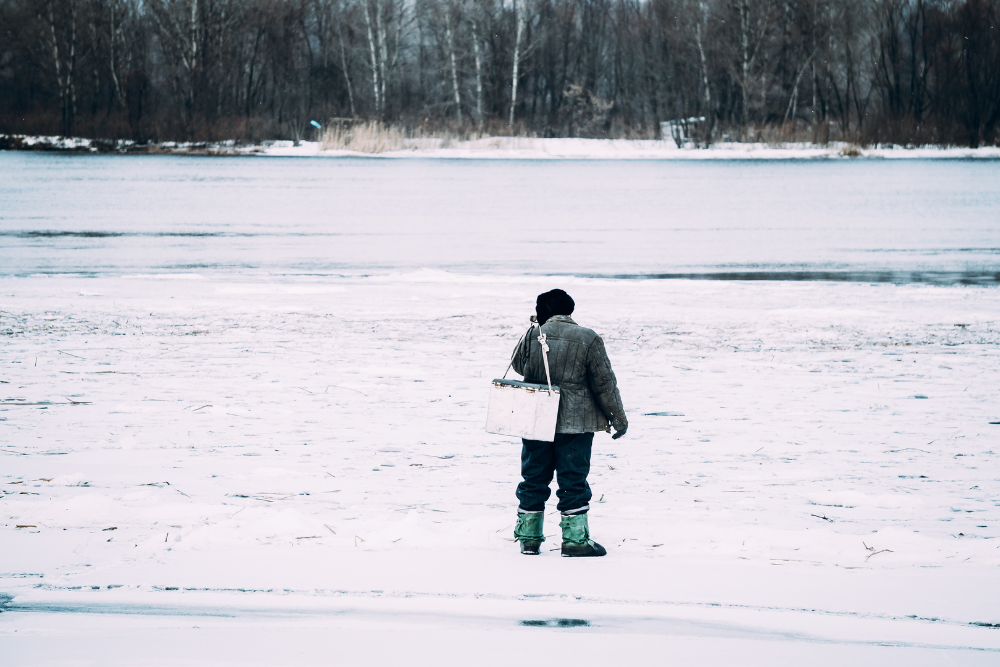
A person dressed in winter clothing stands on a snowy, frozen lakeshore, facing away from the camera and holding a box with a strap, with bare trees visible across the water.
Image credit: Konoplytska from Getty Images
Nina Potarska
26 February 2026

Everyday Adaptation as a Form of Knowledge

When electricity disappears, ordinary infrastructure collapses into improvisation. Across social media, Ukrainians share videos of handmade stoves made from metal cans, clay candle heaters, and improvised cooking devices assembled from scarcely available materials. These are not experimental hobbies — they are responses to dire necessities for survival.

“Kamforka-parties” around heat sources in courtyards and parks bring moments of warmth, conversation, and shared presence in our fragmented daily life. When there’s laughter, it is rarely carefree. Laughter shields despair–humor is our emotional insulation.

Our adaptation agility is part of our intergenerational psyche. Ukrainian society carries an extended, layered memory of scarcity and crisis. Our elderly survived the devastation and hunger following World War II. Their children navigated the economic collapse of the 1990s by learning how to “make do,” save, reuse, and store things “just in case.”

These habits — sometimes dismissed as relics of the Soviet era — are in fact forms of embodied, collective social knowledge. They resurface as survival mechanisms amidst crisis, extending continuity when formal systems fail.

Laughter through tears

Outsiders often misunderstand when Ukrainian humor springs up under extreme conditions. Memes, jokes, and ironic videos — reflect impressions of lightness, even defiance. In reality, our humor is rarely about comfort. It is about our endurance.

Ukrainian writer Lesya Ukrainka once wrote: “To avoid crying, I laughed.”

This perfectly captures what’s essential in our present moment. Humor here is not denial of suffering; it’s the means to remain emotionally present without being overwhelmed. It is laughter born of exhaustion, not ease.

Social Dehumanisation: When Hardship Becomes “Normal”

Prolonged exposure to crisis produces more than fatigue. It reshapes social perception. Researchers of violence and social psychology describe this process as social dehumanisation — not as cruelty, but as a gradual normalisation of unacceptable conditions.

When cold homes, blackouts, fear, and uncertainty persist over long periods, society adapts by lowering expectations. Suffering becomes routine. Empathy dulls not because people stop caring, but because continuous caring is unsustainable.

This shift can manifest subtly:

  • in phrases like “everyone is going through this”;
  • in the silent acceptance of deprivation as inevitable;
  • in the displacement of responsibility from systems to individuals;
  • in humor that hides pain rather than expressing it.

The danger of dehumanisation lies precisely in its invisibility. When survival is romanticised as resilience, the structural causes of suffering fade. Survival becomes a moral virtue instead of a sign of systemic failure.

Survival Is Not a Goal

This distinction matters deeply. Survival should never be mistaken for success.

Strategies to stay warm, fed, and psychologically intact are signals — indicators of unmet needs. They point to failed infrastructure, insufficient social support, and dignity under threat.

Understanding survival practices is not about celebrating ingenuity. It is about identifying what must be restored.

Post-Conflict Recovery: Beyond Rebuilding Walls

Postwar survival often focuses on physical reconstruction: power grids, housing, roads. Yet research on post-conflict recovery consistently shows that psychosocial damage lasts longer than physical destruction.

Long-term crisis erodes:

  • trust between people,
  • the sense of predictability,
  • the ability to plan,
  • the feeling of safety — even after violence subsides.

Survival and coping strategies during war can become obstacles in peace time if left unaddressed. Constant alertness, hoarding, emotional detachment, and humor as armor —  self-protective amidst crisis may hinder recovery if not gently unpacked.

Post-conflict resilience depends on whether societies create space to acknowledge exhaustion, fear, and grief — without rushing people back into “normality.”

Rebuilding social bonds requires:

  • recognising fatigue as a collective condition, not individual weakness;
  • creating safe spaces for shared reflection and meaning-making;
  • restoring dignity through care, not through demands for strength.

Why This Matters Beyond Ukraine

In a global context increasingly shaped by geopolitical competition, shifting alliances, and the language of power and military might, losing focus on human dignity is dangerously easy.

Ukraine’s experience is not exceptional — it is instructive. What has been unleashed in Ukraine has gone beyond our borders.

It proves how quickly modern societies can be pushed back to survival mode. It shows the thin fragility t of normality. And it demonstrates the extent of recovery beyond infrastructure, but humanity itself.

For global populations, especially in the United States, this is not a distant tragedy. It is a reminder: crises test not only states, but values. When human life becomes negotiable, when suffering is treated as collateral, dehumanisation spreads far beyond the battlefield.

From Survival to a Liveable Future

The survival strategies emerging today in Ukraine are not merely temporary solutions. They are a form of social evidence — proving needs to live, not just endure.

If future reconstruction efforts ignore this treacherous lived experience, peace may arrive only on paper while society remains in a permanent state of emergency.

True recovery begins when daily survival skills are no longer required — when warmth, safety, and dignity are no longer improvised, but guaranteed.

Share the post
A woman with long, wavy platinum blonde hair and red lipstick wears a white button-up shirt and sits indoors, facing the camera with a neutral expression.
Nina Potarska

Nina Potarska is a sociologist, political scientist, and gender expert specializing in peacebuilding and conflict resolution. Since 2016, she has been serving as the national coordinator of WILPF in Ukraine, advancing women’s participation and promoting gender perspectives in national and international frameworks. Her work focuses on gender-based human rights violations, the rights and needs of women living near the contact line, gender-based and conflict-related violence, and gender-inclusive mediation.

Matt Mahmoudi

Matt Mahmoudi (he/him) is a lecturer, researcher, and organizer. He’s been leading the “Ban the Scan” campaign, Amnesty International’s research and advocacy efforts on banning facial recognition technologies and exposing their uses against racialized communities, from New York City to the occupied Palestinian territories.

Berit Aasen

Europe Alternate Regional Representative

Berit Aasen is a sociologist by training and has worked at the OsloMet Metropolitan University on Oslo. She has 40 years of experience in research and consultancy in development studies, including women, peace, and security, and in later years in asylum and refugee studies. Berit Aasen joined WILPF Norway five years ago. She is an alternate member of the National Board of WILPF Norway, and representing WILPF Norway in the UN Association of Norway, the Norwegian 1325 network and the Norwegian Women’s Lobby. Berit Aasen has been active in the WILPF European Liaison group and is committed to strengthening WILPF sections and membership both in Europe and relations across continents.

Your donation isn’t just a financial transaction; it’s a step toward a more compassionate and equitable world. With your support, we’re poised to achieve lasting change that echoes through generations. Thank you!

Thank you!

Melissa Torres

VICE-PRESIDENT

Prior to being elected Vice-President, Melissa Torres was the WILPF US International Board Member from 2015 to 2018. Melissa joined WILPF in 2011 when she was selected as a Delegate to the Commission on the Status of Women as part of the WILPF US’ Practicum in Advocacy Programme at the United Nations, which she later led. She holds a PhD in Social Work and is a professor and Global Health Scholar at Baylor College of Medicine and research lead at BCM Anti-Human Trafficking Program. Of Mexican descent and a native of the US/Mexico border, Melissa is mostly concerned with the protection of displaced Latinxs in the Americas. Her work includes training, research, and service provision with the American Red Cross, the National Human Trafficking Training and Technical Assistance Centre, and refugee resettlement programs in the U.S. Some of her goals as Vice-President are to highlight intersectionality and increase diversity by fostering inclusive spaces for mentorship and leadership. She also contributes to WILPF’s emerging work on the topic of displacement and migration.

Jamila Afghani

VICE-PRESIDENT

Jamila Afghani is the President of WILPF Afghanistan which she started in 2015. She is also an active member and founder of several organisations including the Noor Educational and Capacity Development Organisation (NECDO). Elected in 2018 as South Asia Regional Representative to WILPF’s International Board, WILPF benefits from Jamila’s work experience in education, migration, gender, including gender-based violence and democratic governance in post-conflict and transitional countries.

A woman in a blue, black, and white dress smiles radiantly in front of a leafy green background.

Sylvie Jacqueline Ndongmo

PRESIDENT

Sylvie Jacqueline NDONGMO is a human rights and peace leader with over 27 years experience including ten within WILPF. She has a multi-disciplinary background with a track record of multiple socio-economic development projects implemented to improve policies, practices and peace-oriented actions. Sylvie is the founder of WILPF Cameroon and was the Section’s president until 2022. She co-coordinated the African Working Group before her election as Africa Representative to WILPF’s International Board in 2018. A teacher by profession and an African Union Trainer in peace support operations, Sylvie has extensive experience advocating for the political and social rights of women in Africa and worldwide.

WILPF Afghanistan

In response to the takeover of Afghanistan by the Taliban and its targeted attacks on civil society members, WILPF Afghanistan issued several statements calling on the international community to stand in solidarity with Afghan people and ensure that their rights be upheld, including access to aid. The Section also published 100 Untold Stories of War and Peace, a compilation of true stories that highlight the effects of war and militarisation on the region. 

IPB Congress Barcelona

WILPF Germany (+Young WILPF network), WILPF Spain and MENA Regional Representative

Lorem ipsum dolor sit amet, consectetur adipiscing elit. Mauris facilisis luctus rhoncus. Praesent eget tellus sit amet enim consectetur condimentum et vel ante. Nulla facilisi. Suspendisse et nunc sem. Vivamus ullamcorper vestibulum neque, a interdum nisl accumsan ac. Cras ut condimentum turpis. Vestibulum ante ipsum primis in faucibus orci luctus et ultrices posuere cubilia curae; Curabitur efficitur gravida ipsum, quis ultricies erat iaculis pellentesque. Nulla congue iaculis feugiat. Suspendisse euismod congue ultricies. Sed blandit neque in libero ultricies aliquam. Donec euismod eget diam vitae vehicula. Fusce hendrerit purus leo. Aenean malesuada, ante eu aliquet mollis, diam erat suscipit eros, in.

Demilitarisation

WILPF uses feminist analysis to argue that militarisation is a counter-productive and ill-conceived response to establishing security in the world. The more society becomes militarised, the more violence and injustice are likely to grow locally and worldwide.

Sixteen states are believed to have supplied weapons to Afghanistan from 2001 to 2020 with the US supplying 74 % of weapons, followed by Russia. Much of this equipment was left behind by the US military and is being used to inflate Taliban’s arsenal. WILPF is calling for better oversight on arms movement, for compensating affected Afghan people and for an end to all militarised systems.

Militarised masculinity

Mobilising men and boys around feminist peace has been one way of deconstructing and redefining masculinities. WILPF shares a feminist analysis on the links between militarism, masculinities, peace and security. We explore opportunities for strengthening activists’ action to build equal partnerships among women and men for gender equality.

WILPF has been working on challenging the prevailing notion of masculinity based on men’s physical and social superiority to, and dominance of, women in Afghanistan. It recognizes that these notions are not representative of all Afghan men, contrary to the publicly prevailing notion.

Feminist peace​

In WILPF’s view, any process towards establishing peace that has not been partly designed by women remains deficient. Beyond bringing perspectives that encapsulate the views of half of the society and unlike the men only designed processes, women’s true and meaningful participation allows the situation to improve.

In Afghanistan, WILPF has been demanding that women occupy the front seats at the negotiating tables. The experience of the past 20 has shown that women’s presence produces more sustainable solutions when they are empowered and enabled to play a role.