

Three decades on, in a world still reeling from militarisation, shrinking civic space and global inequality, we reflect on the journey of the Peace Train — a powerful symbol of resistance and hope. As we mark 110 years of WILPF, we’re not just celebrating our legacy; we’re facing the urgent realities of today. In a time when multilateralism is under pressure and peace work is being undermined by rising authoritarianism, repression and underinvestment, the lessons and spirit of the Peace Train remind us why our work remains as vital as ever.
In this conversation with Barbara Lochbihler, WILPF’s Secretary-General from 1992 1999 and a key organiser of the Peace Train, her reflections offer a stark reminder of what still matters: feminist organising, political clarity and cross-border solidarity. This conversation is part of WILPF’s “Then and Now” campaign — a space to reflect on past actions and connect them to the work we face today.
You played a key role in launching the WILPF Peace Train to Beijing in 1995. What inspired this bold and symbolic journey across continents?
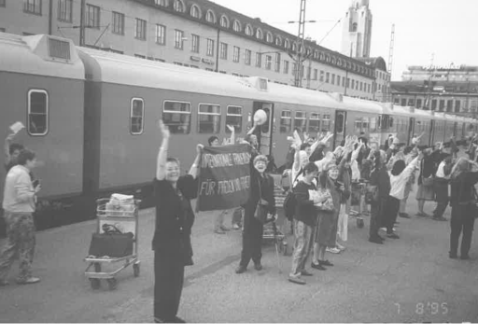
The history of WILPF began in 1915, with women crossing borders to advocate for peace, cooperation, justice and freedom. Eight decades later, in August 1995, we departed from Helsinki – after WILPF’s 80th Congress – on a journey to the World Conference on Women in Beijing.
The Peace Train traveled through Eastern Europe and Asia, crossing borders and passing through countries experiencing economic and social transition, as well as countries affected by conflicts and wars. Along the way, we met with women from Chechnya and the former Yugoslavia.
The unique experience of having a train to ourselves – one that we could shape around our feminist anti-war agenda, was inspiring and adventurous, compared to the usual serious, input providing mechanisms to UN Documents.
The Peace Train brought together women from diverse countries and backgrounds. How did this diversity shape the conversations, priorities and actions that emerged during the trip?
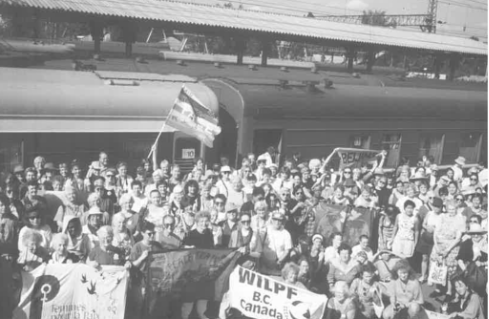
The participants came from all walks of life. Many were women who challenged systems of injustice and discrimination in their countries. They advocated for peaceful conflict resolution, educated for peace and human rights, and stood in solidarity against violence against women and for democratic structures.
We had participants from 42 countries, ranging in age from 18 to 86—223 women and 9 men, both WILPF and non-WILPF members. They lived and traveled together in a confined space for 22 days – a journey filled with surprises and even some conflict.
We had two empty train cars that we used for discussions, dancing, conflict resolution, and storytelling. Thematically, we covered issues like health and nuclear radiation, disarmament, and the redirection of military spending to improve women’s lives. We talked about eradicating racism, building alternative economies and promoting women in politics.
In what ways did the Peace Train experience influence the feminist and peace agendas at the Beijing Conference?
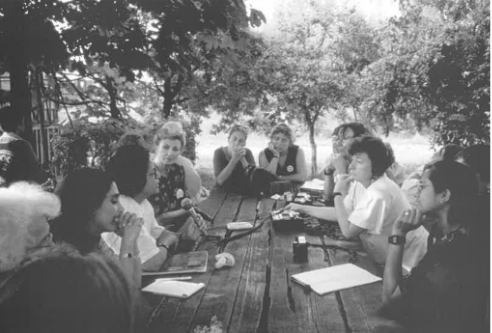
On our route to Beijing, the Peace Train stopped in St. Petersburg, Saratov, and Voronezh in Russia; Kiev and Odessa in Ukraine; Bucharest in Romania; Istanbul in Turkey; and Almaty in Kazakhstan. Sadly, a planned stop in Urumqi, China, was cancelled at the last moment.
At each stop, we held activities and roundtable discussions with local women’s organisations, parliamentarians and researchers. The themes were chosen by the local women and connected to the broader, global concerns we carried with us.
WILPF participants linked these themes to the inputs we prepared for the Beijing Platform for Action. We shared these insights widely and discussed them in the Peace Tent at the NGO Forum in Beijing itself.
Reflecting on the Peace Train’s significance today, how do you view its symbolism in a world where multilateralism is under threat and civil society spaces are shrinking?
We are seeing a sharp increase in authoritarianism, nationalism and racism, along with serious attacks on international institutions like the United Nations.
WILPF, with its ECOSOC consultative status and its offices in Geneva and New York, must continue to bring women’s peace demands to UN forums and strengthen the Women, Peace and Security agenda.
What lessons from that experience do you believe are most crucial for feminist peace activists today, especially as we confront growing militarisation, shrinking civil society and rising global inequality?
The Peace Train was a learning and sharing experience for everyone involved. WILPF has never claimed to offer a blueprint for change, but rather a way of interacting, thinking, and working that is dynamic, renewing, and ready to meet new challenges.
International solidarity is just as necessary today as it was 30 years ago. We must continue to work closely with organisations at the local, national and international levels. And we must stay convinced: peace is possible. War is not inevitable.
What Comes Next
Barbara’s reflections take us back to a moment of feminist organising that was bold, joyful and deeply political. The Peace Train brought people together across borders to stand for peace and justice – and that sense of collective purpose still resonates today.
As we look back through WILPF Then and Now, we are not only honouring that history, we’re also reconnecting with the organising tools, values and solidarity that carried us through. Because the struggles we face today demand that same clarity and courage.
That’s why we’re still calling to Move the Money, away from war and militarism, and toward care, climate, and justice. The Peace Train was about building momentum. Today, we need to build pressure.
→ Explore the WILPF Then and Now campaign
→ Take action with Move the Money


