111 years for peace. Will you help us reach 112?

The world spends €500,000 on the military every six seconds.

WILPF needs the same amount to keep its International Secretariat running in 2027. Without it, the team that connects our global movement will be reduced even further. Every gift counts, whether it’s €25 once or €5 a month. The world needs a feminist peace movement. Today, that movement needs you.

Celebrating Feminists’ Voices, Inspiring Global Peace

News
#Militainment #SmallArms #War

Sharing the knowledge: perspectives shared by experts during the “Militainment, the Arms Industry and the Marketing of #MilitarisedMasculinities, Weapons and War” meeting

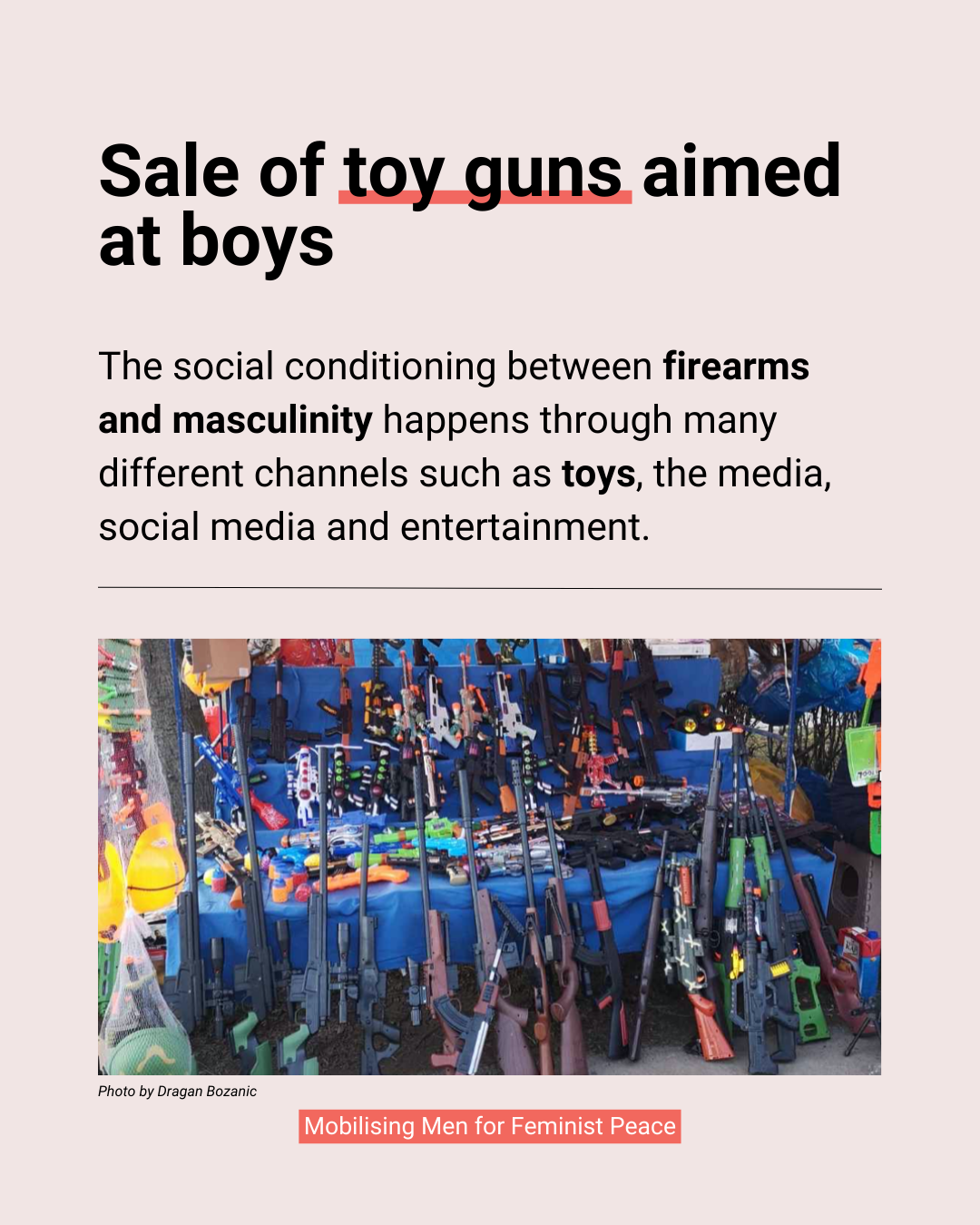
Last week, we co-convened an international meeting focused on understanding and developing strategies to counter practices used by militaries and the gun industry to promote militarisation, war, and the sale of weapons, especially those that exploit gender stereotypes and weaponise ideas about manhood and masculinities. The meeting delved into the gendered marketing tactics that glamorise militarised masculinities. 

Image credit: WILPF
WILPF International Secretariat
30 June 2024

Last week, we came together for an international meeting focused on understanding and developing strategies to counter practices used by militaries and the gun industry to promote militarisation, war, and the sale of weapons, especially those that exploit gender stereotypes and weaponise ideas about manhood and masculinities. 

The meeting which was co-convened by WILPF, Pathfinders for Peace, the Gender Equality Network for Small Arms Control (GENSAC), and the Small Arms Survey in Geneva brought critical voices in the field such as Nicole Hockley; the Co-Founder of Sandy Hook Promise whose son, Dylan, was killed, in the Sandy Hook school shooting in 2012, Jackson Katz; an activist-scholar known for creating a gender violence prevention and education program entitled ‘Mentors in Violence Prevention’, which is used by U.S. military and various sporting organizations, Dragan Bozanic; a sociologist with expertise in gender equality and gender and SALW (small arms and light weapons) and a member of the UN Secretary-General’s Network of Men Leader, Folade Mutota; the Executive Director and co-founder of the Women’s Institute for Alternative Development in the Trinidad and Tobago, Guy Feugap; a teacher and activist affiliated with WILPF Cameroon and the Africa Organizer for World BEYOND War, Claire Taylor from Gun Free South Africa and many other experts in the field.

Here are some thoughts shared by the experts:

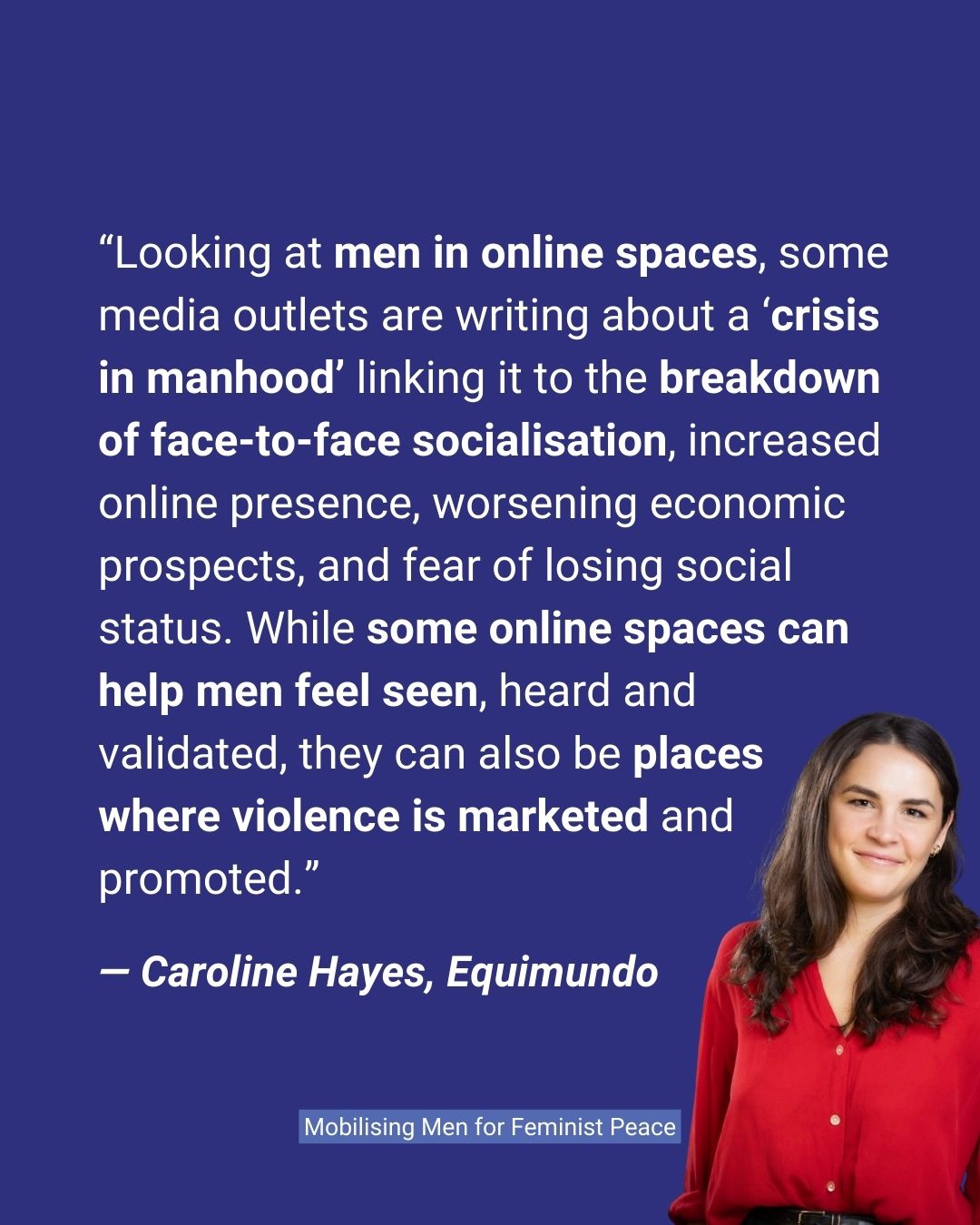
Caroline Hayes from Equimundo: Center for Masculinities and Social Justice said:
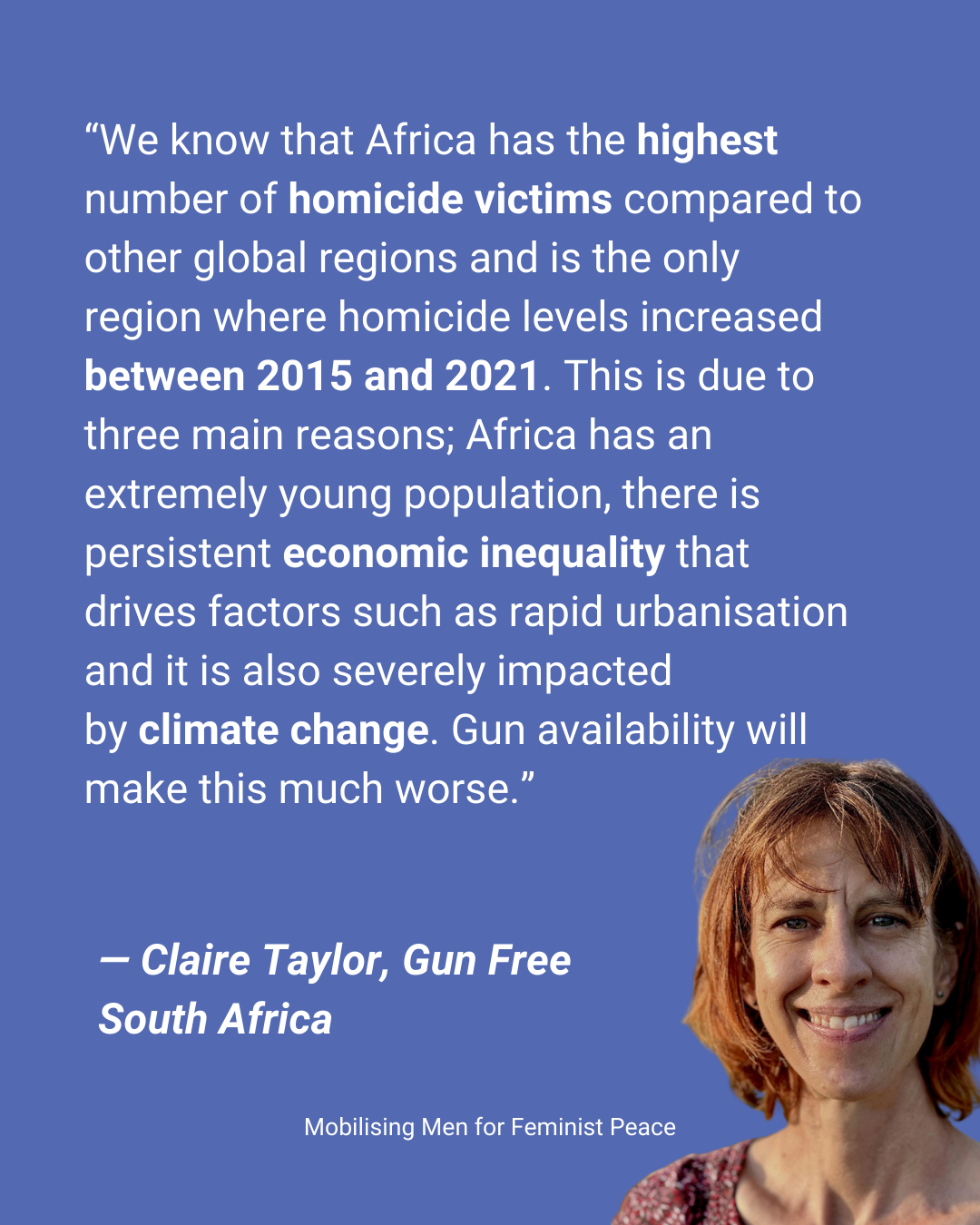
This is what Claire Taylor from Gun Free South Africa had to say:
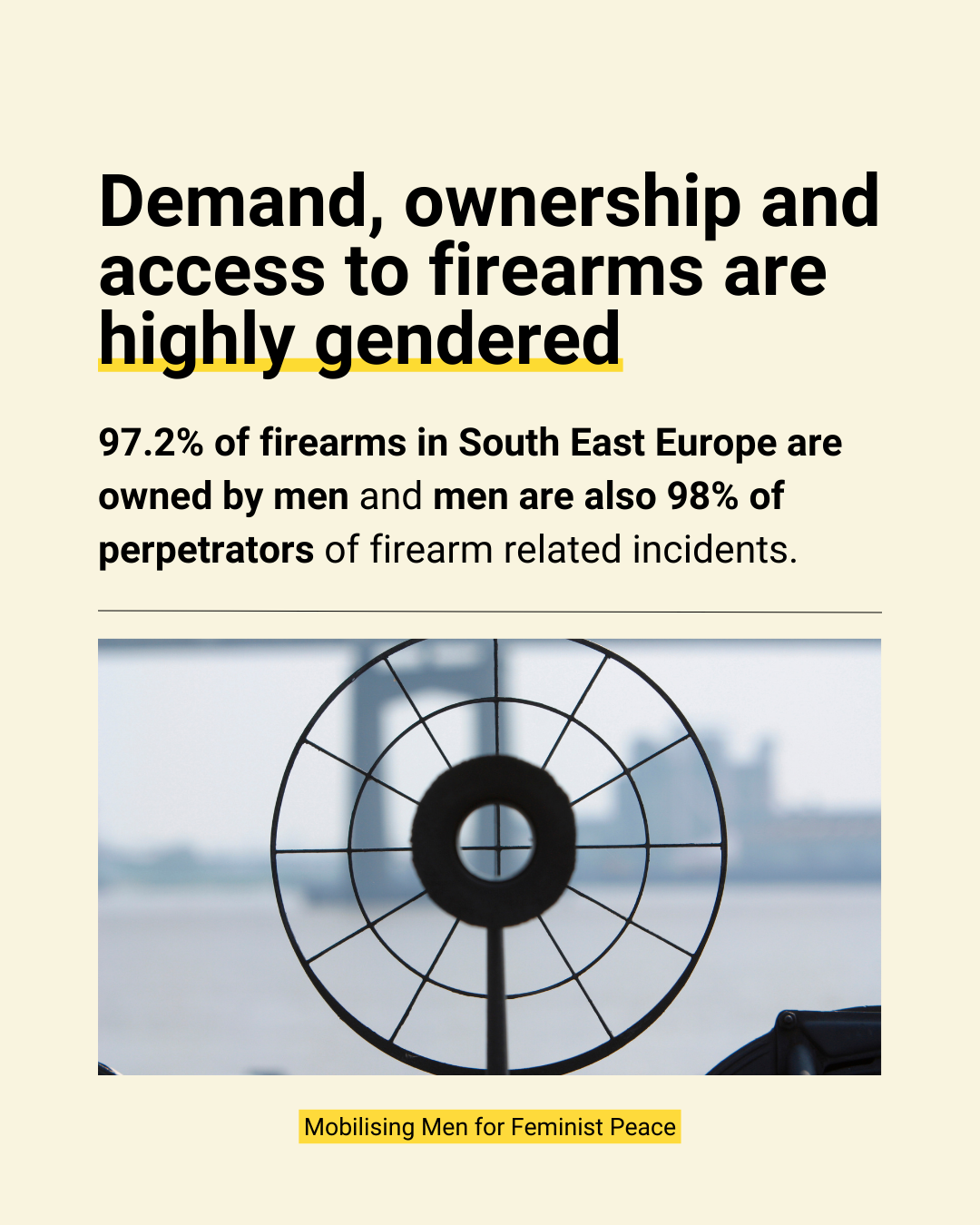
Here is what we’ve learned from Dragan Bozanic, an expert on gender norms and small arms proliferation in the Western Balkans.
Watch some of our interviews with the experts:


Callum Watson, the gender coordinator at the Small Arms Survey shared his thoughts on the importance of including new perspectives in the work on small arms.


Natália Pollachi, an expert on small arms with the Instituto Sou da Paz tells us how small arms are marketed to women in Brazil and refutes the arguments to link gun ownership with the safety of women.


Nicole Hockley, the Co-Founder and CEO of Sandy Hook Promise, one of America’s leading school safety organizations spoke to us about how Sandy Hook Promise came about after losing her son Dylan in the Sandy Hook school shooting and how she initiated a lawsuit against Remington, a large gun-maker at the time.


Ray Acheson, the director of WILPF’s disarmament programme, Reaching Critical Will (RCW) spoke to us on the manifestations of the gun culture in the United States.


Guy Feugap from WorldBeyondWar talks to us about the impact of arms proliferation in Cameroon.

All the other videos are available on WILPF’s knowledge hub: https://t.ly/Zz347.

Keep following our page for further information and content.

Share the post
A white dove is flying over a blue Venus symbol, which represents female gender. The background is transparent, highlighting the symbols in the foreground.
WILPF International Secretariat

WILPF International Secretariat, with offices in Geneva and New York, liaises with the International Board and the National Sections and Groups for the implementation of WILPF International Programme, resolutions and policies as adopted by the International Congress. Under the direction of the Secretary-General, the Secretariat also provides support in areas of advocacy, communications, and financial operations.

Mercy Osei Konadu

Mercy Osei Konadu

Africa Alternate Regional Representative

Mercy Osei-Konadu is a Gender, Rights and Development Practitioner, with experience in programme planning and management, policy advocacy and partnership development. Her career spans the United Nations, USAID, other Public and Private Institutions, and Civil Society, with expertise in gender equality, women’s empowerment, population and development, SRHRs, WPS, humanitarian response and sustainable development.  

Mercy holds a Bachelor’s Honours Degree from the Kwame Nkrumah University of Science and Technology (KNUST), Kumasi-Ghana, and a Master’s Degree in Development Studies from the University of East Anglia, Norwich, United Kingdom. She is a member of WILPF Ghana Section, WGWYPS Ghana network, and other civil society advocacy networks. She currently serves as the WILPF Africa Alternate Representative.  

Contact: mercy.osei@wilpf.org

Matt Mahmoudi

Matt Mahmoudi (he/him) is a lecturer, researcher, and organizer. He’s been leading the “Ban the Scan” campaign, Amnesty International’s research and advocacy efforts on banning facial recognition technologies and exposing their uses against racialized communities, from New York City to the occupied Palestinian territories.

Hanne Peterson

Hanne Peterson

Europe Alternate Regional Representative

Hanne Petersen is a feminist peacebuilder from Denmark with expertise on gender and law, legal pluralism, and legal cultures (esp. Greenland, China, Nordic Countries, Germany). She is a retired Professor (emerita) of Legal Cultures at the Faculty of Law, University of Copenhagen. Hanne has been a member of WILPF Denmark since 2003, increasing her activism since she retired 2024 on the national, regional, as well as international level within WILPF. She is an alternate board member of WILPF Denmark since 2022 and an executive committee member since 2024. She’s been active in regional initiatives and mobilisations since 2023. She currently serves as the Alternate European Regional Representative on WILPF’s International Board. Hanne grew up in post & cold world war Northern/ Western Germany (‘South Schleswig’) in the 1950s and 60s as part of the Danish minority.  

Contact: hanne.petersen@wilpf.org

Your donation isn’t just a financial transaction; it’s a step toward a more compassionate and equitable world. With your support, we’re poised to achieve lasting change that echoes through generations. Thank you!

Thank you!

Person with short dark hair, glasses, and a red and black patterned jumper stands with arms crossed against a plain white wall.

Diana María Salcedo López

VICE-PRESIDENT

Diana María Salcedo López is an anti-militarist feminist from Colombia. She has a solid track record spanning two decades incorporating gender and intersectional perspectives into public policy, advocating for victims of armed conflict, and consolidating territorial peacebuilding processes as an activist, but also consultant for NGOs, international cooperation agencies, the UN and government entities in Colombia. She is the director of WILPF’s national section in Colombia (LIMPAL Colombia), where she leads efforts on issues such as feminist approaches to the energy transition, the protection of women human rights defenders and the implementation of the Women, Peace, and Security agenda. She represents the organisation in the Special Women’s Body for Monitoring the Peace Agreement and in the Intersectoral Commission on Security Guarantees for Women Human Rights Defenders and Leaders in Colombia. Diana holds a degree in political science from the National University of Colombia, a master’s degree in Women’s, Gender, and Citizenship Studies from the University of Barcelona, and as well as in Human Rights, the Rule of Law, and Democratisation from the University of Alcalá de Henares in Madrid.

Contact: diana.salcedo@wilpf.org  

A woman with straight, light brown hair and glasses stands indoors by a window, wearing a blue shirt and black blazer. The background is softly blurred with buildings and trees visible outside.

Desirée Sterner

VICE-PRESIDENT

Desirée currently serves as President of the Swedish Section (IKFF), a role she has held since 2023. Her engagement with WILPF began at the grassroots level through the local branch in Lund/Malmö during her university years. Desirée brings a deep substantive understanding of WILPF’s core issues, rooted in academic training in gender, peace and security (LSE), war studies (Swedish Defense University), peace and conflict studies, and human rights (Lund University), combined with several years of practical advocacy, movement-building and organisational leadership work in Swedish civil society.  


Contact: desiree.sterner@wilpf.org  

A woman in traditional African attire stands against an orange background, wearing a patterned headwrap, white dress with colourful trim, layered necklaces, bracelets, and a blue ring, with her hand resting on her chin.

Sylvie Jacqueline Ndongmo

PRESIDENT

Sylvie Ndongmo is a Cameroonian peacebuilder, feminist leader, civil society actor and Women, Peace and Security expert with over 30 years of experience in peacebuilding, mediation, and gender equality advocacy. This is her second term serving as International President of WILPF. She is also the founder of WILPF Cameroon and Executive Secretary of Women Peace Initiatives. She coordinates the Women and Youth Early Warning Monitoring Room in Cameroon and was appointed to the African Union Advisory Panel on Democratic Elections and Governance in Africa. Her work focuses on advancing women’s leadership, conflict prevention, and sustainable peace through feminist, inclusive, and intergenerational approaches.   

Contact: sylvie.ndongmo@wilpf.org

WILPF Afghanistan

In response to the takeover of Afghanistan by the Taliban and its targeted attacks on civil society members, WILPF Afghanistan issued several statements calling on the international community to stand in solidarity with Afghan people and ensure that their rights be upheld, including access to aid. The Section also published 100 Untold Stories of War and Peace, a compilation of true stories that highlight the effects of war and militarisation on the region. 

IPB Congress Barcelona

WILPF Germany (+Young WILPF network), WILPF Spain and MENA Regional Representative

Lorem ipsum dolor sit amet, consectetur adipiscing elit. Mauris facilisis luctus rhoncus. Praesent eget tellus sit amet enim consectetur condimentum et vel ante. Nulla facilisi. Suspendisse et nunc sem. Vivamus ullamcorper vestibulum neque, a interdum nisl accumsan ac. Cras ut condimentum turpis. Vestibulum ante ipsum primis in faucibus orci luctus et ultrices posuere cubilia curae; Curabitur efficitur gravida ipsum, quis ultricies erat iaculis pellentesque. Nulla congue iaculis feugiat. Suspendisse euismod congue ultricies. Sed blandit neque in libero ultricies aliquam. Donec euismod eget diam vitae vehicula. Fusce hendrerit purus leo. Aenean malesuada, ante eu aliquet mollis, diam erat suscipit eros, in.

Demilitarisation

WILPF uses feminist analysis to argue that militarisation is a counter-productive and ill-conceived response to establishing security in the world. The more society becomes militarised, the more violence and injustice are likely to grow locally and worldwide.

Sixteen states are believed to have supplied weapons to Afghanistan from 2001 to 2020 with the US supplying 74 % of weapons, followed by Russia. Much of this equipment was left behind by the US military and is being used to inflate Taliban’s arsenal. WILPF is calling for better oversight on arms movement, for compensating affected Afghan people and for an end to all militarised systems.

Militarised masculinity

Mobilising men and boys around feminist peace has been one way of deconstructing and redefining masculinities. WILPF shares a feminist analysis on the links between militarism, masculinities, peace and security. We explore opportunities for strengthening activists’ action to build equal partnerships among women and men for gender equality.

WILPF has been working on challenging the prevailing notion of masculinity based on men’s physical and social superiority to, and dominance of, women in Afghanistan. It recognizes that these notions are not representative of all Afghan men, contrary to the publicly prevailing notion.

Feminist peace​

In WILPF’s view, any process towards establishing peace that has not been partly designed by women remains deficient. Beyond bringing perspectives that encapsulate the views of half of the society and unlike the men only designed processes, women’s true and meaningful participation allows the situation to improve.

In Afghanistan, WILPF has been demanding that women occupy the front seats at the negotiating tables. The experience of the past 20 has shown that women’s presence produces more sustainable solutions when they are empowered and enabled to play a role.