
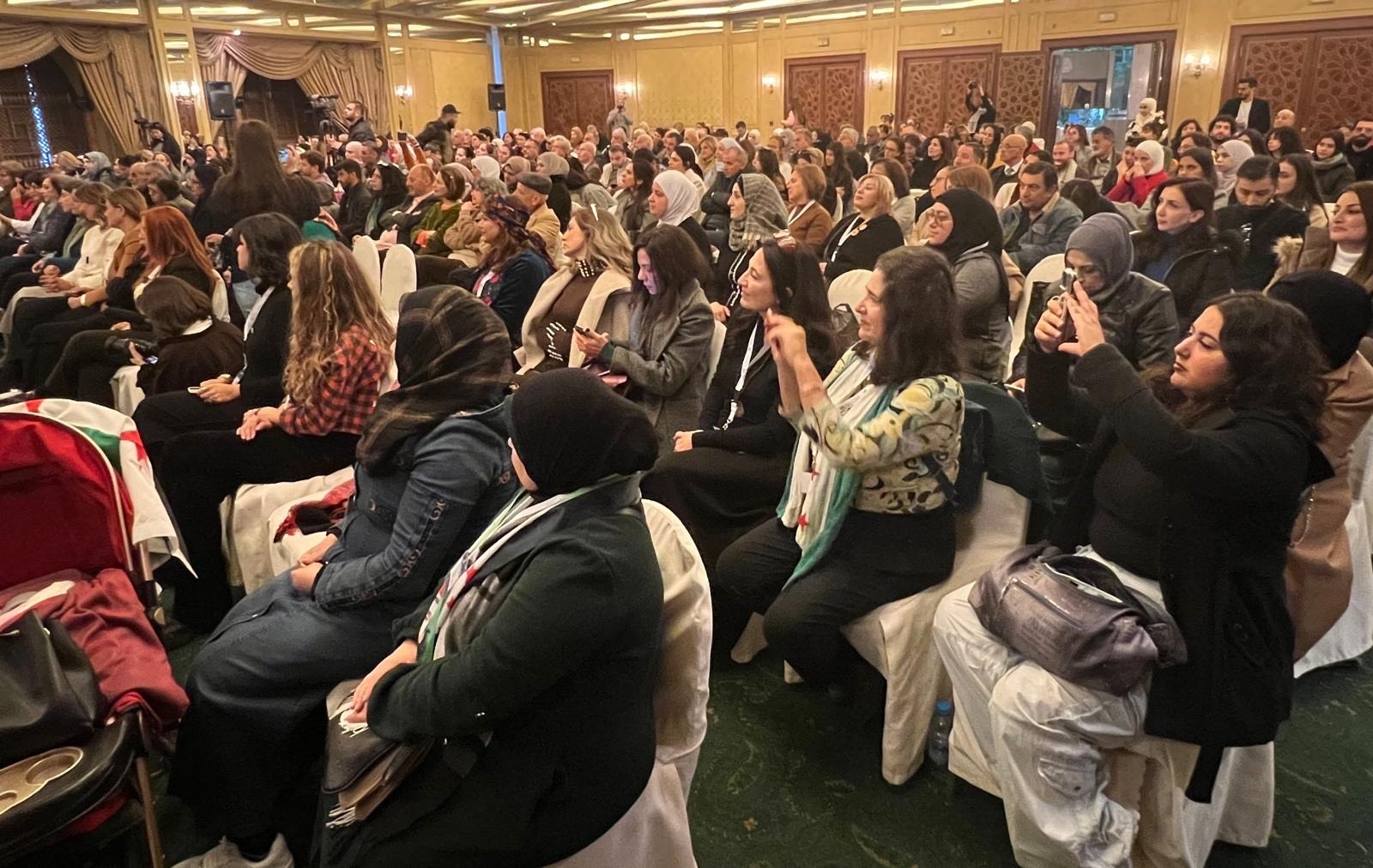
Almost a full year after the fall of the Assad regime in December 2024, the promises of inclusion and reform ring largely hollow for Syrian women. Despite widespread talk of “empowerment” and “equal participation,” women remain mostly excluded from meaningful decision-making, their visibility serving more to polish the regime’s image than to secure genuine rights or power.
The first transitional (indirect) elections, held on 5-6 October, 2025, made that painfully clear: only six women won seats in the 119-member parliament. Likewise, among the newly appointed government officials following the regime’s fall, women are scarcely visible. The scene is overwhelmingly masculine. The closer you look, the more convinced you become that women in Syria are rendered invisible, no matter how qualified or competent they may be.
Syrian women speak of the widening gap between rhetoric and reality – and how their participation is often reduced to unpaid “volunteering,” symbolic representation, or token gestures meant to whitewash the regime’s image rather than advance women’s rights. In the testimonies below, they describe what that looks like in Syria today.
| This analysis continues Alaa Al-Muhammad’s first homecoming dispatch for WILPF, “Coming Home: Women’s Leadership in Syria’s Transformative Transition” (30 April 2025), which captured the optimism and hope she found on return. This follow-up, written after months in Syria, documents the gap between images of inclusion and the reality of exclusion. |
Token Representation and Absence from Decision-Making
Initially, expectations for change, openness, and equity ran high in the post-Assad period. Many hoped that a new political chapter would finally allow women to help rebuild the country on equal footing. Yet nearly a year in, women’s presence in Syrian government institutions remains far from genuine or influential. Beneath the surface of inclusivity and carefully staged imagery, deep social, political and economic structures continue to reproduce exclusion – conferring on women only symbolic or marginal roles that keep them away from real decision-making and policy influence.
The first transitional elections on 5-6 October, 2025, made this clear: women won six of 119 seats – just 4% – despite constituting 14% of 1,578 candidates. (Elections in Sweida, Hasakah and Raqqa were postponed, leaving 21 seats pending – unlikely to alter the overall outcome.) This level of representation is even lower than under Assad (10-13%), continuing a long decline from 12% in 2012 to 9.6% in 2024.
Against this backdrop, Syrian women continue to face numerous barriers limiting their access to employment opportunities in government institutions compared to men. These barriers are deeply rooted in social, cultural and political structures.
Yamama Obeid, a feminist activist and human rights defender, explains,
“The first of these barriers lies in traditional gender roles that confine women to the household, burdening them with caregiving responsibilities for children and the elderly – duties society deems non-negotiable.”
This, she adds, directly affects women’s ability to pursue professional careers or further education, especially in the context of early marriage and mounting domestic responsibilities.
Employment opportunities for women remain largely confined to certain sectors such as education, caregiving and healthcare, while many government departments remain virtually closed to them. This gendered segregation is particularly visible in sensitive areas such as border control or security institutions, where women are almost entirely absent.
According to Yamama,
“Security considerations play a major role in restricting women’s employment. They are usually excluded from positions that require work in remote areas or outside urban centers, and their roles are limited to jobs that are geographically close and socially aligned with traditional gender expectations – like teaching, caregiving or managing orphanages.”
Structural discrimination within state institutions further entrenches women’s exclusion from decision-making positions. Ministries of sovereignty remain exclusively male. Of 23 ministries, there is currently only one female minister. Even at lower decision-making levels, such as ministerial advisors, women are almost entirely absent. This institutional bias is reinforced by a social culture that reproduces hierarchies within families and communities.
Kinda Omaren, a recently appointed official at the Syrian Ministry of Emergency Affairs, shares,
“Women’s participation in government institutions is modest and varies across sectors. Although their presence is broader today in public affairs than in the past, when it comes to leadership roles or key executive positions, the gender gap becomes strikingly clear.”
She adds,
“Recruitment still often feels symbolic. There may be many women in these institutions, but they rarely get equal opportunities to take part in decision-making or shape public policy.”
Kinda also observes that while awareness of women’s inclusion is growing, representation remains weak and unequal. Many so-called “empowerment” initiatives focus more on projecting a progressive image than achieving meaningful change.
Meanwhile, surveillance, harassment and political exploitation have made public engagement even riskier for women than before. Several women’s rights activists have faced defamation campaigns and reputation attacks aimed at silencing them and driving them out of public life. This includes activists such as Farah Youssef and Alaa Amer, as well as several women who ran as candidates in the parliamentary elections. As a result, many women activists now choose silence over exposure, fearing threats, intimidation or the misuse of their names for political agendas.
One activist who prefers to remain anonymous recalls:
“I spoke openly about women’s issues during official meetings, using terms like democracy and political participation. I was later advised by a female government official to replace ‘political participation’ with ‘community development’ and to avoid using the word ‘democracy,’ claiming that society wouldn’t accept it.”
Today, Syrian women’s near absence from the political and legislative arena – despite their vital roles during the revolution, war and reconstruction – reflects the deep uncertainty and lack of trust that often characterise post-conflict societies.
Women’s Volunteering, Men’s Paid Employment
A further driver of Syrian women’s marginalisation and exclusion from public employment is that women are often seen as volunteers rather than professionals. Their contributions are viewed as supplementary rather than essential, and their volunteer work is often treated as an “extra service” that can be discarded at any time.
Describing an offer she received from a government-affiliated directorate, choosing not to reveal more details for safety reasons, Dalal says:
“They contacted me about a job, and once we discussed the details, I asked about the salary. Their response was that the work was voluntary and offered no financial compensation. Meanwhile, they contacted a male friend of mine and offered him a good salary for almost the same work.”
Similarly, Samira works long hours – often exceeding official hours – due to the nature of her job, which involves field visits and extensive follow-ups. Yet she receives no pay, while a male colleague earns a solid salary for occasional consultations.
The state’s refusal to recognise women as breadwinners – based on the assumption that Syrian families are supported by men – gives decision-makers a convenient excuse for workplace gender discrimination, whether intentional or not. This devaluation of women’s unpaid labor not only undermines their economic independence but also reinforces traditional gender roles that confine them to caregiving positions.
Meanwhile, according to UNHCR research, since the start of the Syrian conflict, around 19% of Syrian households have been headed by women. This reality underscores that women are, in fact, de facto breadwinners, despite persistent societal and institutional assumptions to the contrary.
Addressing this issue requires a collective, deliberate effort – one that recognises women’s contributions, compensates them fairly, and actively challenges the deep-rooted social norms that sustain gender inequality.
Beyond Tokenism
After months of working directly with government institutions, building relationships, and engaging in policy spaces, one thing became painfully clear: we remain invisible. And when women do appear, their presence often serves a single purpose – to make the authorities look progressive and inclusive. In reality, it’s little more than window dressing.
Since returning to Syria, I’ve continued my advocacy and training work with even greater energy, because I truly believe the country needs all our efforts. I began conducting workshops and was excited to receive more invitations to lead training sessions and organise events. Yet despite the growing number of initiatives under banners like “women’s empowerment” and “creating spaces for women,” much of this remains superficial and performative.
While women often handle the bulk of organisational and logistical work, men still dominate the spotlight – delivering keynote speeches, appearing in photos, and talking about “open spaces” and “support,” as if women’s participation were a privilege they graciously granted rather than a right.
Experience shows that many of these initiatives are designed less to empower women and more to signal openness – to project a liberal, secular, or feminist image that serves institutional or personal interests. Some projects exist merely to secure funding or media coverage, portraying a misleading picture to the outside world that women face no barriers, while their actual participation remains limited and tokenistic.
On 1 September, for instance, a meeting was held in Aleppo governorate with Syrian Minister of Information Hamza Mustafa and a group of journalists – but no female journalists were invited. In response, Aleppo’s women journalists issued a statement condemning their marginalisation and exclusion.
Unless women’s work and contributions are recognised as fundamental to state- and nation-building – and unless the structural barriers blocking their access to power are dismantled – their presence will remain decorative, serving as a PR tool for external consumption rather than a force for genuine change.
Real empowerment is not about slogans or token representation. It requires political will translated into fair policies, equal opportunities, and shared power – steps that would finally allow more than half of Syrian society to shape the country’s future alongside men.


