
Download the full edition in PDF
The Eleventh Review Conference of the Treaty on the Non-Proliferation of Nuclear Weapons (NPT), to be held 27 April to 22 May 2026, will be meeting at a time of global war. Over the past few years, tensions and outright armed conflict involving nuclear-armed states have increased. Attacks against nuclear facilities, threats to use nuclear weapons or to resume explosive nuclear testing, expansion and “upgrading” of nuclear arsenals, and nuclear weapon proliferation are all currently underway. Billions of dollars are being spent on nuclear weapons each year even as the global economy crumbles under the weight of unlawful, reckless wars that are catastrophically impacting the environment, human rights, the costs of food and fuel, and any remaining semblance of international law or global constraints on violence.
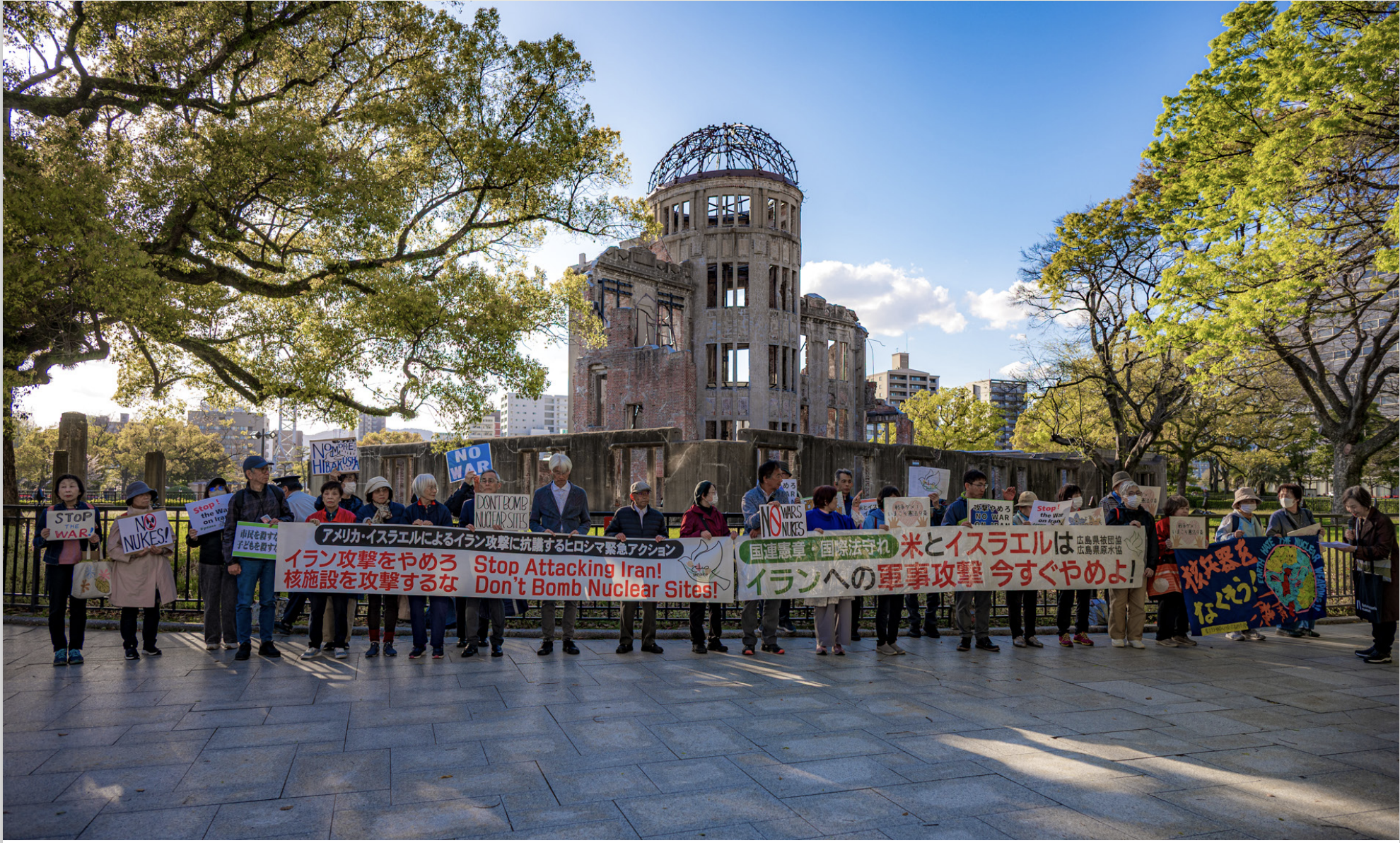
The unprecedented level of militarisation of the planet, led by the United States, has enabled the unfathomable violence we are all now experiencing. And in the midst of it all, nuclear risks are greater than ever. The last remaining nuclear arms control agreement between Russia and the United States has expired. China and France are expanding the size of their nuclear arsenals while India, Russia, the United Kingdom, the United States, and others are continuing with the modernisation of their nuclear weapons, facilities, and delivery systems. European countries are embarking upon new nuclear alliances, changing their nuclear doctrines, or suggesting they might acquire their own arsenals. Canada has announced it will supply nuclear-armed, non-NPT state party India with uranium. Israel and the US have been bombing Iranian nuclear facilities while also waging war, genocide, and imperial aggression against several other countries.
In short, none of the nuclear-armed or their nuclear-supportive allies appear to believe themselves to be bound by international law. Back in 2023, Poland asserted that the security of states cannot be diminished in the pursuit of the goals of the NPT. This is now apparently the dominant perspective of states that support nuclear weapons: they see international law as being out of line with their security interests. Law and multilateralism, which are meant to constrain violence, are being abandoned in the pursuit of imperial ambitions. The US government is unabashedly pursuing “Manifest Destiny” for the 21st century, recalling an era of violent expansion, colonialism and genocide and applying it to its modern day wars for oil and markets. Even those countries that have defended the so-called rules based order since the end of World War II seem to have given up on the pretense of justice or accountability. They appear to only be interested in the survival of their capitalist state systems, bound to the demands of the increasingly intertwined military-technology-industrial complexes and fossil fuel and extractive critical mineral industries.
The Review Cycle So Far
Within this broader context, this NPT review cycle does not bolster much hope for a successful Review Conference. The 2023 PrepCom could not agree to reference the Chair’s summary and recommendations in the procedural report. Iran, backed by Russia and Syria, blocked the summary from being tabled as a working paper or listed in the procedural reports list of documents because they felt it was biased against Iran and in favour of Western states’ positions. While the burial of a Chair’s summary was a new low point even for the NPT, the defence of the summary was disingenuous as well. The states expressing dismay at the rejection of this paper have killed much more meaningful outcomes from NPT meetings in the past.
The outcome of the 2024 PrepCom was slightly better—the Chair’s summary was listed as a working paper in the Committee’s procedural report, though Russia insisted on a footnote clarifying that the summary is not a consensus-based document. Still, stark divisions between nuclear and non-nuclear-armed states persisted throughout the meeting. On the final day, some delegations argued that the revised version of the summary added undue emphasis to positions that undermine nuclear disarmament and said the first version was a more accurate reflection of discussions. The nuclear-armed states, in contrast, seemed happy with the weight given to their positions in the revised text.
In 2025, the PrepCom did not adopt recommendations for the RevCon, nor did it adopt the Chair’s draft decision on strengthening the NPT review process. As has been the core problem throughout the last three NPT review cycles, the nuclear-armed states and their nuclear-complicit allies refuse to implement Article VI and the NPT’s core agenda of nuclear disarmament, and reject any text that holds them those obligations.
Amidst this grim context, some NPT states parties are still trying to do what they can to achieve something. At the 2024 PrepCom, some delegations and civil society groups pushed for peer-reviewed reporting mechanisms and interactive dialogues through which the nuclear-armed states would offer increased transparency about their arsenals. While some of the nuclear-armed states expressed openness to such initiatives, it is hard not to see their willingness to participate in transparency initiatives as a disingenuous way to distract from their failure to disarm. Moreover, not all nuclear-armed states are interested in these initiatives at all. Russia argued the suggestions for enhanced transparency are an attempt to “convert the NPT review process into a tool for oversight and coercion,” while China argued that standardised reporting “will strengthen the strategic superiority of some countries to the detriment of the security interests of others.” France, which was previously a proponent of increasing transparency, announced earlier this year that it would no longer be disclosing details about its nuclear arsenal or doctrine.
The Importance of Being Earnest
Many are wondering what is achievable at this RevCon—a reaffirmation of past commitments, or of even just the core principles of the Treaty? Will it possible for the nuclear-armed states to even acknowledge the past, let alone make commitments to achieve a better future?
It is essential for this RevCon to reaffirm past outcomes and commitments. It’s also important to agree to an action plan with concrete measures to implement the NPT, particularly Article VI, the implementation of which lags far behind that of the other Treaty’s other provisions.
In the pursuit of these goals, states parties and others participating in this work must be ambitious. Even in the midst of the horrors with which the world is embroiled, we cannot allow past failures or current instabilities hold us back from pursuing ambitious goals to make the world safer. History, and the memory of that history, show us what is possible, and what has changed. Even as the nuclear-armed states and their nuclear-supportive allies pursue dominance through violence, they cannot take away the changes that we have collectively achieved in terms of dismantling the narrative of nuclear deterrence, prohibiting nuclear weapons through international law, and raising the perspectives and voices of those previously marginalized in debates and those who have been most harmed by nuclear activities globally.
The antinuclear movement, made up of survivors, organisers, activists, academics, diplomats, and other government or international organisation officials, has been building a new world, a world free of nuclear weapons. The states that are addicted to the power they perceive from the bomb are pushing back, just as the far right in many countries is trying to push back against women’s liberation or LGBTQ+ rights or racial equality. Their work is reactionary, not visionary. They are not leading; they are trying to stop justice, accountability, peace, equality. While they might make some gains in their projects, and it might seem like they wield all the power, we need to remember that we created the conditions they are pushing back against. Amidst our despair, we must remember our role—as the ones who create change—and act accordingly. As author and activist Rebecca Solnit says, both optimism and pessimism “assume we know the future, and therefore nothing is required from us. I think the future is radically uncertain, and therefore much is required of us.”
[PDF] ()


