
Welcome to Mobilising Men for Feminist Peace, a podcast from WILPF, the Women’s International League for Peace and Freedom, in which we uncover the transformative power of feminist peace and explore how men can be active proponents of achieving gender equality and peace.
Show Notes
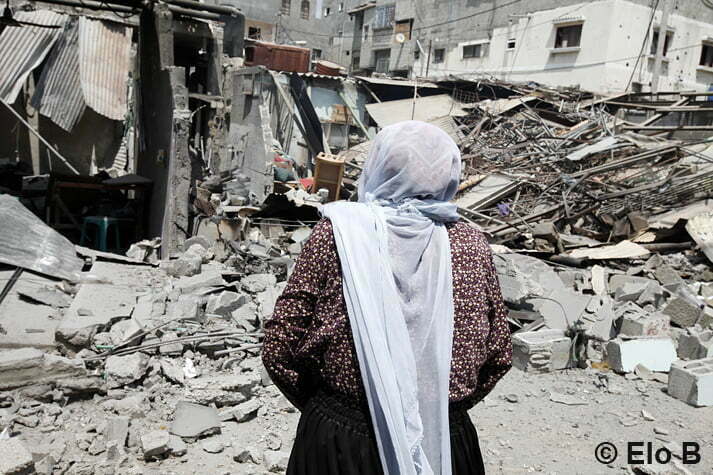
Despite the recent truce between Hamas and Israel, tensions still run high for residents of the Gaza strip. The tumultuous landscape, uncertainty and pending return of violence highlights just how urgent it is we find a lasting and sustainable solution to the Israeli-Palestinian conflict.
In this episode (Episode 1 of Season 1) we explore the 75 year history of the conflict, which has seen Palestinians fight for years for the right to exist safely on their land. We’re also joined by two special guests living on the frontline of the violence. Izz Al-jabari and Randa Siniora share powerful stories and insights, and examine the role of activism and feminism in the conflict.
Our guests are:
- Izz Al-jabari, activist and artist living in Hebron.
- Randa Siniora, Deputy Director General at Women’s Centre for Legal Aid and Counselling.
Sources
Our boys & men deserve to live, not just our women & children by Dr. Ayesha Khan
Palestinian men are also deserving of our grief by Defying Gender Roles
Q&A with Dalia Far: Let’s Talk About Palestine!
Episode full transcript
“You cannot imagine every day that we wake up afraid of being arrested, or afraid to be shot or killed. There are no words to describe what occupation and colonisation does for the human soul,” Izz Al-Jabari
Reem Abbas: [00:00:00] Tensions are rising as the conflict in Palestine and Israel continues to escalate. Deaths in Gaza have risen beyond 15,000, according to latest reports. In this urgent episode, we speak to two special guests living on the front line of this violence. Welcome to the Mobilizing Men for Feminist Peace podcast, where we journey into the intersection of masculinities, violence, and feminist solutions.
Thanks for joining us on our special episode in Palestine, where I’m joined by guest co-host Salma Kahale.
Salma Kahale: Today, we will talk about violence, masculinities, the feminist movement, and what happens when violence is sanctioned by the international community. Due to the urgency of this topic, we are releasing this episode to coincide with the launch of our podcast.
Reem Abbas: I am Reema Abbas, and I am the communications coordinator of the Mobilizing Men for Feminist Peace program [00:01:00] at the Women’s International League for Peace and Freedom.
Salma Kahale: And I am Salma Kahale, a Syrian feminist and social justice activist. I have worked on campaigns, programs, and advocacy on youth engagement, gender justice, and transitional justice for the last 20 years. I’m also the MENA Director at the Women’s International League for Peace and Freedom.
Reem Abbas: As we are recording, it’s the 29th of November. And the information in this episode is accurate as of today. We’re coming to an end of a four day pause in the fighting. And while we hope the pause is extended, today’s discussion illustrates why we need a more lasting and sustainable solution.
October 7th marked the most recent escalation of violence in Palestine and Israel. It has been 75 years since the Israeli Palestinian conflict began. What started as colonial powers [00:02:00] carving out a state for the Jewish population in British-ruled Palestine unleashed decades of a recurring nightmare for Palestinians.
Salma Kahale: Israel was created based on a promise made by British Lord Balfour in 1917 for the establishment of a national home for the Jewish people in Palestine. The British, who were in charge of Palestine following World War I slowly facilitated the transfer of the Jewish population to Palestine. The Zionist state of Israel was declared in 1948, also known as Nakba or the Catastrophe, with the ethnic cleansing of the Palestinians in parts of the land. Israel occupied the rest of historic Palestine in 1967, an occupation deemed illegal under international law. Palestinians have been fighting for the right to exist safely on their land for many years through armed resistance as well as through a long history of peaceful and non violent resistance.
Reem Abbas: They have also been subjected to violence [00:03:00] that is deadly and violence that doesn’t kill you but kills your hope and your wish to live. This is what Teju cole called Cold violence. He describes cold violence as when fathers and mothers listen to politicians on television calling for their extermination, putting the people into deep uncertainty about the fundamentals of life over decades and years is a form of cold violence through an accumulation of laws rather than by Military means, a particular misery is intensified and entrenched.
Salma Kahale: The people in Gaza have been living in a constant state of hot and cold violence, and this is why Gaza is often called an open air prison. Right now, over 2 million people are trapped in Gaza, fleeing from one area to another as Israel launches aerial bombardment and Ground attacks, which have so far led to the loss of over 15, 000 lives.
Reem Abbas: To discuss the situation [00:04:00] in Gaza and touch upon the larger context in Palestine, we are joined by two special guests, activist Izz Al-jabari, and Randa Siniora of the Women’s Center for Legal Aid and Counseling. So Izz, you’re an artist, you’re an activist, and you work on masculinities as well. Can you tell us more about yourself?
Izz Al-jabari: I’m based in Hebron, here in the West Bank, very near to Gaza. We are just 30 minutes far away from Gaza. And my age now is 33, and I am never, ever in my life visit or saw Gaza.
Reem Abbas: Thank you, Reza, and thank you for being with us today. Randa, you are a respected women’s rights advocate in Palestine. We want to learn more about you. Where did you grow up? And what continues to inspire your activism?
Randa Siniora: Thank you very much, Reem. I’m Randa, a feminist and human rights activist for almost [00:05:00] 38 years in human rights work. I’m born for a middle class family in Jerusalem, and I’ve grown up all my life in the occupied territory. I was only six years and a half when the occupation of the West Bank in 1967 took place. I was devoted all my life with passion to do my human rights work and feminist work. I’m a very strong believer in human rights and the feminist issues.
Salma Kahale: I mean, we have seen the pictures, the videos of Gaza, the news reports. Can you tell us what is unfolding there? Can you tell us a little bit more about the situation?
Randa Siniora: Actually, from the 7th of October, we were anticipating a catastrophic situation in Gaza, but not to that extent. You know, I cannot imagine that the world and humanity has abandoned the Palestinian people. At the level of decision makers and politicians, especially in the [00:06:00] Western countries where we are seeing the target of the Israeli military incursion on Gaza or the military attack, or simply the war on Gaza is not a symmetrical war, where the targets are mostly civilians and civilian objects such as hospitals, schools where the people have taken refuge.
Or the residential homes of the people and all that, you know, targeting the civilian population causing a lot of casualties with the bombardment through airstrikes on the Palestinian civilian population. We’re talking about almost three weeks of land operations that the Israeli military started. But with continuing airstrikes on a civilian population were over 1.5 million Palestinians have already became possibly displaced from their own homes with the demolition of over 45 to 50 percent complete demolition of the homes of the people, [00:07:00] which entails a catastrophic situation that will unfold very soon after – if we reach ceasefire, which we’re hoping that will happen yesterday not only today. And we’re talking here about Palestinian people being left without clean water to drink, without food and without fuel in order to run the hospitals and to run the normal life and also to purify the drinking water. This is in our opinion from the very beginning, from the first two days when the Israeli minister of defense, Galant said, these are human animals and they do not deserve to be provided with food, water, and so on, he was speaking about all the Palestinian people. And therefore we knew very well that this is going to be a war crime and a crime against humanity that is being committed against civilian population, causing casualties, mostly among children and women. Israel has enjoyed and continues to [00:08:00] enjoy a culture or an ongoing policy of impunity without anybody making Israel accountable for the war crimes and war crimes against humanity that is now taking place and being committed against the Palestinians.
From the first week of the war on Gaza, Israelis were negotiating with the neighboring countries, especially Egypt and Jordan about the idea of forcibly transferring the Palestinians out of the occupied territories, which we consider as ethnic cleansing, of course, it has been rejected, but every day we see that it’s only yesterday that it came again to the forefront and that the Israelis are still pushing for 200, 000 tents to be posted in the Egyptian land, in the Sinai Peninsula, close to regions on the areas inside Egyptian borders.
So what we are seeing is a situation that is really [00:09:00] catastrophic and genocide being committed against the Palestinian people, with all the international community being silent. Just to end on one positive note, we’ve also seen how the Palestinian support the of the right of the Palestine people to justice and freedom is being shown by many of the southern globe of the world and by the peoples of the world in the West and in even the United States and the Western countries that took the stand on the side of an occupying authority. But at the same time, we see the whole peoples of the world demonstrating and calling for a ceasefire and of the right of the Parisian people to self-determination and to do justice and freedom for a durable and just solution to the conflict.
Salma Kahale: There’s so much that is happening, there’s so much violence, there’s so many different kinds of violence and injustice that are happening in Gaza in particular. Are there things that are striking to you or you would like to [00:10:00] add to in terms of the violations that are happening in Gaza?
Izz Al-jabari: Thank you, dear. I think there are no words, uh, describe what’s happening now in Gazan or the occupied land of Palestine. The Israelis start a very systematic genocide against the Palestinians. It doesn’t start from the 7th of October. It accelerates from 7th of October. But I think it’s now from 75 years. The ethnic cleansing, the Palestinian, if we look at the history, if we look at everything that was the Israelian do, we will see it very clear, they genocide the Palestinian people. And actually it’s not just a genocide, also it’s Holocaust. If we look at the definition of Holocaust now. We will see it apply on the Palestinian case. Very clear. There are many pictures, many videos, many news [00:11:00] show very clearly what the Israelian do for the child, for the woman we receive a very horrible news from Gaza that what happened for the woman, what happened for a child, we saw all kind of horrible picture about babies being killed, child being cut their hand, their legs, their heads.
It’s awful. It’s everywhere. I think all the people around the world saw this picture. And until now, the thing that shook us the most that no one in the world react in a proper way. And they give even the Israelian and they support them to do this genocide. And always, I think, are the human beings learn something from the World War number one and the Second War?
Are we learn something from all the the catastrophic that happened in the world? And it’s shocking that the [00:12:00] Palestinian has no right that has no voices. And when the Israeli leader said there are animals a front all around the world, they make it clear. And the world even support them in this in a couple of days. And also, it’s not just happen in Gaza in the West Bank. This year’s was the most rough years that Israel and killed many Palestinian on the street. You cannot imagine what they do, how they cut the West Bank from each other, how they put barriers between all the city. And we now we are in cages. They locked us today. They lock down Hebron, all Hebron. They didn’t allow to anyone to get out of from the city before a couple of days, they killed and a very old man driving his taxi and he’s doesn’t subject the Israel and for any danger. They killed them in a very cold, the blood front, our office in Hebron for the [00:13:00] organization, the human rights organization I work with . So it’s violence all around us. We didn’t have the voice to speak. We didn’t have even the right to said we under genocide and Holocaust. And now we didn’t know where we going. The situation in Gaza get worse and worse and worse. What all the human agree upon in terms of a human rights, the Israeli threw it in the garbage. And they do whatever they want.
Randa Siniora: You know, maybe yesterday’s event is about invading the hospital is a very good example how the Israelis intelligence claim that the hostages were under the hospital and that there were passages towards Hamas militants under the hospital and that the hospital has been used for military purposes.
Now, after invading the hospital and seeing that the only battle they had was with the [00:14:00] children that were taken away from the incubators and from the ICU units because of the lack of electricity and that the people were all, you know, sick people who were with chronic diseases or injured persons that needed the best possible treatment under the current situation have been attacked.
The lies are showing up and it’s becoming much clearer to the world that even the events on the periphery of Gaza on the 7th of October, it was claimed that 40 children were beheaded. And then it turned out that this, that was not true. And they shut down the voices of some of the Israeli persons who were hostages with the Hamas who were in the periphery, who were saying that many of the people were killed when the clashes took place by friendly weapons. So it was said by Israeli media and with [00:15:00] the testimonies from Israeli eyewitnesses who were there and said that the bombardment was extremely high. And Haaretz came out yesterday with a whole interview with a woman called Mrs. Porat something who was one of the hostages who was saved in the bombardment and the clashes that took place. And therefore, it is very important to investigate and call on the Commission of Inquiry that was established by the Commission on Human Rights in 2021 to investigate all these incidents. So if anybody has committed war crimes, no matter who committed those war crimes, that there is a clear criteria for the rules of the war and who violated or who did not violate human rights or international humanitarian law or criminal law. So it is very important that we move from the situation where there are lies, quote unquote, [00:16:00] being made by the Israelis against the Palestinians. At the same time, they are conducting operations that are not dismantling the Hamas as a militant group in the Gaza Strip, but they are attacking the Palestinians and their homes, their schools, the churches, the mosques, everywhere, even when they were going through what the Israelis claimed were safe paths for the civilians, they were attacked, bombarded, and many casualties fell on the way to southern parts of the Gaza Strip. Not to mention that with this going on in parallel line, we’re seeing acceleration in the situation in the West Bank and in Jerusalem, which we can discuss if you want. But this is combined with the atrocities of our people in the Gaza Strip.
Reem Abbas: Thank you so much, Izz and Randa. You’ve brought up so many points about [00:17:00] how the violence is just in different places and how the propaganda works to kind of legitimize this violence. You’ve said that you feel that the international community is turning a blind eye or almost sanctioning this kind of violence. So right now, the violence on Gaza and on Palestinians is almost sanctioned, you know, by Israel and its allies under the banner, of course, of retaliation against Hamas. So how does this feed into the larger conversation within Palestine on resistance using arms versus, you know, nonviolent civic politics as a means of cementing your right to exist on your land. So how is this affecting the conversations that are now happening on the ground on the way to do resistance in Palestine?
Izz Al-jabari: There are many points to highlight it, but first the problem with the international community, they’re biased and they have double standard and they stand with a stronger for their benefit.[00:18:00]
We witness Europe sell weapons everywhere around the world for Africa, for Arab country, and they use this industry to control people. For us, the international community from long, long, long time ago, they do nothing for the Israeli and for all their crime, not just now, forever, from 75 years, they do nothing. We have different laws, uh, came from Geneva, came from UN, they didn’t apply it. They didn’t even force Israel to follow any law they invented. So the law, it’s against the weak people, not for the stronger people. And this is the bias that we saw from a long time ago. And now it was very clear. And the thing that shook us the most that even they apply this pressure on the human rights organization and they banned them [00:19:00] for speaking or publish any statement.
And they link all the event that happened to the 7th of October. They be a blind eye for all the crime that Israel do. And the reason for the 7th of October from the Israelian behavior and action in Palestine as an occupation. So this is the problem now. And for us, whatever that we said or speak or said, we with the resistance or we that we are not with the resistance, we are with peaceful solution or not. The people, they didn’t care, simply. They care with the one who has The power. And this, you know, we can speak this for the morning as diplomatic or as a low speech. But in reality, it’s a big lie. It’s a very big lie. And now people put the pressure in their [00:20:00] government in all Europe, but the government, they didn’t care. And even they start to arrest people. So the freedom of speech Even the bandit in the Western community, if they stand with the Palestinian, I think all the system need to be changed. The human being, they need to wake up and see the reality. They see they are living in a big lie, running by the people who is in power. European countries, they spend a lot of money all around the world to promote the idea of freedom, democracy, freedom of speech. But in the difficult time, they throw all this in the garbage, very simply. And they put blind eyes and they didn’t want to see the reality. And the reality, it’s out there. All the social media, if you open [00:21:00] Telegram or if you research more, you will find it, if you want.
Randa Siniora: I wanted to add to what my colleague said, which I agree with is that to me as a human rights defender, I still believe that the problem is with the powerful states and, perhaps our mistake as Palestinians always and human rights defenders focusing on the global North without giving attention to the global South and to the people. We were very much engaged in advocacy work that has been focused specifically on governments and parliamentarians. But now, to me, I learned a lesson that as a human rights defender, I have to go to my supporters from the people who could pressure their governments. While maybe we don’t see now the immediate impact of the people’s demonstrations and outrage in Europe and in the United States specifically.
I think it’s going [00:22:00] to backfire on those who are in power because at least they have elections and they won the votes of the people. So I think we should think of new strategies and a changing paradigm in how we look at issues more than losing our hope and confidence. In the importance of international human rights standards, which are not Western, and we are fighting all those our enemies at the national level when they were saying that we have Western agendas and Western, especially as feminists, we were always attacked because we are holding Western agendas. Although the international community appears that they have abandoned international human rights law and humanitarian law, I think we still cannot ignore the importance of these tools. In calling for respecting the legal obligations as well as their moral obligations under international law, we should not give them that carte blanche of doing whatever they want at ease in comfort. I [00:23:00] think we should continue insisting. That they have really taken double standards that made it more difficult for us to convince our own constituencies and the people we work with that international human rights law and legal means of resisting or peaceful means of resisting are much better than violent or armed conflict.
But now the people are like seeing that only if you are powerful in front of Israel, who is being supported by all these states, and you know, the only occupying power, in the world, who considers itself as a victim is Israel. I’ve never heard in history, and this is I’m quoting one of the Israeli journalists, who said we saw many, many occupations being violent, committing genocide, attacking people, attacking civilians, but an occupying power being violent, committing [00:24:00] genocide, ethnic cleansing, and at the same time claiming that they are the victim.
That history only started on the 7th of October and ignoring all these decades of Israeli military, military occupation, acquisition of other people’s land by by force, and then saying our right to self defense. Even in international law, being myself a human rights activist that have that background, I tell you it is, it’s not true that Israel has the right as an occupying power to self-defense.
And the result is that not Israel is retaliation against Hamas is the retaliation against the civilian population. International humanitarian law is very clear about the right of the people. The self-determination is very clear about the right to resist by all means, we always have been confident that maybe Oslo agreement at a two state solution will bring in [00:25:00] a solution. We ‘re over 30 years now with the Oslo Accords, and the interim period of five years have never ended. On the contrary, it allowed Israel to create more facts on the ground that are making it more even difficult now, especially in the West Bank and occupied East Jerusalem. We’re seeing a situation where even a peaceful means of boycott, the BDS movement is being attacked. Is it a militant movement? No, it’s not a militant movement. It’s a movement that started, not in Palestine, not in the occupied territory. It started in Europe. Now we are being attacked. We are labeled as a pro-BDS movement, boycott, divestment and the sanctions. Although these are very well established in chapter seven of the UN charter, the people, you know, imposing sanctions. And now if we, some [00:26:00] of the organizations are resorting either to the federal court in California to sue Biden and the American administration, some of the figures there, or to the ICC, the International Criminal Court, we are being considered that we’re bringing Israel or Israeli officials before international bodies.
We did not make them. They are mechanisms that we want to use. As human rights defenders, we believe we have to use all means in order to reach to a situation where we can pressure the international community for a just and durable solution. And me being as a peace builder and believing that I’m not going to carry weapons, I want to do my part.
I want to feel that my conscience is clear. That anything that we can do as human rights organizations, as feminist organizations, towards a just and durable solution and ending a prolonged military occupation is our duty to do. We cannot say we abandoned that, but the ordinary people, I tell you, [00:27:00] they lost confidence in a two state solution and peaceful means of resistance. They think that only, you know, the world doesn’t know gaps. If there’s a gap, somebody comes and fill in the gap. So the people think that we’ve seen brave people for the first time. I’m not defending and I cannot put myself in a situation where I say all what has been done was fair and right, but I speak the language of the Secretary General.
That it’s true that according to international humanitarian law, in all situations, you should not target civilians. And this is true, what my conviction is, but at the same time, when you speak about people who have been cornered under a military siege of over 16 years, where their lives were being controlled in the largest concentration camp ever in the world, you cannot expect 2 million people 2.3 million people to be [00:28:00] silent and not to resist and find a solution. I mean, the casualties among the people, the losses, I know for sure that over 4, 500 children have been killed. We know that around 1,500 are still under rubble. We’re talking about 30, 000 injured people that will have long term disabilities.
And this is still overburdening women specifically who are widowed, who would become the head of the households, who will have to manage homes with, without having homes, with no clean water, without sewage system, and to do the unpaid care duties that will overburden women even further after this catastrophic retaliation against the civilian population.
We use the word retaliation. Israel is retaliating against civilian population, innocent people that should be protected under the full Geneva Convention. And [00:29:00] therefore, the now the public opinion in Palestine is with pushing further by all means for a just and durable solution. But as human rights defenders, we strongly believe that we cannot resolve the problem and end occupation by military means.
We know that only a just one, not only bluffing us, deceiving us with another political solution that is not addressing the core issues of East Jerusalem, of water, of borders, of refugee right to return, and all of the issues that we consider a settlement and dismantling of settlements. We are not going to resolve the issue properly.
The Palestinians have the right to self-determination. They have the right to their homeland. We should not accept any kind of scenarios that Israel is speaking about of absorbing us in the Arab world. We are a nation. And we [00:30:00] have all the elements of a nation. Palestinians are a nation and they have been there existing prior to the advent of the state of Israel and we have the right to our homeland.
So we shouldn’t accept anything beyond our right to self-determination to our own state and for a just and durable solution. Otherwise, what happened, what’s happening in Gaza will be repeated again. And again, in Gaza and in the West Bank and in in in Jerusalem, it’s time for the world to understand that only now political solutions should come and from a powerful position of the rights of the Palestinian people for their own homeland. That’s what I believe.
Salma Kahale: It was really helpful how you laid out the humanitarian and human rights law in this regard, but also, you know, the moral, psychological, tactical, strategic issues in relation to resistance. And I think it’s also in this moment of disillusionment with all these [00:31:00] frameworks, it’s really helpful to separate the values, as you say, and say, we, these are our values as well, human rights are ours, and separate them from Western governments and Western powers and look at how we can reclaim them and how we can get power to make the changes, but not just by depending on or trying to convince Western governments. So I think it’s a really helpful also to think about not just the resistance in terms of violence, nonviolence, but all our work is including as human rights and feminist activists and the place of advocacy.
Also, I think we’re all really questioning how we do that work. I wanted to also pick up on a point that you have said and mentioned also on the gendered impact and to talk also about the gendered narrative in a way. In a recent article Dr. Aisha Khan, who’s a scientist who writes on social justice and decolonization, was writing about the [00:32:00] coverage in Gaza and she said the media selectively highlights women and children as helpless, docile, passive victims of an obscure humanitarian crisis or a nameless tragedy and the boys and men, however, are demonized as terrorists while their deaths, stories, and suffering are strategically erased to manufacture consent for genocide. And so I think really also thinking about resistance, thinking about, you know, All this narrative looking at the way in which civilians are gendered as women and children and, and thinking about then how Palestinian men in particular are demonized. I wonder how this impacts on the movement to resist occupation, but also how this impacts the violence that is happening on men and on the community at large.
Randa Siniora: Whether it’s covered by media or not, we’ve seen caring parents, both men and women. It [00:33:00] wasn’t only parents, you know, showing the care for the children. We’ve, we’ve seen journalists adding to their job, male journalists adding to their job, taking the children from the under the rubble or injured children. The situation now is showing how much we are as Palestinians in a solidarity situation and that we are very close to each other. The people have divided the bread among themselves, the clean water among themselves.
They were really very caring for their neighbors, for the people they didn’t know. Anywhere you go, you can find people to support you. And I’ve heard stories from my friends and from people that I know in Gaza, which are amazing. It shows how we stand with each other in such situations. And it’s not like only women who are doing that.
On the contrary, we’ve seen physicians, we’ve seen nurses, we’ve seen journalists, we’ve seen medical personnel, we’ve seen ordinary people. [00:34:00] Ordinary people, men and women, helping each other. So this stigmatization or dichotomy between men being pro terrorism and are militant, and women are not, it’s not like that.
It is, in my opinion, it’s not like that. And we have proven even, even we’ve seen examples by Hamas hostages coming up or prisoners who have been taken, Israelis, speaking about how they were treated properly. And we’ve seen also what the media doesn’t want to show it, that they’ve written on the mirrors or on the walls that Muslims do not kill women and girls.
I’m very concerned that only to look at women as only the victims and as receivers of humanitarian aid in the future. In my opinion, this is wrong. We’ve seen this a video with a woman who crossed Netzarim, which is the Israeli settlement in the periphery of Gaza, tried to bring the corpse of her, the body of her son, and he was [00:35:00] able to enter into Bnei Netzarim, hold her baby in a blanket and bring him after 10 days of being in the air as a corpse, you know, he was killed. And she said, if I were able to carry there were four other bodies there, I wish I was able to carry them and bring them back to me. We also saw a story of another woman who was like trying to make bread for all the people in the refugee camp and she said that we built this oven instead of queuing for bread, which we cannot find it because the bombardment was also the airstrikes were on bakeries. So the people tried to find means to do their own bread and she was doing it for everybody in the refugee camp, not only for her. And we saw the example. So now the future that we want to see is that women are part of the decision making process. Women are deciding what are the priorities and what are the needs. And not only receivers of humanitarian aid. And this is what happened actually in [00:36:00] previous military incursions on Gaza.
That women were only considered as victims and as receivers of humanitarian aid. And many times they have not taken their priorities and reconstruction into account. Because most of the property is in the hand of men. And when they started to rebuild the demolished homes, they only looked at the owners, and most of them are not women.
So with the death of the husband and the widowing of women, and the responsibilities of household women, over 2, 500 now, women became the main breadwinners of the family, raising the 11 percent of the women being the heads of the households to another 2 or 3 percent maybe. Because of the war, we are expecting a lot of priorities and needs that women are aware of because they are lacking and they should therefore not only be victims and receivers, [00:37:00] but also should contribute to decision making and to committees that will be developed. And this is what we will really work with the feminist organizations and women’s-led organization in Gaza in order to ensure that we do.
Salma Kahale: Looking at the way in which these gendered narratives impact not just on the, you know, the demonization of men and making them legitimate targets, but also takes away the agency of women and their ability to be leading, I would love your input on this and your perspective on how this narrative plays a role.
Izz Al-jabari: Exactly. I agree with you and with Randa. And from a long time ago, I believe in the same. I believe that when we distribute the gender and we said women and men and we play with the narrative, that it will achieve for me politic goals, not the human goals.
Because if we look at the human goals that we need [00:38:00] more understanding for the role of women and men and produce a better life for women and men. When we start to put the acceleration in one part and we try to set, okay, this here, it’s the problem in the masculine behavior or here or here, we didn’t give the right picture for the people from long time ago, I said, we need to understand the root of violence to understand how we can deal more appropriately with the gender narrative and to understand it more in all aspects, because, because not all the men, it’s powerful men. There are a very minority of people they have the power and the most of people, they didn’t have it, even men.
And they are targeted in all the war. Now, there are a lot of civilian here and in Gaza and the West Bank as a man, they subject to a huge violence just because they are a man. It’s make it worse [00:39:00] when produce the narrative of gender as the problem in some part.
For me to achieve justice, that to understand the humanity and understand the dynamic of power and deal with the dynamic of power, not deal with the gender narrative, I believe in the normal time human can have their philosophy about how they will deal with the human mechanism or the human narrative of gender. But in the time of war and killing people, we need to understand more where this coming from and how we can deal with it. Be united, men and women. And I think this also will reproduce, it’s not just during the war. After the war also will reproduce a lot of issues and a lot of problems. We need to change the structure, and I mean the structure, the philosophy that they rule the world [00:40:00] now, the system of the world, and this include also the system of a human rights organization and gender organization, because I work also with gender organization, and I see there are a gap.
There are a problem with dealing with the gender narrative. We need to understand it’s coming from where – it’s come after the second war. And the colonizing philosophy also that produce a lot of the situation that we are live under it. Even the philosophy of the gender, it’s very important for me to go to the root, understand it.
Randa Siniora: Although actually we cannot deny the fact that there is this dichotomy between the public and the private sphere. And the whole patriarchal structure is based on this idea of women confined to the private, to the traditional roles within the family and the [00:41:00] household while the men are within the public and political life.
So to reshuffle that or to change it also requires changing the people’s attitudes and the discourse that further emphasizes the traditional roles of women in the private and the roles of men in the public.
Reem Abbas: This is definitely a very interesting debate. And I want to go back to Izz on this because he has written and he has also expressed his opinion on contextualizing, basically, this conversation and the dynamics of manhood and masculinities.
So in your very beautiful message Izz , you said that once the skies over Gaza are free of the harbingers of death. and the land is no longer awash with the blood of the innocent, we can, with clear conscience, redirect our focus towards rebuilding the lives of the Palestinians through gender-responsive and psychosocial interventions.
And before I prob you on what you [00:42:00] mean here by gender responsive, I want to also bring in how working to challenge men’s norms about manhood should be linked and cannot be unlinked with the context of genocidal violence or systemic violence that is as directed against them and the communities that they’re part of. So in a way, how can we contextualize the work when we talk about masculinities, gender equality and so on? So I really, I would like to listen to you on that.
Izz Al-jabari: The answer it will be for me from longer time ago, I abandoned the political speech. Because in the political speech, you didn’t try to see all the human aspect and you focus about the result, the goals, and you focusing on many aspects, it doesn’t show the reality of the core of the issue.
And from a long time ago, what I said, The system that they created now, after the Second World [00:43:00] War, it’s continued to be a system that itself in their core, it’s a masculine system. Even this system creates human rights, but for me, it’s very clear, and when I mean the system, I mean the philosophy, and this system for me in itself has this, the power, the masculine power.
This masculine power, it can be used differently. Maybe sometimes they use it for both genders. They have power because we saw like an example, there are a lot of women fighting in the Israeli army, that a lot of women when I was traveling to Jerusalem, they stand on the checkpoint and they humiliate the Palestinian man.
And we saw it very clearly. I tried to look at the core of it, the core of the system and the problem of the power. And the most danger is the power itself and [00:44:00] the philosophy that support this power. Because now with the Israeli and they use the religion to make their crime, something normal and something legitimate. I always return not to a politic. I returned to human values. And I try to touch the human heart by saying, if we understand ourself, if we understand the pain that we come with it, as I am always said, like a lot of Israeli and Jewish came from a very painful place. After what happened for them in the Holocaust, and until now they not able to admit the pain they caused it for the people, for the Palestinians.
Until now, they cannot admit it, and they cannot look at their victims’ faces, because if they look at their victims’ faces, they will see their father and the [00:45:00] grandfather. We need to change the human behavior, even, regardless that the gender, we need to look about our action and we need to be honest with ourself and look at the values of a human being, not just to speak about politic, because all the system, if now I start to speak about system and logic aspect of gender narrative, I will not stop. But in the end it’s this, actually, the reality? It this, what it means to be a human being? Is this what it means, freedom and the human rights?
Salma Kahale: I am really enjoying this conversation because I mean, we’re coming here under very difficult circumstances, but also the way in this conversation, we have really picked apart, you know, looking at intersectional analysis and where we’re talking about, it’s not just about men, women, but also [00:46:00] talking about, we’re not just dealing with individual actions of men, but looking, you know, looking at root causes, looking at structures and systems.
I really think like there’s a lot to unpack here in terms of how we talk about masculinities, how we talk about justice, about freedom, what it means, and what that means beyond this liberal human rights system that individualizes it somewhat or this discourse that individualizes this behavior. I want to turn to Randa and ask you for your perspective.
I mean, we often talk about, that we can’t wait for gender liberation until the day after or we talk about, you know, there is the slogan, no liberated homeland without the liberation of women. It’s one of the quotes that we see in marches in Palestine. So I’m just wondering in this time with such violence and such intense brutality, [00:47:00] how do you see this question of the liberation of women and Palestinian women? And also, you know, how the feminist movement is working and positioning itself within the broader Palestinian liberation movement.
Randa Siniora: I think that what is feminist is also political. What is political is also personal. And therefore, we cannot, the issues are very much interrelated. I always believe that this is only an excuse that you have to relegate back or postpone gender equality till after liberation. And we’ve been seeing experiences in the world that If you don’t see the interrelated relationship between different factors and how they intersect with each other, you cannot understand and you cannot achieve much.
So, for example, I mean, always we look at the interrelated [00:48:00] relationship between patriarchy and colonial occupation. Even before the war on Gaza. Each one feeds into the other one and further exacerbates and creates multi-layered pressure or oppression on women. So therefore, we never have to say something could be postponed. And the feminist movement, of course, because the water we drink is political. And therefore, we can’t say, and everything is important, so we cannot If distance ourselves from what is happening, because even when you look at what is happening, we know how it is having a different gender impact on women and girls compared with other members of the society.
So having this analysis and the ability of working and keeping in mind our if you want to say the gender radar in front of our eyes, I strongly believe that it helps us to understand more how power relations are based, and it [00:49:00] doesn’t matter who is in power, but the suppression of the other who is not in power is going to be affected.
And therefore, understanding that interrelated relationship between what Israel is doing and the violence that is being inflicted on all the Palestinians and the genocides, and genocide acts and the ethnic cleansing that, that we face now is very much linked with the, the suppression of other rights and other freedoms, including women’s right to liberation and patriarchal structures, which are very enshrined in our own society.
So there is a very strong relationship, and I’m not a believer that you either do this or that. And this is only an excuse for those who are in power, and mostly men, who do not want to see gender equality being achieved.
Reem Abbas: I want to give you just two minutes to reflect on something that is very important. Randa, you live in the [00:50:00] West Bank, and as you live in Hebron, near Jerusalem and near Gaza. And I know a lot of people who are not familiar with the situation right now in Palestine believe that the violence is only in Gaza. So I just want you to quickly reflect on your constant battles where you live on a daily basis. How does it feel to constantly live on the front lines and what are the main daily struggles that you can share with us?
Randa Siniora: In the West Bank and including East Jerusalem? I’m a Jerusalemite. I live in Jerusalem. And actually, we have been witnessing a lot of settler violence lately. And again, settler violence is targeting everybody, you know, because the Israelis have even further armed the settlers and gave them even more weapons to attack all Palestinians in the occupied territory, not only that they’re residing on our land illegally and abusing our own resources, the most fertile land in Palestine, [00:51:00] water resources, and so on. They’re also attacking us, vandalizing and attacking people. Everybody is being affected, but because women are adjacent to agriculture land in adjacent to their own homes and mostly do not leave with the children, they are mostly affected.
Now, the restrictions of movement that are being imposed by the Israelis since the Israeli further imposed on the Palestinians with imposing more gates and every government is a little bit isolated from the other in the sense that moving from Ramallah to Jerusalem has been more complicated with closing checkpoints, putting new gates, controlling the life of the people to movement. We are very much isolated now in cantons that are separating us from each other. This is disrupting the daily life. There have been mass arrests. Over 2,500 Palestinians have been arrested, 80 percent of them with administrative detention, without [00:52:00] charges or trial. Only yesterday we heard of 15 women, young women from Hebron that have been arrested and we’re seeing a lot of restrictions and Israel is continuing with expropriation of land, of home demolitions, of arresting people, of vandalizing, you know, at checkpoints, young men, especially young men, but also young women are being searched and their mobiles being checked to see if they show any kind of solidarity or alliance with the war on Gaza beside Hamas or whatever. They passed a law that is being now implemented, even Palestinians inside Israel who have Israeli citizenship, have been controlled by the new law, they have been fired from their jobs.
Discrimination is being seen at all levels. So the situation, there are night raids, child arrests, all the problems that we face, excessive use of force, there [00:53:00] are over 200 persons killed by the Israeli military since the beginning of the 7th of October, the war on Gaza in the West Bank. And the Jerusalem area is very much restricted.
We have also women who have been, with chronic diseases, being treated in Palestinian hospitals in Jerusalem, that have been thrown out of the hospitals. And they are now in the different parts of the West Bank without their family, worried about their families in Gaza, or they were accompanying their children with chronic diseases in the West Bank, but are very badly treated. And they are intending to send them back to Gaza while the war is still going on and while Gaza is still under fire. So there’s a lot of problems, thousands of workers being arrested who were in Israel working legally when the events took place. Over 2,500, 3,000 were [00:54:00] arrested. They are being moved from one place only two days ago. They moved the prisoners nude, without their clothes on, and they were insulting them from one prison, from another prison near Ramallah to another place. So what we’re seeing in the West Bank is also trying to get hold of the, of the situation.
They’re attacking people, bombarding the Jenin refugee camp, Ain Shams refugee camp in Tulkarm, and continuing with their home demolitions. Only yesterday, they demolished a house in Ras Al-Amood which is near Jerusalem, in my family’s neighbourhood. You know, my parents’ neighborhood. So they are doing their job as normal. More restrictions on movement, more violence and insults on daily basis at checkpoints and for the younger generation and suppression of freedom of speech and opinion, definitely for everyone.
Reem Abbas: And Izz, let’s hear [00:55:00] from you. What is your daily life in Hebron?
Izz Al-jabari: Thank you, Randa. I think Randa speak with a lot of things. And for me, if I need to start to speak how the Palestinian live, I think I will not finish until tomorrow.
It’s a lot. And until now, even ourself as a Palestinian, we didn’t understand all the aspect that the Israeli occupation do for our body and soul. And this will take us for a long time to understand what they do for us. You cannot imagine every every day in these days that we woke up afraid of being get arrested or afraid to be get shot or killed.
All of this, it’s, it’s like a drop on the sea of what the Israeli occupation do. Even if I need to start how they cut the cities from each other a long [00:56:00] time, long time ago, I will not finish. But I will set like a very short story, conversation with a friend of mine. She not a believer. She didn’t believe in God.
And she didn’t believe in different lives. So, we open this discussion and I tell her, I prefer to believe there are another life for a human being. She looked at me and she said, no, I didn’t believe I will live this life. I have this moment of thinking and I tell her, If you live under an occupation, you will have to think about there are another life and for me again, I said it and maybe this will explain in a mysterious way what I feel maybe that I continue believe there are a different life. There are more justice and more good than this exist life, we live [00:57:00] under it. Because it’s, it’s horrible. There are no words to describe what occupation and colonization do for the human soul.
Randa Siniora: I want to say something small if I can, just simple things, based on what Izz was saying. You know, listening to some of the stories of a girl saying, I see my aunt crying, my mother who was killed by the Israeli bombardment. I want to find a place, a small place to mourn my mother. So she didn’t, she didn’t find a place to cry and mourn her mother. So we expect the losses that happened due to the Israeli atrocities against the Palestinian people will create a lot of psychological, psychosocial pressure that will l negatively impact the souls of the people in the Gaza Strip, and us. Because we feel like we need moments to go [00:58:00] back to our humanity. To mourn the people we lost, to think about how we will continue our life being under occupation. And therefore, the life that we want better is here, guys, in this land, because it’s our homeland. And we have to fight for it. And we shouldn’t lose the hope that we will be able to get our right, because we have justice on our side.
We should believe that a better life should be here, in this world. No matter if we believe in another life or not, it’s because we deserve a better life. This is what I want to end with.
Reem Abbas: I think no word is more powerful than that. And I just want to thank you so much for your time, for speaking out and for your voice, you know, which is right now one of the most precious things to have.
Thanks to Izz Al-jabari Jabari and Randa Siniora for joining us for this special and urgent episode.
Salma Kahale: Today we [00:59:00] learned that while we continue to believe in human rights and humanitarian law, we need to look at new ways and avenues to uphold these values. Engaging with movements and peoples across the world is a powerful and needed strategy to put pressure on the Israeli state to end occupation and apartheid.
Reem Abbas: That gendered narratives in the media erase stories of civilian male suffering in Palestine, while also portraying women as helpless victims with the same agency as children, palestinian women need to be included in decision making going forward, instead of being viewed as merely passive receivers of humanitarian aid.
Salma Kahale: And finally, we learned about the relationship between the patriarchy and colonialism and how they feed into one another, further oppressing women in occupied territories.
Reem Abbas: Thanks for listening. You can find all the resources for this podcast episode on our website and in the show [01:00:00] notes.
Salma Kahale: Did you know that the Women’s International League for Peace and Freedom also has other podcasts? Think and Resist : Conversations about Feminism and Peace is an exceptional podcast produced by WILPF’s Women, Peace and Security, and disarmament teams as they explore how feminism can redefine security.
We recommend you listen to episode three called, What About Masculinity and Militarism.
Reem Abbas: We also have an Arabic language podcast called Political Is Personal, produced by WILPF’s MENA Team, with feminists in the region. We recommend the latest episode, Unpacking the Root Causes of Violence and Conflict between Palestine, Yemen, and Syria.
If you would like to support the work of WILPF, consider reading our great publications and following our social media channels. I am Reem Abbas.
Salma Kahale: And I’m Salma Kahale. And you’ve been listening to Mobilizing men for Feminist Peace from WILPF. See you next time.[01:01:00]
OG PODCASTS: This podcast is produced by OG Podcasts. Find out more at ogpodcasts.co.uk


