
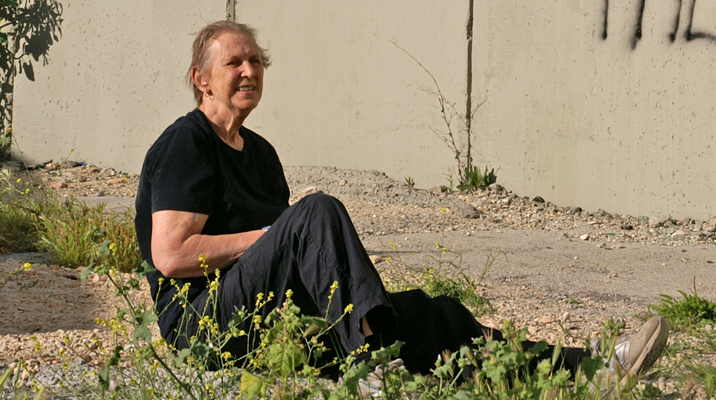
Cynthia Cockburn, our beloved WILPF member, the author of WILPF 2015 Manifesto, inspiring feminist, and peace activist, has passed away on 12 September 2019. In this obituary, published by The Guardian, Cynthia Cockburn is remembered for her incredible work as an advocate for peace and women’s rights.
Cynthia Cockburn Obituary
Academic, feminist and peace activist who explored the themes of masculinity and war, and gender and technology
Known for her research and activism in the field of gender, war and peace-making, Cynthia Cockburn, who has died aged 85, worked closely with female peace activists in countries experiencing acute conflict.
Her publications included The Space Between Us: Negotiating Gender and National Identities in Conflict (1999), based on research of women’s organisations working across ethno-national lines in Northern Ireland, Bosnia-Herzegovina and Israel/Palestine; The Line: Women, Partition and the Gender Order in Cyprus (2004); From Where We Stand: War, Women’s Activism and Feminist Analysis (2007); and Antimilitarism: The Political and Gender Dynamics of Peace Movements (2012), mainly featuring peace movements in South Korea, Japan, Spain, and the UK.
Cynthia involved the women she was studying, consulting them on the questions she asked and her interpretation of her findings. She sought to translate her theories about war, violence and peace into concrete campaigning.
Her argument that gender-as-we-know-it plays an important part in perpetuating war has practical implications for movements for demilitarisation, disarmament and peace. She argued that we need to make the shaping and reshaping of much of masculine culture a policy issue, since current prevailing masculine traits and types of behaviour often result in domestic, criminal and military violence.
Always eager to learn about the complexities of a situation, she wanted to find out what a feminist anti-militarist and peace position would look like in any given context. For example, in a time of anti-sanctions and antiwar activism in relation to Iraq in the 1990s, Cynthia and the wider Women in Black (WiB) network in London were among the few British-based activists who pointed not only to the terrible effects of economic sanctions on Iraqi society, particularly on women, but also to the effects of Saddam Hussein’s atrocities.
Cynthia’s feminist peace activism started at the Greenham Common women’s peace camp, which she visited between 1981 and 2000. In 1993, she was key to establishing WiB in London and was instrumental in sustaining it over decades as an organiser and participant in weekly vigils at the statue of Edith Cavell in Trafalgar Square. The political choir Raised Voices was another important part of Cynthia’s local political engagement. As well as singing in the choir, she wrote the lyrics to several of the songs that have made up its repertoire.
She was also closely connected to international peace activism through the Women’s International League for Peace and Freedom (WILPF) and the global network of WiB, and had recently started to write a history of WiB.
Born in Leicester, Cynthia was the daughter of Constance (nee King), a milliner’s assistant before her marriage, and Shirley Ellis, a sewing thread manufacturer. On leaving Malvern girls’ college (now Malvern St James school), where she was a boarder, Cynthia found work as a typist at the Home Office and moved in 1953 to London, a city that, she often stressed, changed her life.
Her last published book, Looking to London: Stories of War, Migration and Asylum (2017) was a tribute to the city she loved. It tells the story of female refugees who have sought a haven among the capital’s Kurdish, Somali, Tamil, Sudanese and Syrian communities.
Her early research interests ranged from local governance to the sexual division of labour. Her publications from this period included The Local State: Management of Cities and People (1977); Machinery of Dominance: Women, Men and Technical Know-How (1990); Brothers: Male Dominance and Technological Change (1991); In the Way of Women: Men’s Resistance to Sex Equality in Organizations (1991) and Gender and Technology in the Making (1993).
Cynthia’s joint work with Susan Omrod on the microwave oven, for example, contributed to the development of the field of gender and technology studies. Designed by men and marketed initially as a state-of-the-art technology for men without wives, the microwave attracted little interest when placed in the “brown goods” – TVs and hi-fis – leisure sections of shops, aimed at men. It flourished only once moved to the “white goods” – washing machines, ovens and fridges – catering for what were seen as women’s needs.
Despite never having attended university herself, Cynthia held several honorary degrees, including an honorary doctorate from the University of Lund (Sweden), a visiting chair in the Department of Sociology at City University London, and an honorary chair at the Centre for the Study of Women and Gender at the University of Warwick.
She contributed to the Guardian, Red Pepper, Feminist Review, Open Democracy and Peace News. Increasingly, photography had become an important aspect of her work, and her own pictures appear in all her recent books.
By sheer coincidence, I ended up renting a room in Cynthia’s house in Kentish Town, north London, in 1994 when starting a PhD on the Egyptian women’s rights movement at SOAS. Her home, buzzing with a constant flow of visitors from across the globe, was also a venue for organising local vigils and protests. Yet what impressed and inspired me most over the years, as we became close friends, was her profound commitment to social justice and her desire to put her feminist theory and politics into everyday practice.
She did much of the house maintenance herself and was good at carpentry; she built a pigeon loft on the roof. Cynthia loved nature and bird watching and knew more than 100 birds by song.
When she learned that her cancer was no longer treatable, she sought an assisted death at Dignitas in Switzerland.
She cared deeply about those around her, whether her many friends, or her family. In 1959 she married Charles Cockburn, an architect, and, even after they separated in the 70s and later divorced, they maintained a close friendship.
Cynthia is survived by their daughters, Claudia and Jess, and her granddaughters, Elsa Maria, Josie and Deniel.
• Cynthia Kay Cockburn, sociologist and peace activist, born 24 July 1934; died 12 September 2019
The obituary of Cynthia Cockburn was written by Nadje Al-Ali and published in The Guardian on 24 September 2019.
If you want to share a memory or some words about Cynthia, then email: info@wilpf.org and we will share your contribution below this text. Please write “Cynthia Cockburn” in the subject field.
Testimonials
“Cynthia shed feminist light, wove together feminist communities, sang songs of peace, listened, listened, listened, watched the birds – and stopped traffic. I’ll be forever and gratefully in her debt, the other ‘Cynthia’” – Cynthia Enloe
“I first met Cynthia at Women’s International League for Peace and Freedom (WILPF) and become close in pursuit for women’s rights. She was my professor for life and a strong figure who guided me to fight for women’s rights. Ever since, our journey took us on many roads fighting for women’s rights from the streets of London to the International Court of Justice in the Hague. She was a passionate woman who cared deeply about women around the world. I witnessed this first hand when she wrote about me in her book ‘Looking to London: Stories of War, Escape and Asylum’. She was selfless and cared about empowering those around her to have a voice. I will miss you my dear friend.” – Dahabo Ahmend
“What a huge loss for us all, for feminist activists and researchers across the globe who will miss her company, friendship and guidance, for the Women in Black who will miss her weekly presence and creative organizing, for her fellow choir singers in Raised Voices who will miss her song-writing and singing, for the birds who will miss her watching, for the trees who will miss her photographing and storytelling, and of course, for her daughters and grandchildren for whom she was such a loving and caring presence…
My memories of our time honoring and celebrating her life and work in Istanbul during the Gender and Peace Conference in May 2017, and then the magical two days in London in Fall 2017 that Nadje Al-Ali beautifully imagined and curated are so fresh! Thank you Nadje for bringing us all together — it was and is precious!
From Istanbul to Diyarbakır to Mardin to Habab to Bristol to London, I feel so privileged and grateful to have journeyed this life with Cynthia for more than 15 years. She will always have a very special place in my heart — and in my thinking on politics, militarism, peace, gender and life.
The night I learned of her passing, the gorgeous photo of a tree, with its reflections on water that Cynthia had given me as a gift a few years ago kept me company. She had such an eye for beauty, such grace, such generosity, such wisdom combined with such modesty and innocence… As she “listened, and listened, and listened” (to borrow from Cynthia Enloe) she would be the water reflecting the tree… All of her reflections were full of life, love, solidarity, hope and resilience — and beauty!
May these reflections continue to shine a loving light on us all” – Ayse Altinay
“With her groundbreaking research and writing through the years, feminist researcher, Women in Black activist, birdwatcher, and songwriter Cynthia Cockburn has paved the way for a whole new body of critical feminist scholarship on war and peace, introducing us to creative feminist struggles for peace and justice, from Bosnia to Ireland, from Okinawa to Cyprus, from Sierra Leone to Palestine. Cynthia’s comparative and intersectional lens has taught us that we would be missing a crucial part of human creativity and wisdom if we do not see the light that so many courageous people around the world are shining on to the darkest moments and acts of humanity, and that “gender” is crucial to understanding and moving beyond violence and war.” – The Sabanci University – Gender and Women Studies Center of Excellence
“She lived a long and productive life. I frequently read from her writings, and we will best honor her by letting her voice live and bring on her messages.” – Margrethe Tingstadt
“I knew Cynthia long before I joined WILPF, going back when I was still a student. She was not only inspirational and devoted to feminist politics, but also always showed her genuine care for those women who she worked with and those around her. She listened to what you say and engaged with you seriously, her attitude being open, friendly and welcoming, which never made you feel you’re nothing nor your ideas are unimportant. I, like many others really miss her.” – Maki Kimura
“I met Cynthia in 2000, in London, where I had gone to study a Master in Art, I was looking for accommodation, desperate, because what I had for my small budget was indecent and unacceptable, and she, surely for sorrow more than for another thing, she offered me a room. The house was beautiful. Two-storey, with garden and wooden floor, wide and thick planks. My room I remember had carpeting and a huge window. It was very spacious and I felt very happy there. A luxury for which Cynthia could have charged twice as much or more, because she was worth it, but according to her own words she shared her house so as not to be alone, so that the house would have life… And so for a year, Cynthia, Alide (the other woman who lived in her house) and I lived together and shared unforgettable. Little by little we became intimate and I discovered his passion: his work for/with/for others. She was an activist, feminist, devoted body and soul to the human collective: she sought peace, harmony, balance. I felt and I feel very fortunate to have met her, and I would have liked to have stayed with her much longer in London because for me, she was without a doubt the best example and encouragement I could have: I really liked talking to her, She was very observant, you always learned with her. I remember one time she scolded me because I had bought some sausages (cheapest, I’m sure) and she told me that this { staff{ couldn’t get into the house and that if I didn’t have money, she would buy me food.I also remember asking her to please lend me an oval mirror with wooden frame, to perform an action { up side down{ and, as it was a very precious object for her – a familiar-like souvenir}, showed reticence because it could damage it in transport… She finally paid for my cab and lent it to me. Or I remember also when she told me, excited and expectant, that she was going to modify the way of communicating via mobile SMS and that we would develop a new skill with the thumb. I’ve never met anyone more coherent. She acted as She thought. Both in the great actions of his life and in the small ones. That I tell you is a grain of wheat inside the silo of all the things and actions that Cynthia has been carrying out throughout her life. Later we met in Paris and in Madrid. It was a privilege for me to be with her again. I really admired her. I love you very much, Cynthia, wherever you are you will make it better, sure.” – Mara Regulión
“Cynthia fully embraced the role of an activist-academic (I think she would prefer that order). She was a brilliant scholar who made sure her research remained grounded in the lived realities of women. She played a critical role in so many of endeavours of WILPF, including drafting the Manifesto in a very inclusive (and challenging!) consultation process, making sure all voices were heard and taken seriously.She inspired so many of us and will be missed.” – Barbara Katarzyna Trojanowska


