
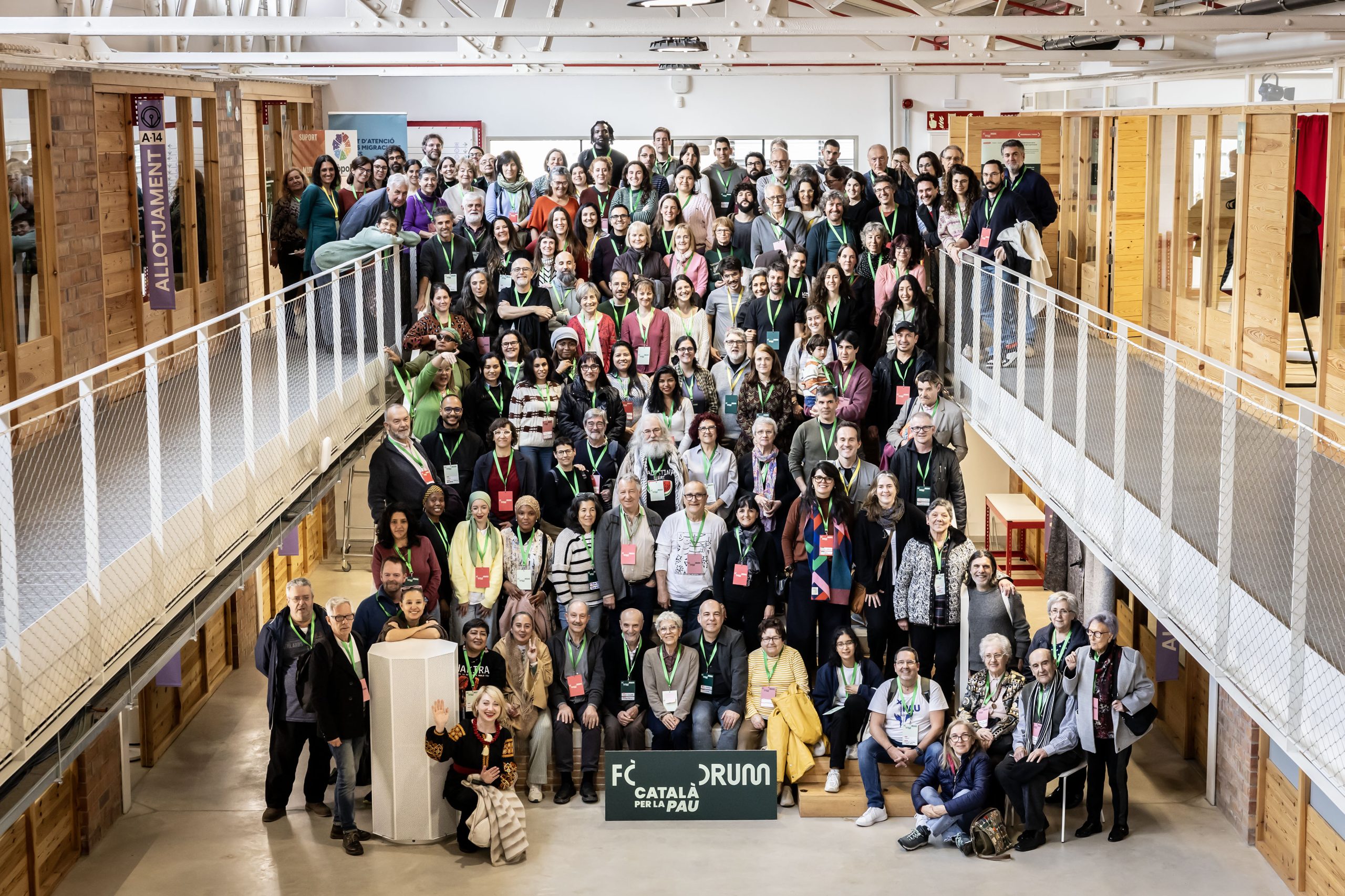
At WILPF, we’re committed to supporting bold voices and meaningful participation in peace processes, from local to global levels. This year, we were proud to see Paula Jou Fuster, an active member of the Young WILPF Network and WILPF Spain, take part in the Catalan Forum for Peace.
The Catalan Forum for Peace is a two‑year participatory process in Catalonia, designed to bring together citizens, civil society organisations and institutions to reflect, debate, and shape public policy for peace under the guiding theme “Less violence, more global justice”. It aims to co‑create the first public peace policy in Catalonia, the Pla Director País de Pau (Master Plan for a Country of Peace), and to strengthen the peace movement in the region through inclusive discussions on issues ranging from culture of peace and security and justice, to global challenges and women, peace and security.
In the following interview, Paula reflects on what this Forum was about, her role in leading the implementation unit of the Forum, and the insights she gained through her engagement. We also include questions for our Secretary General, who delivered a keynote speech at the event—highlighting WILPF’s broader vision for inclusive peace processes.
Paula, can you tell us what the Catalan Forum for Peace was about?
The Fòrum Català per la Pau is a participatory process launched in 2024 with two main objectives: first, to develop the first public policy for peace in Catalonia; and second, to strengthen the peace movement in the territory. The initiative brought together a diverse range of actors, including the Catalan government, civil society organisations, the Catalan Council for Peace, and the International Catalan Institute for Peace (ICIP).
Regarding the first objective, a participatory process was organised across different regions of Catalonia. More than 500 participants representing around 100 organisations contributed approximately 900 proposals for the policy. These proposals were discussed within five thematic areas: culture of peace; security and justice; conflicts, violence and peace; global threats to peace; and women, peace and security. The contributions were later systematised into a draft policy document that the Catalan Council for Peace (the government’s main advisory body on peace issues) submitted to the Catalan government. This document will serve as the starting point for the government to draft the final policy.
The second objective focused on strengthening civil society engagement around peace and bringing peace-related discussions to audiences beyond the traditional peace movement. This effort culminated in a final event held in Barcelona on 28 February 2025, which brought together people from both within and outside the peace movement for a space of collective reflection, dialogue, and future planning.
During the morning of the event, civil society organisations from across Catalonia organised eight workshops exploring different dimensions of the peace movement, from feminist and environmental perspectives to the role of new technologies in warfare, theatre-based reflections on contemporary conflicts, and youth voices in peace work. The day also included an opening session with the Catalan Minister for Foreign Affairs, the President of the Catalan Council for Peace, and WILPF’s Secretary-General, Dr Amrita Kapur, who participated as keynote speaker. In the afternoon, the programme shifted to a more institutional focus, with two roundtables discussing the government’s involvement in the process and reflecting on the Forum’s broader significance and next steps.
What was your role at the Forum? What made you want to take part?
I was involved in the Forum as a Project Officer within its implementation unit. In practical terms, this unit was responsible for supporting coordination and decision-making among the different stakeholders involved in the process, as well as implementing the collective decisions taken, both in relation to drafting the policy proposal and organising the final event.
My motivation for taking part in this initiative was both professional and personal. Professionally, the Forum represented an opportunity to contribute to a unique process aimed at strengthening the peace movement in my own territory. At the same time, as a member of a peace organisation such as WILPF, I felt strongly about supporting initiatives that try to address the structural causes of violence and conflict, particularly from a feminist antimilitarist approach.
In the current global context, where militarisation and conflict dynamics are intensifying, I believe it is particularly important to promote initiatives that attempt to influence these structures. The idea of developing a public peace policy in Catalonia, one that addresses internal inequalities while also shaping how the territory engages internationally, seemed a meaningful and worthwhile effort.
What was the most meaningful part of your experience?
One meaningful aspect was seeing the results of the participatory process translated into a concrete policy proposal. Watching hundreds of ideas and discussions gradually take shape into a policy framework gave a sense that collective efforts can eventually lead to tangible peacebuilding outcomes.
The final event itself was particularly powerful. More than 240 people participated throughout the day, including individuals who had never previously been involved in the peace movement. Reaching new audiences is often a major challenge for peace organisations, so seeing this level of engagement was encouraging.
The event also helped build momentum among peace organisations in Catalonia. Many of the groups present had never worked together before or even met in person. Seeing such a diverse group of people (activists, organisations, and institutions) come together around a shared commitment to working towards peace, each from their own perspectives and approaches, was genuinely inspiring.
How did being part of WILPF shape the way you approached the Forum?
Being a member of WILPF has progressively shaped how I understand peace work. The field has enormous transformative potential, both locally and globally, but it can also reproduce power dynamics, particularly when certain voices remain marginalised.
Approaching peace work from an intersectional feminist perspective means paying attention not only to outcomes but also to the processes through which decisions are made. In my role within the Forum’s implementation unit, where I was working with actors that were very diverse in nature and sometimes in their interests, this perspective encouraged me to prioritise inclusive participation whenever possible.
This meant, for example, trying to facilitate the involvement of youth, migrant and racialised voices, and ensuring that communication processes remained transparent and accessible for all actors. It also meant dedicating time to building trust with stakeholders and navigating differences constructively, something that is essential in complex multi-actor initiatives.
From a more personal angle, I also participated, in representation of WILPF Spain, in one of the participatory sessions focused on the theme of conflicts, violence and peace. During that session, I contributed proposals related to disarmament, particularly around supporting nuclear testing survivor communities and advocating for concrete steps for Spain to advance nuclear disarmament, including signing and ratifying the Treaty on the Prohibition of Nuclear Weapons.
What message would you give to other young people interested in peace activism?
Peace activism can take many forms and happen at many levels, from everyday actions to larger collective initiatives. In my view, any effort that contributes to building more just and peaceful societies is valuable, regardless of its scale.
I also believe that sustaining this kind of work requires community. Being part of networks that share your values, concerns and hopes, even if there are internal differences, is incredibly important. Working together, supporting each other, and building collective resilience becomes especially crucial at a time when spaces for peace activism are shrinking in many contexts and when this work is sometimes delegitimised or even criminalised.
For me, WILPF represents that kind of network.
Amrita, your speech at the Forum resonated with many. What key message did you want to share?
My key message was that this initiative is an important blueprint for envisioning the kind of policy framework needed to build a truly inclusive and peaceful society. Its inclusive and participatory process has organically identified key priorities that address the root causes of violence and conflict—an approach typically seen only in post-conflict settings.
At a time when the consequences of failing to address these root causes are threatening millions of lives around the world, this pioneering public peace policy offers a powerful opportunity to demonstrate why governments must rethink how they deliver peace and justice for their societies.
Why is it important to include young voices like Paula’s in peace processes?
Young people are inheriting a planet and global community that is more conflict-affected than at any time since World War II. We are deeply polarised, with the most marginalised experiencing extraordinary violence and crime committed with impunity, and we are facing existential climate threats.
Including young people’s perspectives is critical, not only to enable them to exercise agency in shaping the decisions that will define their future, but also to ensure that structural initiatives respond to the concerns and needs arising from new and evolving threats to safety, peace, and justice.
How can organisations like WILPF help shape public policy for peace at local and global levels?
Organisations like WILPF translate feminist analysis and grassroots experience into concrete policy proposals that influence national, regional, and multilateral decision-making. They bridge the local, national, regional, and global levels by supporting local actors to engage directly in policy processes, while amplifying the priorities of women and affected communities within decision-making fora.
Through sustained advocacy, coalition-building, and accountability work, they help ensure that peace policies are designed and implemented inclusively, in ways that address structural inequalities and advance justice.


