
Celebrating Feminists’ Voices, Inspiring Global Peace

Long read
#Environment

The Double Dividend: Eight Reasons Why the World Cannot Afford to Keep Choosing Bombs Over a Liveable Planet

As the First Conference on Transitioning Away from Fossil Fuels is underway in Santa Marta, Colombia, calls for climate action have never been more urgent. Yet governments continue to increase military spending – reaching a record US$2.88 trillion in 2025 – while claiming there is no money for a just transition away from fossil fuels – the root cause of the climate crisis. We are facing a crisis of priorities. In this article, we set out eight reasons why the world cannot afford to keep choosing bombs over a liveable planet – alongside the launch of our new paper, “The Double Dividend: How Reducing Military Spending Can Finance a Just Transition The Fossil Fuel Treaty as a Tool for Justice and Peace“. Published on the margins of this landmark conference and in support of the Global Days of Action Against Military Spending, this blog is a part of a growing call to “Demilitarise for climate justice.”

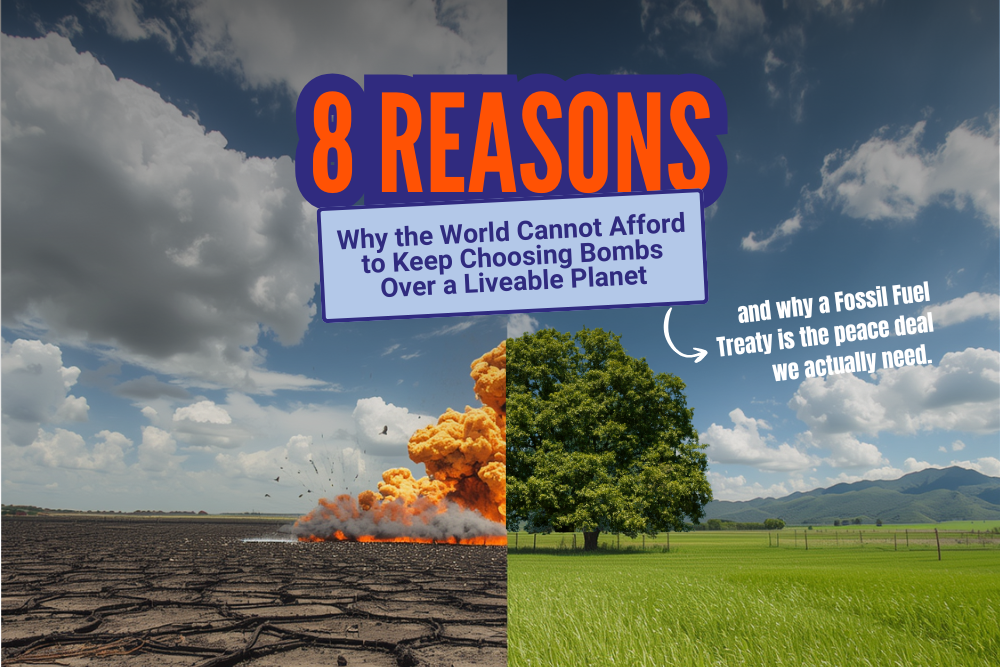
An image split in half: the left shows cracked, dry earth and an explosion; the right shows a green, grassy field with trees under a blue sky. Text reads, “8 reasons why the world cannot afford to keep choosing bombs over a liveable planet.”.
Image credit: WILPF
Mitzi Jonelle Tan and Katrin Geyer
28 April 2026
Table of Contents

Two perspectives that reflect the same global reality

I (Mitzi) grew up in the Philippines, a country that faces some of the world's most devastating climate impacts, yet has contributed less than half a percent of global greenhouse gas emissions. Every typhoon season, entire lives and livelihoods are lost and destroyed. Governments claim they have no resources available for countries like mine to deal with a crisis we have not caused, yet these same governments spent US$2.7 trillion on militaries in 2024. These militaries not only exacerbate the climate crisis, but in countries like the Philippines, are used to harass and threaten environmental defenders trying to protect land and nature. This is a choice being made, every year, at the direct expense of a livable future for people like the communities I come from.
A woman with long brown hair wearing glasses and a pink dress stands outdoors, smiling. She is accessorised with a pearl necklace and bracelets, and is surrounded by lush green foliage.
Mitzi Jonelle Tan
Gabriela Germany | Fossil Fuel Treaty Initiative
I (Katrin) work in international peace and climate justice advocacy. I live in the UK. I see the same choice play out, both where I live and in multilateral spaces. Last year, the UK government announced that it would reduce its development and climate spending to help fund an increase in military spending. This means that the UK is at its lowest level of ‘Official Development Assistance’ (ODA) since 1999. At the multilateral level, I see governments arrive at climate negotiations pleading poverty – while just weeks before, they had pledged to increase their military budgets to record highs. 
A woman with long, wavy blonde hair smiles at the camera. She is wearing a cream-coloured cable-knit vest over a striped shirt and a gold chain necklace, standing against a plain white background.
Katrin Geyer
WILPF

Together with the Fossil Fuel Treaty Initiative, the Women’s International League for Peace and Freedom (WILPF) has spent the past months researching what should be an obvious question:

Why is no one seriously asking whether the world's military budgets – which are growing at a pace that the UN Secretary-General himself has called alarming – could instead be financing the global just transition away from fossil fuels that the climate crisis demands so urgently?

WILPF’s new paper, The Double Dividend: How Reducing Military Spending Can Finance a Just Transition, makes the case that it can and it must. Published during the Global Days of Action Against Military Spending and during the First International Conference for a Transition Away from Fossil Fuels in Santa Marta, Colombia, this moment demands a shift in priorities. 

Here are 8 reasons why:

1. We are living through a crisis of priorities, not a crisis of resources

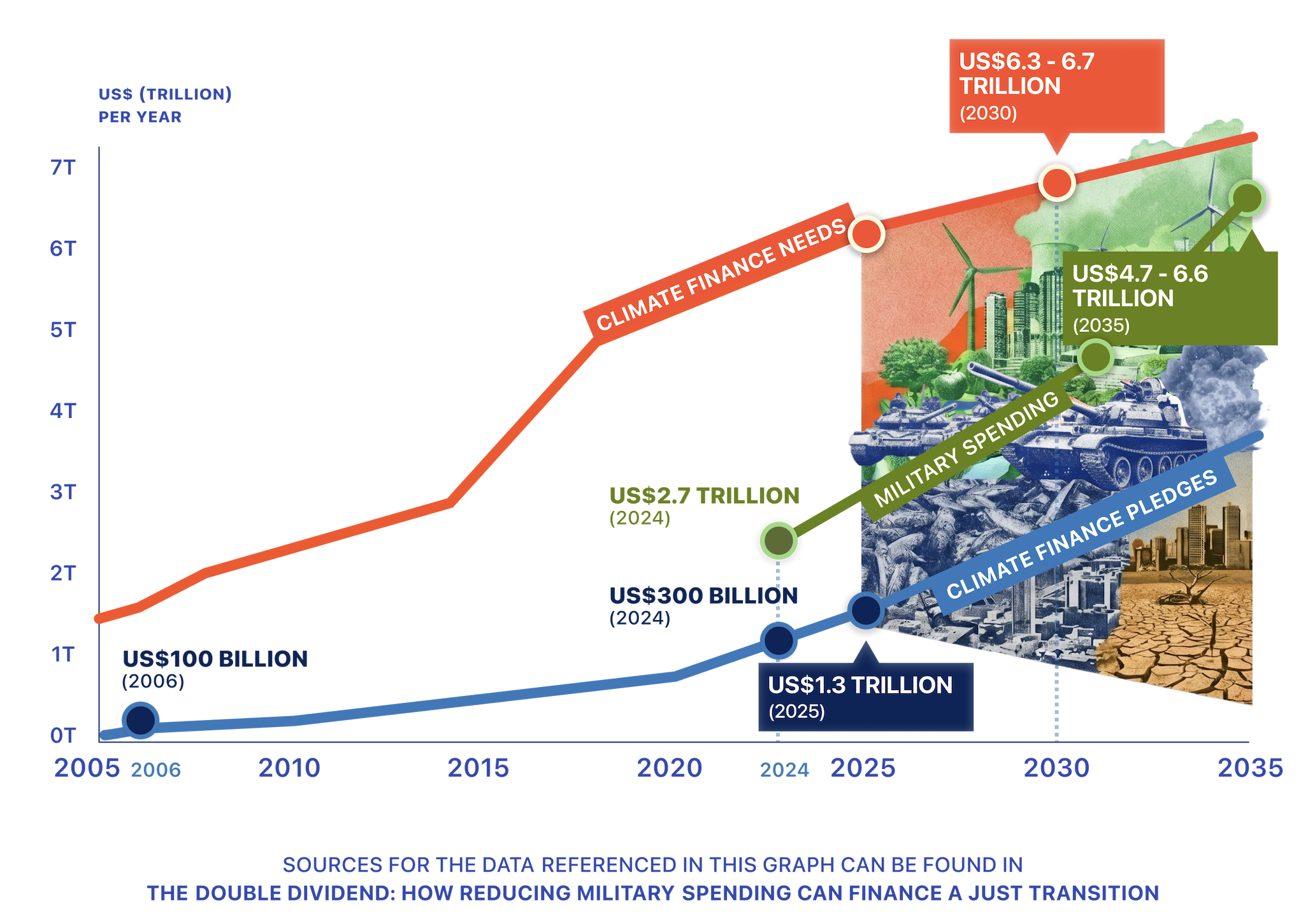
Line chart showing rising climate finance needs and climate finance pledges from 2005 to 2035, with military spending compared. Climate finance needs increase sharply, surpassing pledges; military spending remains higher.

The financing gap for a global just transition stands at trillions of dollars. Climate pledges to the most vulnerable nations remain chronically unmet. Nearly one-fifth of the Sustainable Development Goals have regressed below their 2015 baseline. 

And yet, governments collectively spent US$2.7 trillion on military expenditure in 2024 for the tenth consecutive year of increase.

The richest countries are spending 30 times as much on their armed forces as they are on climate finance for vulnerable nations. The money exists. This is a crisis of priorities and political will.
2. Military spending is one of the biggest – and most overlooked – drivers of the climate crisis

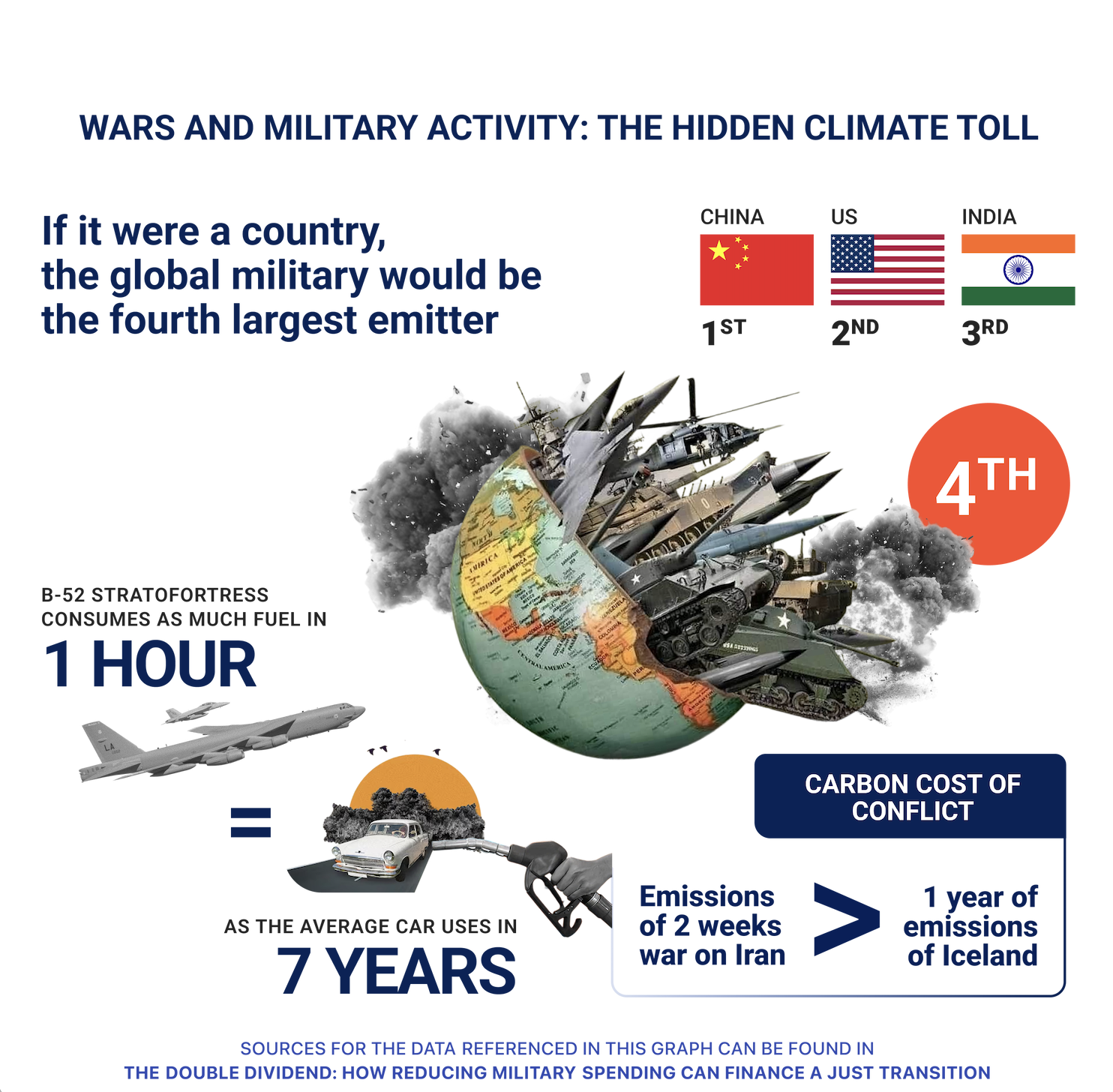
Infographic showing that the global military would rank as the fourth largest carbon emitter if it were a country. Includes images of war machines, emissions data, national flags, and comparisons of fuel consumption and carbon costs.

Fossil fuels are the lifeblood of modern militaries. If the world’s armed forces were ranked as a single country, they would be the fourth largest emitter on Earth – after China, the United States, and India. The top 20 military spenders are responsible for at least 10 billion metric tonnes of CO₂ equivalent of military-related emissions in the first quarter of this century alone. This is equivalent to the annual emissions of about 2 to 2.5 billion cars. That’s more cars than currently exist on Earth.

This data is almost certainly an undercount. States are not required to report their military emissions to the UN climate body, so most do not. The true figure, including military supply chains and arms manufacturing, could be three times higher. 

You cannot solve a climate crisis while systematically ignoring one of its biggest contributors.
3. Wars are climate catastrophes

Military emissions in “peacetime” are only part of the picture. Active conflict releases enormous and largely uncounted quantities of carbon, while destroying forests, contaminating soil and water and obliterating the infrastructure of communities already on the frontlines of climate breakdown.

The first two weeks of the recent US war on Iran released more carbon pollution than Iceland produces in an entire year. Four years of Russia’s war in Ukraine have generated an estimated 311 million tonnes of additional CO₂ – comparable to France’s annual emissions. The first 15 months of Israel’s assault on Gaza have produced a carbon footprint greater than the annual emissions of 36 individual countries.

4. Military spending is actively sabotaging the just transition

The impacts of militarisation on the just transition extend far beyond the competition for financial resources, though that competition is stark and consequential. Military priorities are now shaping the global critical minerals agenda, with NATO and several major governments designating minerals for military use as more “critical” than those needed for renewable energy infrastructure.

Military budgets are crowding out social spending including the care economy, healthcare and education. This disproportionately impacts women and marginalised communities, the very people most affected by the climate crisis and least responsible for it.

And the current procurement surge of fossil-fuel-dependent weapons systems – fighter jets that will still be operational in 2050, warships that run on bunker fuel – are locking in carbon emissions for decades to come. There is no credible pathway to “greening” militaries operating at current scale.

5. False climate solutions are receiving the funding that real ones need

Rather than redirecting military and public spending toward a genuine just transition, governments and the military-industrial complex are funding expensive, speculative and dangerous technologies. This includes carbon capture or geoengineering that entrench fossil fuel dependence and carry significant risks of human rights violations.

Solar geoengineering start-ups are raising venture capital backed by military intelligence firms. Carbon capture infrastructure is receiving billions in public subsidies while just transition finance for the Global South receives a fraction of one percent of available climate funds. These patterns are a continuation of the same extractive logic in a different uniform.

6. Reducing military spending is not a radical idea: it is a foundational UN pillar

For Mitzi, this is intensely personal. "We are not asking for charity. We are asking for the world to apply the principles it agreed to when it founded the United Nations."

Article 26 of the UN Charter tasks the Security Council with planning for the regulation of armaments, “with the least diversion for armaments of the world’s human and economic resources.” Since the 1960s, the General Assembly has repeatedly called for military spending reductions and the reallocation of savings to development. The current UN Secretary-General has named military expenditure reallocation as necessary for financing climate action. Article 2.1(c) of the Paris Agreement demands that military spending should be progressively reduced. 

Strong political will has long existed among the vast majority of UN member states, who – despite holding the majority vote – have been constrained by the refusal of a small minority of heavily militarised states to participate.

7. A growing and increasingly powerful coalition is demanding change

What gives us genuine hope is the movement that is building. Climate Action Network, representing over 1,900 civil society organisations, has made the disruption of militarism one of its strategic goals. The Women and Gender Constituency of the UNFCCC – representing hundreds of feminist organisations globally – has called for military expenditure to be redirected to climate finance. At COP30, Brazil’s President Lula declared that spending twice as much on weapons as on climate action is “paving the way for climate apocalypse.” Panama asked: if US$2.5 trillion to arm ourselves is not too much, why is US$1 trillion to save lives unreasonable?

For Katrin, working in international advocacy, this convergence represents something new: "I have spent years watching peace movements and climate movements talk past each other. What I am seeing now, at COPs, in civil society, in the news, in academic research, is a recognition that these are not separate crises. They are a result of the same system. The climate crisis and militarism are escalating because of a small group of hypercapitalist and heavily militarised countries.” 

8. The Fossil Fuel Treaty offers a concrete mechanism to make peace and climate justice happen

All of this analysis points toward a concrete proposal. The Fossil Fuel Treaty Initiative, now supported by 18 nations, thousands of health professionals, youth and climate activists, Indigenous leaders, and over a million individuals worldwide, is advocating for the negotiation of an international agreement to fairly manage the global phase-out of fossil fuels.

The proposed treaty’s just transition pillar includes a proposal for a Global Just Transition Fund. WILPF proposes that this Fund be financed in part by a reduction and reallocation of a percentage of member states’ annual military expenditure. It is a proposal that cannot be obstructed by a small number of heavily militarised states, but instead harnesses the political will of those countries that are serious about addressing the climate crisis and building a peaceful world for all. 

If we, as the global majority who want peace and climate justice, continue to hold the line, we can achieve the world we envision. The Fossil Fuel Treaty – built on a UN mandate, a global civil society movement and a growing coalition of serious countries – offers a path forward. 

In our struggle ahead, I, Katrin, will hold dearly the words of my colleagues and feminist peace activists Ray Acheson and Madeleine Rees of WILPF: “The leadership for an alternative future will not come from [the governments who produce and sell weapons]...They will have no alternative than to change when it becomes clear that the status quo is no longer tenable, when the tides have turned against their weapons and warfare, when other Governments have forged ahead with new plans, and when their own citizens demand redistribution of resources away from weaponised security to security based on human rights, justice and environmental sustainability.” 

A critical moment for action

The First International Conference for a Transition Away from Fossil Fuels is currently underway in Santa Marta, Colombia. It is the most significant opening in the global climate justice movement in a generation. We are calling on civil society everywhere to amplify our demands and for governments attending to table, seriously and specifically, the question of military expenditure reallocation as a financing mechanism for the just transition. 

Conclusion

To explore the full analysis and recommendations, read “The Double Dividend: How Reducing Military Spending Can Finance a Just Transition” — available at wilpf.org and fossilfueltreaty.org

If you would like to support this work, please consider making a donation to WILPF. Your support helps sustain feminist organising for peace and climate justice – work that is urgently needed now more than ever.

Share the post
The image shows the WILPF logo, featuring a dove carrying an olive branch over a female gender symbol, next to the Fossil Fuel Non-Proliferation Treaty logo with an orange globe and blue circular text.
Mitzi Jonelle Tan and Katrin Geyer

Mitzi Jonelle Tan is a climate justice activist and organizer from the Philippines. She is a youth organizer with the Fossil Fuel Treaty and a member of Gabriela Germany — an international chapter of Gabriela Philippines, an anti-imperialist Filipino women’s organization. 

Katrin Geyer is the Ecological Justice Programme Manager at the Women’s International League for Peace and Freedom (WILPF) and co-author of The Double Dividend.

Matt Mahmoudi

Matt Mahmoudi (he/him) is a lecturer, researcher, and organizer. He’s been leading the “Ban the Scan” campaign, Amnesty International’s research and advocacy efforts on banning facial recognition technologies and exposing their uses against racialized communities, from New York City to the occupied Palestinian territories.

Berit Aasen

Europe Alternate Regional Representative

Berit Aasen is a sociologist by training and has worked at the OsloMet Metropolitan University on Oslo. She has 40 years of experience in research and consultancy in development studies, including women, peace, and security, and in later years in asylum and refugee studies. Berit Aasen joined WILPF Norway five years ago. She is an alternate member of the National Board of WILPF Norway, and representing WILPF Norway in the UN Association of Norway, the Norwegian 1325 network and the Norwegian Women’s Lobby. Berit Aasen has been active in the WILPF European Liaison group and is committed to strengthening WILPF sections and membership both in Europe and relations across continents.

Your donation isn’t just a financial transaction; it’s a step toward a more compassionate and equitable world. With your support, we’re poised to achieve lasting change that echoes through generations. Thank you!

Thank you!

Melissa Torres

VICE-PRESIDENT

Prior to being elected Vice-President, Melissa Torres was the WILPF US International Board Member from 2015 to 2018. Melissa joined WILPF in 2011 when she was selected as a Delegate to the Commission on the Status of Women as part of the WILPF US’ Practicum in Advocacy Programme at the United Nations, which she later led. She holds a PhD in Social Work and is a professor and Global Health Scholar at Baylor College of Medicine and research lead at BCM Anti-Human Trafficking Program. Of Mexican descent and a native of the US/Mexico border, Melissa is mostly concerned with the protection of displaced Latinxs in the Americas. Her work includes training, research, and service provision with the American Red Cross, the National Human Trafficking Training and Technical Assistance Centre, and refugee resettlement programs in the U.S. Some of her goals as Vice-President are to highlight intersectionality and increase diversity by fostering inclusive spaces for mentorship and leadership. She also contributes to WILPF’s emerging work on the topic of displacement and migration.

Jamila Afghani

VICE-PRESIDENT

Jamila Afghani is the President of WILPF Afghanistan which she started in 2015. She is also an active member and founder of several organisations including the Noor Educational and Capacity Development Organisation (NECDO). Elected in 2018 as South Asia Regional Representative to WILPF’s International Board, WILPF benefits from Jamila’s work experience in education, migration, gender, including gender-based violence and democratic governance in post-conflict and transitional countries.

A woman in a blue, black, and white dress smiles radiantly in front of a leafy green background.

Sylvie Jacqueline Ndongmo

PRESIDENT

Sylvie Jacqueline NDONGMO is a human rights and peace leader with over 27 years experience including ten within WILPF. She has a multi-disciplinary background with a track record of multiple socio-economic development projects implemented to improve policies, practices and peace-oriented actions. Sylvie is the founder of WILPF Cameroon and was the Section’s president until 2022. She co-coordinated the African Working Group before her election as Africa Representative to WILPF’s International Board in 2018. A teacher by profession and an African Union Trainer in peace support operations, Sylvie has extensive experience advocating for the political and social rights of women in Africa and worldwide.

WILPF Afghanistan

In response to the takeover of Afghanistan by the Taliban and its targeted attacks on civil society members, WILPF Afghanistan issued several statements calling on the international community to stand in solidarity with Afghan people and ensure that their rights be upheld, including access to aid. The Section also published 100 Untold Stories of War and Peace, a compilation of true stories that highlight the effects of war and militarisation on the region. 

IPB Congress Barcelona

WILPF Germany (+Young WILPF network), WILPF Spain and MENA Regional Representative

Lorem ipsum dolor sit amet, consectetur adipiscing elit. Mauris facilisis luctus rhoncus. Praesent eget tellus sit amet enim consectetur condimentum et vel ante. Nulla facilisi. Suspendisse et nunc sem. Vivamus ullamcorper vestibulum neque, a interdum nisl accumsan ac. Cras ut condimentum turpis. Vestibulum ante ipsum primis in faucibus orci luctus et ultrices posuere cubilia curae; Curabitur efficitur gravida ipsum, quis ultricies erat iaculis pellentesque. Nulla congue iaculis feugiat. Suspendisse euismod congue ultricies. Sed blandit neque in libero ultricies aliquam. Donec euismod eget diam vitae vehicula. Fusce hendrerit purus leo. Aenean malesuada, ante eu aliquet mollis, diam erat suscipit eros, in.

Demilitarisation

WILPF uses feminist analysis to argue that militarisation is a counter-productive and ill-conceived response to establishing security in the world. The more society becomes militarised, the more violence and injustice are likely to grow locally and worldwide.

Sixteen states are believed to have supplied weapons to Afghanistan from 2001 to 2020 with the US supplying 74 % of weapons, followed by Russia. Much of this equipment was left behind by the US military and is being used to inflate Taliban’s arsenal. WILPF is calling for better oversight on arms movement, for compensating affected Afghan people and for an end to all militarised systems.

Militarised masculinity

Mobilising men and boys around feminist peace has been one way of deconstructing and redefining masculinities. WILPF shares a feminist analysis on the links between militarism, masculinities, peace and security. We explore opportunities for strengthening activists’ action to build equal partnerships among women and men for gender equality.

WILPF has been working on challenging the prevailing notion of masculinity based on men’s physical and social superiority to, and dominance of, women in Afghanistan. It recognizes that these notions are not representative of all Afghan men, contrary to the publicly prevailing notion.

Feminist peace​

In WILPF’s view, any process towards establishing peace that has not been partly designed by women remains deficient. Beyond bringing perspectives that encapsulate the views of half of the society and unlike the men only designed processes, women’s true and meaningful participation allows the situation to improve.

In Afghanistan, WILPF has been demanding that women occupy the front seats at the negotiating tables. The experience of the past 20 has shown that women’s presence produces more sustainable solutions when they are empowered and enabled to play a role.