Celebrating Feminists’ Voices, Inspiring Global Peace

UNSCR 1325: The Promise and Limitations of National Action Plans in Asia

19 January 2016

UN Security Council Resolution 1325 (UNSCR 1325) on women, peace and security is considered a landmark resolution, but its promise to transform women from victims to peacebuilders has not been realised in practice. WILPF and other civil society organisations have routinely called for clearer monitoring and evaluation of the resolution by the UN and its Member States.

In 2002, a Security Council Presidential Statement called on UN Member States to develop national level initiatives to help to implement UNSCR 1325. Globally, a number of donor states as well as countries emerging from extended periods of armed conflict have taken steps to develop National Action Plans (NAPs). WILPF’s Women, Peace and Security programme (PeaceWomen) actively monitors UNSCR 1325’s implementation and has traced the development of NAPs.

Initially driven by Northern European States, the tenth anniversary saw a spike in the development of NAPs globally, and the Philippines became the first Asian state to adopt such a plan in 2010 followed shortly after by Nepal in 2011. In 2014 the Republic of Korea (South Korea) adopted a NAP followed in 2015 by Afghanistan and Japan.

Given that many countries across Asia have experienced significant political upheaval and instability as a result of armed conflict, UNSCR 1325 is an important resolution for the region but it took a decade before the formal adoption of any national level initiative. Why hasn’t UNSCR 1325 had much traction in Asia?

Women, Peace and Security in Asia
Photo of market space
UNSCR 1325 is highly relevant to Asian contexts, but the resolution is met with resistance. Photo: Amy Barrow.

UNSCR 1325 is highly relevant to Asian contexts, but the resolution is met with resistance. Asia is incredibly diverse as a region, with multiple cultures, ethnicities and languages. Asia’s colonial history also heavily weighs on the region, with out-dated, colonial penal laws remaining on the books in many states. Several states have experienced sustained periods of armed conflict including Nepal and the Philippines. Territorial disputes in the South China Sea pose an ongoing risk to peace and security in the region. It remains to be seen how the recent election of Taiwan’s first female president Tsai Ing-wen will impact upon cross-strait relations between China and Taiwan.

Women continue to be deeply affected by armed conflict and its aftermath across the region. South Korean ‘comfort’ women who were engaged in sexual slavery during World War II have waited decades for a formal apology and compensation from the Japanese Government. More than half a century of repressive military rule and fighting in Myanmar’s ethnic peripheries has triggered mass migration of Karen refugees across the border to Thailand. Women combatants actively participated in the decade-long Maoist insurgency against the Nepalese government. How can UNSCR 1325 be effectively implemented in Asian contexts?

Asia is increasingly important as a region with the growing prominence of China and India in global affairs. Several countries including India, Nepal, Pakistan and the Philippines contribute a significant number of police and troops to international peacekeeping operations. But, unlike Europe or Africa, there is no region-wide human rights body.

The Association of South East Asian Nations (ASEAN) is the only recognisable international body, yet it operates differently to the European Union and relations between ASEAN Member States are based on the principles of consensus and non-interference. With no institutional momentum to drive forward national responses to UNSCR 1325, the resolution’s successful implementation is reliant on the political will of individual countries.

ASEAN’s ten Member States include Brunei, Cambodia, Indonesia, Laos, Malaysia, Myanmar, Philippines, Singapore, Thailand and Vietnam – many of which have a chequered human rights record. Although ASEAN has taken steps to tackle gender-based violence within South East Asia including human trafficking, to date only the Philippines has proactively taken steps to implement UNSCR 1325. Indonesia rejected the development of a NAP and instead adopted a Presidential Decree on the protection of women and children during civil conflict in 2014.

Asian National Action Plans
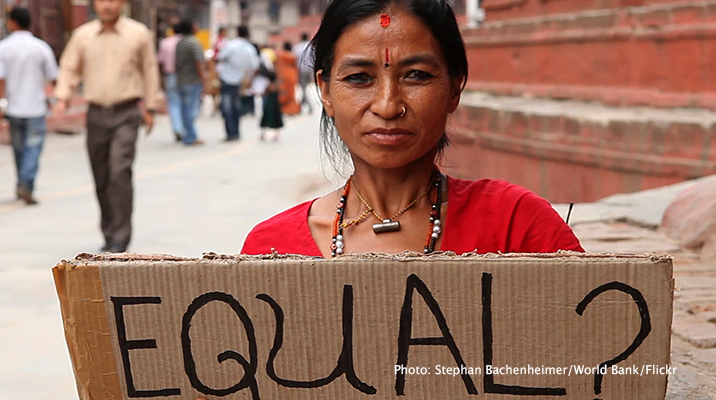
Photo of women holding a sign with the words "Equal"
The Government of Nepal launched its National Action Plan on the implementation of UN Security Council Resolutions 1325 and 1820 (NAP) in February 2011. The plan is the second plan of its kind in Asia, and it seeks to address women, peace and security issues in the post-conflict context of Nepal. Photo: Stephan Bachenheimer/World Bank/Flickr

Globally, the first generation of NAPs on Women, Peace and Security were adopted by donor states including Denmark and the UK and were ‘outward’ looking. These initiatives largely focused on participation in international peacekeeping operations and bilateral programmes with conflict countries. In contrast, both the Philippines and Nepal’s NAPs are ‘inward’ looking and context-specific.

The Philippines and Nepal’s NAPs broadly reflect UNSCR 1325’s three basic pillars of prevention, participation and protection, though each has several unique features. The Philippines includes small arms within the scope of the plan, recognising how a proliferation of small arms and a culture of gun violence in Filipino society may pose a potential threat to women’s peace and security. The Nepal plan recognises fourteen categories of conflict-affected women including single women (widows) and disabled women.

Importantly, each NAP includes indicators such as the number of women in peace negotiations or the number of women candidates in elections as one method of measuring women’s participation. For both the Philippines and Nepal, a lack of resources and underdevelopment pose serious challenges to the successful implementation of the NAPs. Nepal recognises that the support of donors will be important to put the plan into action.

South Korea launched its NAP in 2014 when it was a non-permanent member of the Security Council. Though the country is not actively engaged in armed conflict with North Korea (Democratic People’s Republic of Korea) tensions between sides continue. Given South Korea’s developed market and role as an international donor, the NAP is both ‘outward’ and ‘inward’ looking. Significantly, historical human rights violations are recognised, with the NAP including support services to women survivors of the ‘comfort system.’

Making UNSCR 1325 Relevant in Asian Contexts

UNSCR 1325 is highly relevant to Asian contexts, but the resolution is met with resistance. The slow rate of adoption of NAPs across the region may relate to reluctance on the part of Asian states to transplant universal norms into domestic contexts. Though ASEAN states, at least on paper, have all committed to CEDAW and have adopted resolutions on violence against women and children.

Globally, the role and effectiveness of National Action Plans remains to be seen. Many first generation plans lacked adequate monitoring and evaluation mechanisms, repeating UNSCR 1325’s own flaws.

The Philippines and Nepal National Action Plans present a useful illustration of how Asian states can make the women, peace and security agenda relevant to national contexts by linking UNSCR 1325 with broader developmental goals and gender equality. It is clear however, without adequate financial resources and political will to implement UNSCR 1325 these ambitious National Action Plans are also at risk of foundering.

/by Amy Barrow [ba-divider style=”solid” color=”#000000″]

About the author

Profile photo of Amy Barrow
Amy Barrow

Amy Barrow is Assistant Professor in the Faculty of Law at The Chinese University of Hong Kong (CUHK), where she is a founding member of the Centre for Rights and Justice (CRJ) as well as a member of the Gender Research Centre and the Centre for Civil Society Studies.

Amy’s research expertise includes UN Security Council Resolution 1325 and the development of norms on women, peace and security; gender and the law; human rights; institutional mechanisms for the advancement of women, and socio-legal research methods. Amy has a keen interest in how international law filters down to the grass-roots level, and is used by multiple actors in society. Amy is a member of the WILPF 1325 Working Group.

[ba-divider style=”solid” color=”#000000″]

Share the post

Matt Mahmoudi

Matt Mahmoudi (he/him) is a lecturer, researcher, and organizer. He’s been leading the “Ban the Scan” campaign, Amnesty International’s research and advocacy efforts on banning facial recognition technologies and exposing their uses against racialized communities, from New York City to the occupied Palestinian territories.

Simple blue user icon on a light blue background, featuring a circular head and rounded shoulders, often used as a placeholder profile image.

Hanne Peterson

Europe Alternate Regional Representative

More about Hanne Peterson coming soon.

Your donation isn’t just a financial transaction; it’s a step toward a more compassionate and equitable world. With your support, we’re poised to achieve lasting change that echoes through generations. Thank you!

Thank you!

Person with short dark hair, glasses, and a red and black patterned jumper stands with arms crossed against a plain white wall.

Diana María Salcedo López

VICE-PRESIDENT

Diana María Salcedo López holds a degree in Political Science from the National University of Colombia, a Master’s degree in Women’s, Gender and Citizenship Studies from the University of Barcelona, and a Master’s degree in Human Rights, the Rule of Law and Democratisation from the University of Alcalá de Henares in Madrid. A feminist and anti-militarist, she has a solid track record spanning two decades working as a consultant for non-governmental organisations, international cooperation agencies, the United Nations and state bodies in Colombia. 

Her work has focused on safeguarding women’s rights, incorporating a gender and intersectional perspective into public policy, strengthening the social fabric amongst women who are victims of the armed conflict, and consolidating local peace-building processes. 

She currently serves as director of the Colombian section of the Women’s International League for Peace and Freedom (LIMPAL Colombia), where she leads initiatives on issues such as feminist approaches to the energy transition, the protection of women human rights defenders, the implementation of the Women, Peace and Security agenda, and advocacy in international forums. She also represents the organisation on the Special Women’s Body for Monitoring the Peace Agreement and on the Intersectoral Commission on Security Guarantees for Women Human Rights Defenders and Women Leaders in Colombia. 

A woman with straight, light brown hair and glasses stands indoors by a window, wearing a blue shirt and black blazer. The background is softly blurred with buildings and trees visible outside.

Desirée Sterner

VICE-PRESIDENT

Desirée Sterner currently serves as President of the Swedish Section (IKFF), a role she has held since 2023. Her engagement with WILPF began at the grassroots level through the local branch in Lund/Malmö during her university years. Desirée brings a deep substantive understanding of WILPF’s core issues, rooted in academic training in gender, peace and security (LSE), war studies (Swedish Defence University), peace and conflict studies, and human rights (Lund University), combined with several years of practical advocacy, movement-building and organisational leadership work in Swedish civil society.  

A woman in traditional African attire stands against an orange background, wearing a patterned headwrap, white dress with colourful trim, layered necklaces, bracelets, and a blue ring, with her hand resting on her chin.

Sylvie Jacqueline Ndongmo

PRESIDENT

Sylvie Ndongmo, is a Cameroonian peacebuilder, feminist leader, civil society actor and Women, Peace and Security expert with over 30 years of experience in peacebuilding, mediation, and gender equality advocacy. She serves as International President of the Women’s International League for Peace and Freedom (WILPF) and is the founder of WILPF Cameroon and Executive Secretary of Women Peace Initiatives. She coordinates the Women and Youth Early Warning Monitoring Room in Cameroon and was recently appointed to the African Union Advisory Panel on Democratic Elections and Governance in Africa. Her work focuses on advancing women’s leadership, conflict prevention, and sustainable peace through feminist, inclusive, and intergenerational approaches.  

WILPF Afghanistan

In response to the takeover of Afghanistan by the Taliban and its targeted attacks on civil society members, WILPF Afghanistan issued several statements calling on the international community to stand in solidarity with Afghan people and ensure that their rights be upheld, including access to aid. The Section also published 100 Untold Stories of War and Peace, a compilation of true stories that highlight the effects of war and militarisation on the region. 

IPB Congress Barcelona

WILPF Germany (+Young WILPF network), WILPF Spain and MENA Regional Representative

Lorem ipsum dolor sit amet, consectetur adipiscing elit. Mauris facilisis luctus rhoncus. Praesent eget tellus sit amet enim consectetur condimentum et vel ante. Nulla facilisi. Suspendisse et nunc sem. Vivamus ullamcorper vestibulum neque, a interdum nisl accumsan ac. Cras ut condimentum turpis. Vestibulum ante ipsum primis in faucibus orci luctus et ultrices posuere cubilia curae; Curabitur efficitur gravida ipsum, quis ultricies erat iaculis pellentesque. Nulla congue iaculis feugiat. Suspendisse euismod congue ultricies. Sed blandit neque in libero ultricies aliquam. Donec euismod eget diam vitae vehicula. Fusce hendrerit purus leo. Aenean malesuada, ante eu aliquet mollis, diam erat suscipit eros, in.

Demilitarisation

WILPF uses feminist analysis to argue that militarisation is a counter-productive and ill-conceived response to establishing security in the world. The more society becomes militarised, the more violence and injustice are likely to grow locally and worldwide.

Sixteen states are believed to have supplied weapons to Afghanistan from 2001 to 2020 with the US supplying 74 % of weapons, followed by Russia. Much of this equipment was left behind by the US military and is being used to inflate Taliban’s arsenal. WILPF is calling for better oversight on arms movement, for compensating affected Afghan people and for an end to all militarised systems.

Militarised masculinity

Mobilising men and boys around feminist peace has been one way of deconstructing and redefining masculinities. WILPF shares a feminist analysis on the links between militarism, masculinities, peace and security. We explore opportunities for strengthening activists’ action to build equal partnerships among women and men for gender equality.

WILPF has been working on challenging the prevailing notion of masculinity based on men’s physical and social superiority to, and dominance of, women in Afghanistan. It recognizes that these notions are not representative of all Afghan men, contrary to the publicly prevailing notion.

Feminist peace​

In WILPF’s view, any process towards establishing peace that has not been partly designed by women remains deficient. Beyond bringing perspectives that encapsulate the views of half of the society and unlike the men only designed processes, women’s true and meaningful participation allows the situation to improve.

In Afghanistan, WILPF has been demanding that women occupy the front seats at the negotiating tables. The experience of the past 20 has shown that women’s presence produces more sustainable solutions when they are empowered and enabled to play a role.