Celebrating Feminists’ Voices, Inspiring Global Peace

Analysis
#WorldWaterDay

Where Water Flows, Equality Grows: WILPF’s Voices on Water, Gender, and Justice 

Water is a basic human right — yet for many, it remains fragile, unequal, and increasingly contested. This World Water Day, voices from WILPF’s Environment Working Group (EWG) highlight how water, gender, and peace are deeply connected, including the role of conflict, militarisation, and global power dynamics, and why meaningful solutions must start by listening to those most affected. 

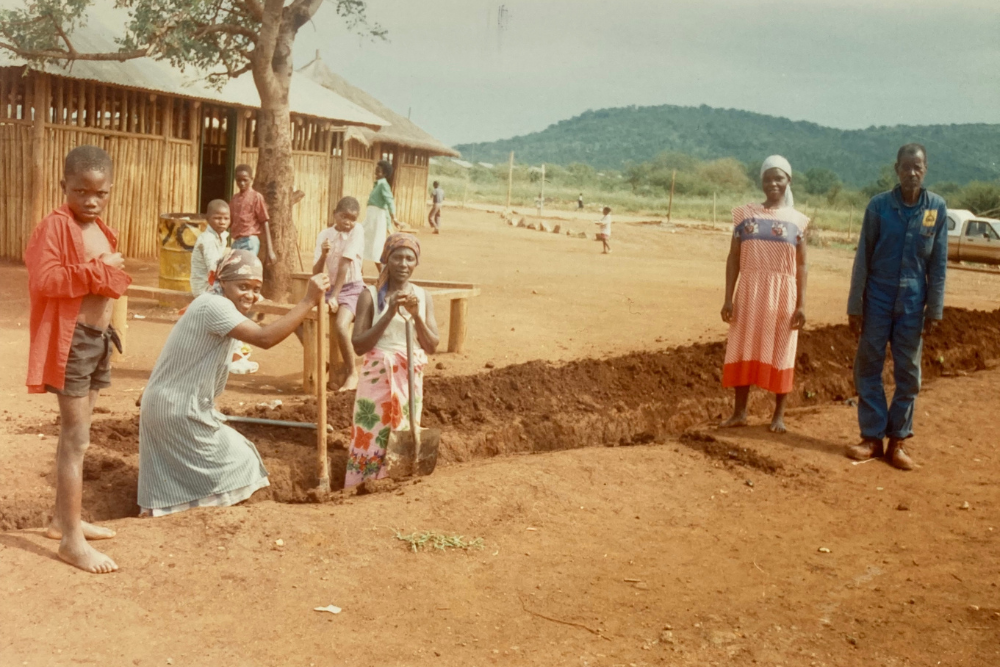
A group of adults and children stand and work by a trench on a dirt ground in a rural area, with wooden buildings and green hills in the background under a cloudy sky.
Image credit: Anna Shepherd
WILPF International Secretariat
22 March 2026

For so many communities, safe, adequate, and affordable water for personal and household use is a necessity that cannot be taken for granted. Access can be uncertain, unequal, and shaped by forces far beyond the tap.  

Contributions from WILPF’s Environment Working Group (EWG) reveal how water is closely linked to gender, power, and peace — and why these connections matter.  

Women and girls are often at the centre of water systems in their communities. They collect water, manage its use, and sustain households and livelihoods. When water becomes scarce, polluted, or inaccessible, it is their time, health, and safety that are most affected. At the same time, their knowledge and leadership are too often excluded from decision-making processes. 

Women Are Not Only Affected, They Are Leading Solutions  

One WILPF member recalls a refugee camp in South Africa in the 1990s, where women took the lead in organising access to water under extremely limited conditions. They dug trenches, maintained infrastructure, and tended garden projects that provided food for their communities. These women were far from passive recipients of aid — they were problem-solvers and organisers, building systems that sustained daily life.  

Yet their experience also highlights challenges that continue to this day. Water projects were not always designed with long-term local ownership in mind, and knowledge and responsibility were not consistently shared. When external actors left, gaps remained, showing that solutions which fail to centre local expertise risk reinforcing inequality rather than addressing it.  

Water, Climate, and Conflict

The global water crisis is further shaped by intersecting pressures. The climate crisisis intensifying droughts and floods, while industrial activity and over-extraction deplete and pollute vital water sources. In many regions, water is increasingly treated as market commodity rather than a shared public good, leaving vulnerable communities without reliable access.  

Beyond environmental and economic pressures, water insecurity is also deeply entangled with conflict and peace. Transboundary water sources can become sites of tension when upstream actors control or divert access, making water diplomacy essential. In this context, the meaningful participation of women, as recognised in UN Security Council Resolution 1325, is critical to building sustainable and peaceful water governance. 

In situations of war, access to water is not only disrupted but can be deliberately targeted or used as a weapon, as seen in contexts such as Gaza and Ukraine. Armed conflict not only damages infrastructure but also contributes to environmental degradation and the climate crisis, further intensifying droughts, floods, and water scarcity. 

Scarcity itself can also drive problematic responses. Technology-driven water “solutions” often require high levels of private investment, reinforcing the commodification of water and deepening inequality rather than addressing root causes. 

Toward Lasting Change

These realities make clear that water justice cannot be addressed in isolation. It requires approaches that are not only technically effective, but also inclusive, rights-based, and grounded in lived experience. 

WILPF’s Environment Working Group members underline that women must not only be included in responding to water insecurity, but in shaping water governance at all levels from community-based initiatives to international diplomacy, in order to prevent insecurity before it arises. 

This also calls for rethinking legal and political frameworks. Recognising nature, and water itself, as a rights-bearing entity, as seen in countries like Ecuador, could open new pathways for communities and women’s groups to defend water as a human right. 

Ultimately, this means moving beyond short-term responses toward lasting change by supporting community-led solutions, addressing inequality and conflict, and ensuring that those most affected have real power in decision-making. 

These challenges are global. From communities facing acute scarcity to countries grappling with ageing infrastructure and pollution, water insecurity is an issue that crosses borders and contexts. 

On this World Water Day, the reflections from WILPF’s Environment Working Group offer both a warning and a way forward. Real change will not come from top-down solutions alone, but from sharing knowledge, shifting power, and working in solidarity with women and girls on the frontlines. 

Share the post
WILPF International Secretariat

WILPF International Secretariat, with offices in Geneva and New York, liaises with the International Board and the National Sections and Groups for the implementation of WILPF International Programme, resolutions and policies as adopted by the International Congress. Under the direction of the Secretary-General, the Secretariat also provides support in areas of advocacy, communications, and financial operations.

Matt Mahmoudi

Matt Mahmoudi (he/him) is a lecturer, researcher, and organizer. He’s been leading the “Ban the Scan” campaign, Amnesty International’s research and advocacy efforts on banning facial recognition technologies and exposing their uses against racialized communities, from New York City to the occupied Palestinian territories.

Berit Aasen

Europe Alternate Regional Representative

Berit Aasen is a sociologist by training and has worked at the OsloMet Metropolitan University on Oslo. She has 40 years of experience in research and consultancy in development studies, including women, peace, and security, and in later years in asylum and refugee studies. Berit Aasen joined WILPF Norway five years ago. She is an alternate member of the National Board of WILPF Norway, and representing WILPF Norway in the UN Association of Norway, the Norwegian 1325 network and the Norwegian Women’s Lobby. Berit Aasen has been active in the WILPF European Liaison group and is committed to strengthening WILPF sections and membership both in Europe and relations across continents.

Your donation isn’t just a financial transaction; it’s a step toward a more compassionate and equitable world. With your support, we’re poised to achieve lasting change that echoes through generations. Thank you!

Thank you!

Melissa Torres

VICE-PRESIDENT

Prior to being elected Vice-President, Melissa Torres was the WILPF US International Board Member from 2015 to 2018. Melissa joined WILPF in 2011 when she was selected as a Delegate to the Commission on the Status of Women as part of the WILPF US’ Practicum in Advocacy Programme at the United Nations, which she later led. She holds a PhD in Social Work and is a professor and Global Health Scholar at Baylor College of Medicine and research lead at BCM Anti-Human Trafficking Program. Of Mexican descent and a native of the US/Mexico border, Melissa is mostly concerned with the protection of displaced Latinxs in the Americas. Her work includes training, research, and service provision with the American Red Cross, the National Human Trafficking Training and Technical Assistance Centre, and refugee resettlement programs in the U.S. Some of her goals as Vice-President are to highlight intersectionality and increase diversity by fostering inclusive spaces for mentorship and leadership. She also contributes to WILPF’s emerging work on the topic of displacement and migration.

Jamila Afghani

VICE-PRESIDENT

Jamila Afghani is the President of WILPF Afghanistan which she started in 2015. She is also an active member and founder of several organisations including the Noor Educational and Capacity Development Organisation (NECDO). Elected in 2018 as South Asia Regional Representative to WILPF’s International Board, WILPF benefits from Jamila’s work experience in education, migration, gender, including gender-based violence and democratic governance in post-conflict and transitional countries.

A woman in a blue, black, and white dress smiles radiantly in front of a leafy green background.

Sylvie Jacqueline Ndongmo

PRESIDENT

Sylvie Jacqueline NDONGMO is a human rights and peace leader with over 27 years experience including ten within WILPF. She has a multi-disciplinary background with a track record of multiple socio-economic development projects implemented to improve policies, practices and peace-oriented actions. Sylvie is the founder of WILPF Cameroon and was the Section’s president until 2022. She co-coordinated the African Working Group before her election as Africa Representative to WILPF’s International Board in 2018. A teacher by profession and an African Union Trainer in peace support operations, Sylvie has extensive experience advocating for the political and social rights of women in Africa and worldwide.

WILPF Afghanistan

In response to the takeover of Afghanistan by the Taliban and its targeted attacks on civil society members, WILPF Afghanistan issued several statements calling on the international community to stand in solidarity with Afghan people and ensure that their rights be upheld, including access to aid. The Section also published 100 Untold Stories of War and Peace, a compilation of true stories that highlight the effects of war and militarisation on the region. 

IPB Congress Barcelona

WILPF Germany (+Young WILPF network), WILPF Spain and MENA Regional Representative

Lorem ipsum dolor sit amet, consectetur adipiscing elit. Mauris facilisis luctus rhoncus. Praesent eget tellus sit amet enim consectetur condimentum et vel ante. Nulla facilisi. Suspendisse et nunc sem. Vivamus ullamcorper vestibulum neque, a interdum nisl accumsan ac. Cras ut condimentum turpis. Vestibulum ante ipsum primis in faucibus orci luctus et ultrices posuere cubilia curae; Curabitur efficitur gravida ipsum, quis ultricies erat iaculis pellentesque. Nulla congue iaculis feugiat. Suspendisse euismod congue ultricies. Sed blandit neque in libero ultricies aliquam. Donec euismod eget diam vitae vehicula. Fusce hendrerit purus leo. Aenean malesuada, ante eu aliquet mollis, diam erat suscipit eros, in.

Demilitarisation

WILPF uses feminist analysis to argue that militarisation is a counter-productive and ill-conceived response to establishing security in the world. The more society becomes militarised, the more violence and injustice are likely to grow locally and worldwide.

Sixteen states are believed to have supplied weapons to Afghanistan from 2001 to 2020 with the US supplying 74 % of weapons, followed by Russia. Much of this equipment was left behind by the US military and is being used to inflate Taliban’s arsenal. WILPF is calling for better oversight on arms movement, for compensating affected Afghan people and for an end to all militarised systems.

Militarised masculinity

Mobilising men and boys around feminist peace has been one way of deconstructing and redefining masculinities. WILPF shares a feminist analysis on the links between militarism, masculinities, peace and security. We explore opportunities for strengthening activists’ action to build equal partnerships among women and men for gender equality.

WILPF has been working on challenging the prevailing notion of masculinity based on men’s physical and social superiority to, and dominance of, women in Afghanistan. It recognizes that these notions are not representative of all Afghan men, contrary to the publicly prevailing notion.

Feminist peace​

In WILPF’s view, any process towards establishing peace that has not been partly designed by women remains deficient. Beyond bringing perspectives that encapsulate the views of half of the society and unlike the men only designed processes, women’s true and meaningful participation allows the situation to improve.

In Afghanistan, WILPF has been demanding that women occupy the front seats at the negotiating tables. The experience of the past 20 has shown that women’s presence produces more sustainable solutions when they are empowered and enabled to play a role.