Celebrating Feminists’ Voices, Inspiring Global Peace

News
#Iran

WILPF Calls for Immediate Ceasefire and Compliance with International Law 

On 2 March 2026, the Women’s International League for Peace and Freedom (WILPF) released an urgent statement responding to the dramatic and deadly escalation of violence following military attacks by the United States and Israel against the Islamic Republic of Iran.

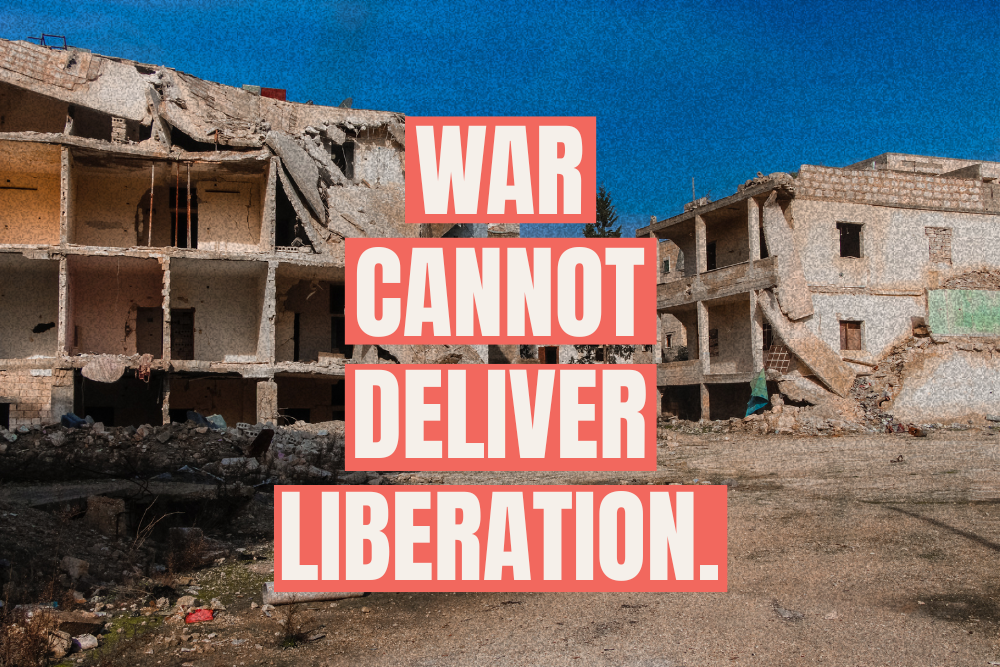
A bombed, damaged building stands in ruins under a blue sky. Overlaid bold text reads: “WAR CANNOT DELIVER LIBERATION.”.
Image credit: WILPF
WILPF International Secretariat
3 March 2026

In just 48 hours, the region has plunged into a dangerous new phase of hostilities. Civilian lives have been devastated. Regional stability has been further eroded. And the international rule of law faces yet another grave test. We invite you to read WILPF’s full statement and stand with us in demanding an immediate ceasefire and accountability under international law.

What Happened?

A large-scale military campaign targeted Iranian leadership and infrastructure, including the assassination of Supreme Leader Ali Khamenei, alongside other officials and hundreds of civilians. An airstrike on a girls’ school in Minab alone reportedly killed more than 100 children and teachers.

In response, the Iranian government launched missile and drone attacks, expanding the conflict beyond Iran’s borders and increasing casualties on all sides. This escalation follows years of mounting tensions, sanctions, threats, and previous unlawful strikes. The current crisis is not an isolated event—it is part of a broader pattern of militarism and impunity.

Why This Matters

International law is clear: unilateral military offensives of this scale amount to acts of aggression. Targeting a Head of State and launching large-scale attacks outside the framework of the UN Charter undermines global norms and fuels wider instability.

WILPF warns that:

  • Militarism does not create security—it deepens insecurity.
  • So-called “preemptive” strikes and regime-change agendas violate international law and erode global accountability.
  • Retaliatory escalation entrenches authoritarianism, shrinks civic space, and harms women human rights defenders and peacebuilders.
  • War cannot deliver liberation for women or any people—especially when driven by militarised states with records of human rights violations.
  • Security built on force is fragile and false. True security must be demilitarised and grounded in the rule of law.

Key Highlights from WILPF’s Call

WILPF calls on all parties to:

  • Immediately halt military attacks; 
  • Prioritise diplomatic channels and regional de-escalation mechanisms; and 
  • Uphold their obligations under the UN Charter, international humanitarian and human rights law. 

WILPF stands in solidarity with all civilians affected and reiterates: militarised “security” is not safety—it is instability by design.

Read our full statement and share it within your networks.

Share the post
WILPF International Secretariat

WILPF International Secretariat, with offices in Geneva and New York, liaises with the International Board and the National Sections and Groups for the implementation of WILPF International Programme, resolutions and policies as adopted by the International Congress. Under the direction of the Secretary-General, the Secretariat also provides support in areas of advocacy, communications, and financial operations.

Matt Mahmoudi

Matt Mahmoudi (he/him) is a lecturer, researcher, and organizer. He’s been leading the “Ban the Scan” campaign, Amnesty International’s research and advocacy efforts on banning facial recognition technologies and exposing their uses against racialized communities, from New York City to the occupied Palestinian territories.

Berit Aasen

Europe Alternate Regional Representative

Berit Aasen is a sociologist by training and has worked at the OsloMet Metropolitan University on Oslo. She has 40 years of experience in research and consultancy in development studies, including women, peace, and security, and in later years in asylum and refugee studies. Berit Aasen joined WILPF Norway five years ago. She is an alternate member of the National Board of WILPF Norway, and representing WILPF Norway in the UN Association of Norway, the Norwegian 1325 network and the Norwegian Women’s Lobby. Berit Aasen has been active in the WILPF European Liaison group and is committed to strengthening WILPF sections and membership both in Europe and relations across continents.

Your donation isn’t just a financial transaction; it’s a step toward a more compassionate and equitable world. With your support, we’re poised to achieve lasting change that echoes through generations. Thank you!

Thank you!

Melissa Torres

VICE-PRESIDENT

Prior to being elected Vice-President, Melissa Torres was the WILPF US International Board Member from 2015 to 2018. Melissa joined WILPF in 2011 when she was selected as a Delegate to the Commission on the Status of Women as part of the WILPF US’ Practicum in Advocacy Programme at the United Nations, which she later led. She holds a PhD in Social Work and is a professor and Global Health Scholar at Baylor College of Medicine and research lead at BCM Anti-Human Trafficking Program. Of Mexican descent and a native of the US/Mexico border, Melissa is mostly concerned with the protection of displaced Latinxs in the Americas. Her work includes training, research, and service provision with the American Red Cross, the National Human Trafficking Training and Technical Assistance Centre, and refugee resettlement programs in the U.S. Some of her goals as Vice-President are to highlight intersectionality and increase diversity by fostering inclusive spaces for mentorship and leadership. She also contributes to WILPF’s emerging work on the topic of displacement and migration.

Jamila Afghani

VICE-PRESIDENT

Jamila Afghani is the President of WILPF Afghanistan which she started in 2015. She is also an active member and founder of several organisations including the Noor Educational and Capacity Development Organisation (NECDO). Elected in 2018 as South Asia Regional Representative to WILPF’s International Board, WILPF benefits from Jamila’s work experience in education, migration, gender, including gender-based violence and democratic governance in post-conflict and transitional countries.

A woman in a blue, black, and white dress smiles radiantly in front of a leafy green background.

Sylvie Jacqueline Ndongmo

PRESIDENT

Sylvie Jacqueline NDONGMO is a human rights and peace leader with over 27 years experience including ten within WILPF. She has a multi-disciplinary background with a track record of multiple socio-economic development projects implemented to improve policies, practices and peace-oriented actions. Sylvie is the founder of WILPF Cameroon and was the Section’s president until 2022. She co-coordinated the African Working Group before her election as Africa Representative to WILPF’s International Board in 2018. A teacher by profession and an African Union Trainer in peace support operations, Sylvie has extensive experience advocating for the political and social rights of women in Africa and worldwide.

WILPF Afghanistan

In response to the takeover of Afghanistan by the Taliban and its targeted attacks on civil society members, WILPF Afghanistan issued several statements calling on the international community to stand in solidarity with Afghan people and ensure that their rights be upheld, including access to aid. The Section also published 100 Untold Stories of War and Peace, a compilation of true stories that highlight the effects of war and militarisation on the region. 

IPB Congress Barcelona

WILPF Germany (+Young WILPF network), WILPF Spain and MENA Regional Representative

Lorem ipsum dolor sit amet, consectetur adipiscing elit. Mauris facilisis luctus rhoncus. Praesent eget tellus sit amet enim consectetur condimentum et vel ante. Nulla facilisi. Suspendisse et nunc sem. Vivamus ullamcorper vestibulum neque, a interdum nisl accumsan ac. Cras ut condimentum turpis. Vestibulum ante ipsum primis in faucibus orci luctus et ultrices posuere cubilia curae; Curabitur efficitur gravida ipsum, quis ultricies erat iaculis pellentesque. Nulla congue iaculis feugiat. Suspendisse euismod congue ultricies. Sed blandit neque in libero ultricies aliquam. Donec euismod eget diam vitae vehicula. Fusce hendrerit purus leo. Aenean malesuada, ante eu aliquet mollis, diam erat suscipit eros, in.

Demilitarisation

WILPF uses feminist analysis to argue that militarisation is a counter-productive and ill-conceived response to establishing security in the world. The more society becomes militarised, the more violence and injustice are likely to grow locally and worldwide.

Sixteen states are believed to have supplied weapons to Afghanistan from 2001 to 2020 with the US supplying 74 % of weapons, followed by Russia. Much of this equipment was left behind by the US military and is being used to inflate Taliban’s arsenal. WILPF is calling for better oversight on arms movement, for compensating affected Afghan people and for an end to all militarised systems.

Militarised masculinity

Mobilising men and boys around feminist peace has been one way of deconstructing and redefining masculinities. WILPF shares a feminist analysis on the links between militarism, masculinities, peace and security. We explore opportunities for strengthening activists’ action to build equal partnerships among women and men for gender equality.

WILPF has been working on challenging the prevailing notion of masculinity based on men’s physical and social superiority to, and dominance of, women in Afghanistan. It recognizes that these notions are not representative of all Afghan men, contrary to the publicly prevailing notion.

Feminist peace​

In WILPF’s view, any process towards establishing peace that has not been partly designed by women remains deficient. Beyond bringing perspectives that encapsulate the views of half of the society and unlike the men only designed processes, women’s true and meaningful participation allows the situation to improve.

In Afghanistan, WILPF has been demanding that women occupy the front seats at the negotiating tables. The experience of the past 20 has shown that women’s presence produces more sustainable solutions when they are empowered and enabled to play a role.