
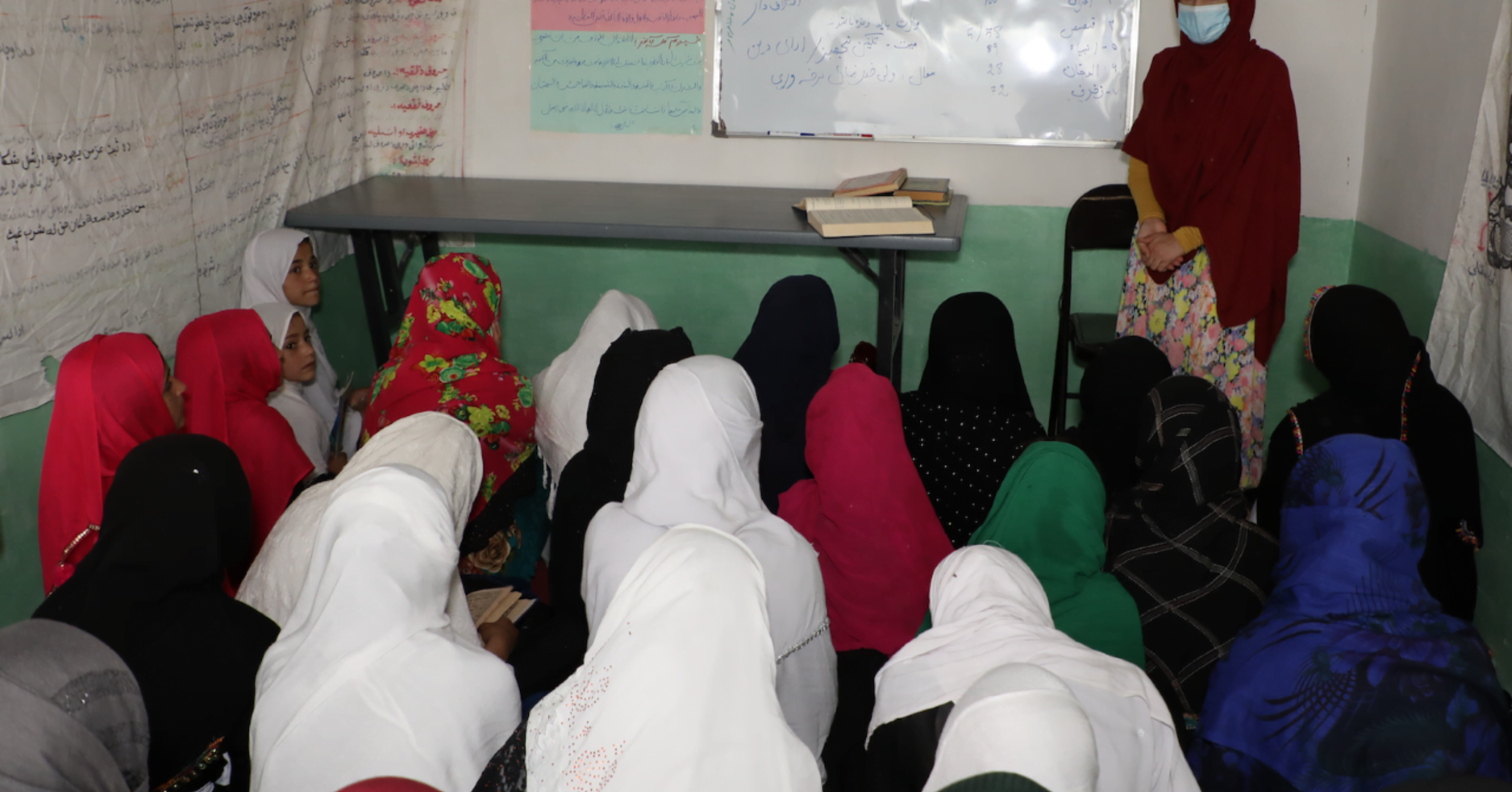
Teaching at a madrassa (Islamic religious school for girls) in a rural province of Afghanistan, before the Taliban takeover. (c) WILPF 2021
Asma’s Story: A Call to Action and Solidarity with Afghan Women
The global community of WILPF joins together with WILPF Afghanistan in mourning the death of Asma,* an Afghan woman, WILPF member, and dedicated human rights and peace activist. Based in Kabul province, Asma dedicated more than 20 years of her life to teaching Afghan girls in secondary school. She was a long-standing member of WILPF, involved since it was first established, and was engaged in multiple projects and activities with WILPF Afghanistan.
She deserves our respect for her many contributions – and her story deserves our attention.
The recent Taliban takeover, and related freezing of Afghanistan’s assets by the United States and IMF, has exacerbated instability, poverty, and hardship in the country. The Taliban has banned girls from attending schools and universities. Female government employees – who represent 25 percent of all government employees in Afghanistan – have been denied the right to work and advised to remain at home and await further instructions. Similarly, nearly 120,000 female teachers have lost their jobs and roughly four million girls are currently out of school.
In addition to these challenges, many women have lost their spouses and ‘breadwinners’ during the last 20 years of war and conflict in Afghanistan. They have been left with orphaned and homeless children to care for in addition to their own children. Now, with their rights severely compromised, these women are in a desperate and dangerous situation, as are the young children attached to them.
Asma was one such woman.
She had been teaching in a girls’ school just before the fall of Kabul to the Taliban, earning a monthly salary of $70 USD and solely supporting her children. That changed when the Taliban took power and female teachers were asked not to return to work. She suddenly found herself without employment, and without an income.
Asma’s children asked her daily for food, and for warm clothes as the weather grew colder. But she could not provide these things, nor could she obtain any support from her extended family. Asma, her other family members, and her neighbours were now facing severe economic hardships. No one had enough money to help or lend to others in a substantial way. While Asma was able to borrow some limited funds from her closest friends for a time, this could only go so far. Soon, Asma was left without any means to feed her children.
Frustrated and broken by her poverty, and facing an unknown future for her and her children, Asma took her own life on 20 October 2021.
The routine discrimination, exclusion, abuse, violence, and outright violation of human rights that Afghan women experience daily, and particularly following the Taliban takeover of Afghanistan in August 2021, should outrage all of us.
At this very moment, women in Afghanistan – women like Asma – are facing the denial of their basic rights, including the right to education, to work, and to healthcare.
This is wrong.
War and conflict in Afghanistan have contributed to the displacement of millions of women – both within and outside the country – and Afghan women now face a heightened risk of gender-based violence, food insecurity, exposure to trafficking, and other harms.
This is also wrong.
In Afghanistan, barriers to education, gender-based violence, domestic abuse, and forced marriages are among the highest in the world – where women also represent 80 percent of deaths by suicide. This is absolutely unacceptable.
We cannot share Asma’s real name publicly. But we will not remain silent about her story and the countless other women who are facing the same brutal hardships, turmoil, and despair that she faced and tried so hard to overcome.
The international community must take urgent action. Specifically, this action must include ensuring the human rights of women and girls; facilitating urgent funding and economic support to women who are without financial means; supporting a ban on forced marriages; and ensuring girls’ access to education, which is their right.
Asma’s death is more than a tragedy. It’s a call to act and join in solidarity with girls and women in Afghanistan as they seek to overcome their present and devastating realities with an eye to securing their futures.
*Asma is a pseudonym; real and full name has been withheld.
_ _ _ _
In our series of blogs about Afghanistan, we are bringing new perspectives and voices to the mainstream narrative told by the media. Read the blog series or visit our webpage dedicated our work on Afghanistan.

Matt Mahmoudi (he/him) is a lecturer, researcher, and organizer. He’s been leading the “Ban the Scan” campaign, Amnesty International’s research and advocacy efforts on banning facial recognition technologies and exposing their uses against racialized communities, from New York City to the occupied Palestinian territories.

Berit Aasen is a sociologist by training and has worked at the OsloMet Metropolitan University on Oslo. She has 40 years of experience in research and consultancy in development studies, including women, peace, and security, and in later years in asylum and refugee studies. Berit Aasen joined WILPF Norway five years ago. She is an alternate member of the National Board of WILPF Norway, and representing WILPF Norway in the UN Association of Norway, the Norwegian 1325 network and the Norwegian Women’s Lobby. Berit Aasen has been active in the WILPF European Liaison group and is committed to strengthening WILPF sections and membership both in Europe and relations across continents.

Your donation isn’t just a financial transaction; it’s a step toward a more compassionate and equitable world. With your support, we’re poised to achieve lasting change that echoes through generations. Thank you!

Prior to being elected Vice-President, Melissa Torres was the WILPF US International Board Member from 2015 to 2018. Melissa joined WILPF in 2011 when she was selected as a Delegate to the Commission on the Status of Women as part of the WILPF US’ Practicum in Advocacy Programme at the United Nations, which she later led. She holds a PhD in Social Work and is a professor and Global Health Scholar at Baylor College of Medicine and research lead at BCM Anti-Human Trafficking Program. Of Mexican descent and a native of the US/Mexico border, Melissa is mostly concerned with the protection of displaced Latinxs in the Americas. Her work includes training, research, and service provision with the American Red Cross, the National Human Trafficking Training and Technical Assistance Centre, and refugee resettlement programs in the U.S. Some of her goals as Vice-President are to highlight intersectionality and increase diversity by fostering inclusive spaces for mentorship and leadership. She also contributes to WILPF’s emerging work on the topic of displacement and migration.

Jamila Afghani is the President of WILPF Afghanistan which she started in 2015. She is also an active member and founder of several organisations including the Noor Educational and Capacity Development Organisation (NECDO). Elected in 2018 as South Asia Regional Representative to WILPF’s International Board, WILPF benefits from Jamila’s work experience in education, migration, gender, including gender-based violence and democratic governance in post-conflict and transitional countries.

Sylvie Jacqueline NDONGMO is a human rights and peace leader with over 27 years experience including ten within WILPF. She has a multi-disciplinary background with a track record of multiple socio-economic development projects implemented to improve policies, practices and peace-oriented actions. Sylvie is the founder of WILPF Cameroon and was the Section’s president until 2022. She co-coordinated the African Working Group before her election as Africa Representative to WILPF’s International Board in 2018. A teacher by profession and an African Union Trainer in peace support operations, Sylvie has extensive experience advocating for the political and social rights of women in Africa and worldwide.
In response to the takeover of Afghanistan by the Taliban and its targeted attacks on civil society members, WILPF Afghanistan issued several statements calling on the international community to stand in solidarity with Afghan people and ensure that their rights be upheld, including access to aid. The Section also published 100 Untold Stories of War and Peace, a compilation of true stories that highlight the effects of war and militarisation on the region.
Lorem ipsum dolor sit amet, consectetur adipiscing elit. Mauris facilisis luctus rhoncus. Praesent eget tellus sit amet enim consectetur condimentum et vel ante. Nulla facilisi. Suspendisse et nunc sem. Vivamus ullamcorper vestibulum neque, a interdum nisl accumsan ac. Cras ut condimentum turpis. Vestibulum ante ipsum primis in faucibus orci luctus et ultrices posuere cubilia curae; Curabitur efficitur gravida ipsum, quis ultricies erat iaculis pellentesque. Nulla congue iaculis feugiat. Suspendisse euismod congue ultricies. Sed blandit neque in libero ultricies aliquam. Donec euismod eget diam vitae vehicula. Fusce hendrerit purus leo. Aenean malesuada, ante eu aliquet mollis, diam erat suscipit eros, in.
WILPF uses feminist analysis to argue that militarisation is a counter-productive and ill-conceived response to establishing security in the world. The more society becomes militarised, the more violence and injustice are likely to grow locally and worldwide.
Sixteen states are believed to have supplied weapons to Afghanistan from 2001 to 2020 with the US supplying 74 % of weapons, followed by Russia. Much of this equipment was left behind by the US military and is being used to inflate Taliban’s arsenal. WILPF is calling for better oversight on arms movement, for compensating affected Afghan people and for an end to all militarised systems.
Mobilising men and boys around feminist peace has been one way of deconstructing and redefining masculinities. WILPF shares a feminist analysis on the links between militarism, masculinities, peace and security. We explore opportunities for strengthening activists’ action to build equal partnerships among women and men for gender equality.
WILPF has been working on challenging the prevailing notion of masculinity based on men’s physical and social superiority to, and dominance of, women in Afghanistan. It recognizes that these notions are not representative of all Afghan men, contrary to the publicly prevailing notion.
In WILPF’s view, any process towards establishing peace that has not been partly designed by women remains deficient. Beyond bringing perspectives that encapsulate the views of half of the society and unlike the men only designed processes, women’s true and meaningful participation allows the situation to improve.
In Afghanistan, WILPF has been demanding that women occupy the front seats at the negotiating tables. The experience of the past 20 has shown that women’s presence produces more sustainable solutions when they are empowered and enabled to play a role.