
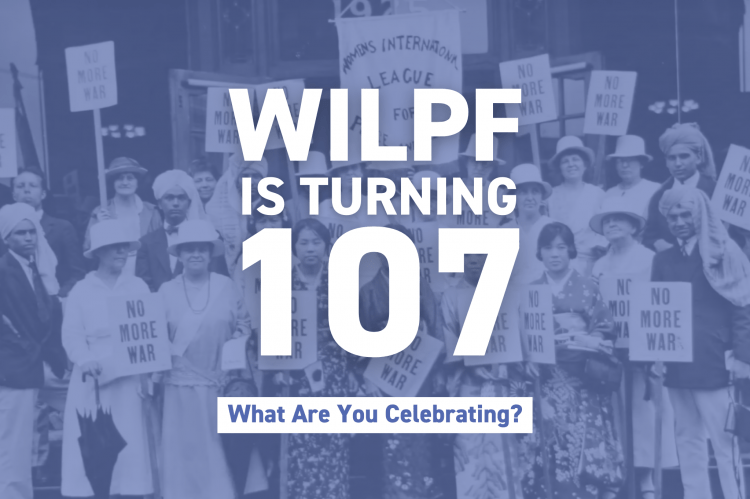
On this day in 1915, WILPF’s roots began to take hold when 1,136 activists for women’s voting rights and peace gathered in The Hague as the First World War raged in Europe.
At the meeting, the activists engaged in dialogue about the root causes of war and committed to taking action to help end the suffering. Together, they established the International Women’s Committee of Permanent Peace; in 1919, the Committee was officially renamed the Women’s International League for Peace and Freedom (WILPF) – now a global feminist peace organisation with representation in more than 50 countries worldwide.
We invite you to delve into our storied past by reading our WILPF Heritage Month zine, our Herstory page, and our timeline. And if you’re interested in helping to shape our future, consider becoming a member or donor today!
While you’re here, take a moment to check out these incredible highlights from the past 107 years.
Strong beginnings
WILPF’s global movement for feminist peace started strong! Within the first five years of our founding as the International Women’s Committee of Permanent Peace in 1915, 19 Sections had launched around the world. Among them was WILPF Japan, which was created in 1921 as one of our first Sections outside of Europe and remains active today!
Advocating for the creation of the League of Nations
Throughout the 1920s, as nationalism and fascism took root in the wake of the First World War, WILPF members advocated for the creation of a League of Nations – a group of nations committed to taking diplomatic, peaceful approaches to the prevention and resolution of war. The League of Nations was established in 1919, and in 1944 it was dissolved and replaced by the United Nations.
Creating a women-only peace encampment
In 1983, WILPF co-founded Seneca Camp near a US army base to protest against the imminent deployment of nuclear missiles to Western Europe.
The camp was soon dubbed the Women’s Encampment for a Future of Peace and Justice (WEFPJ) and was reserved entirely for women. Learn more about it in our zine or watch this video.
Advocating for a nuclear-free world
WILPF has been on the forefront of advocating for a nuclear-free world since the 1950s. In 1999, we established Reaching Critical Will (RCW) – a programme dedicated to leading WILPF’s analysis and advocacy for disarmament. RCW works closely with the International Campaign to Abolish Nuclear Weapons (ICAN), of which WILPF is a steering group member.
In 2021, our years of advocacy efforts and analysis played a critical role in the achievement of a historic milestone: the entry into force of the Treaty on the Prohibition of Nuclear Weapons (TPNW), which was adopted in 2017. The first treaty to recognise the disproportionate impact of nuclear weapons on Indigenous peoples and on women, TPNW represents a major step towards nuclear disarmament.
Shaping Future WILPF
So far in 2022, WILPF’s international community has been busy creating our next International Programme – a global strategy that will guide our continued evolution and impact as the world’s longest-standing women’s peace organisation. Members from all over the world have been involved in the process as we prepare to present the strategy at Congress in July 2022. Learn more about Future WILPF.
Stay connected and get involved!
For more information about what WILPF is up to today, read Stories of Feminist Peace 2021, follow us on our social media – Instagram, Facebook, Twittter and LinkedIn – and sign up to receive our e-newsletters!
If you’re interested in deepening your involvement with WILPF, consider becoming a member, joining your local Section (or starting one!), or supporting our work by donating.
Here’s to another century of progress towards a future of feminist peace!


